The Records Around the Family
Family history research doesn't stop with names and dates. In the archives of Chicago Heights and beyond, I began finding the businesses, neighborhoods, relationships, and institutions that surrounded my relatives, and a much larger history than the one my family passed down.
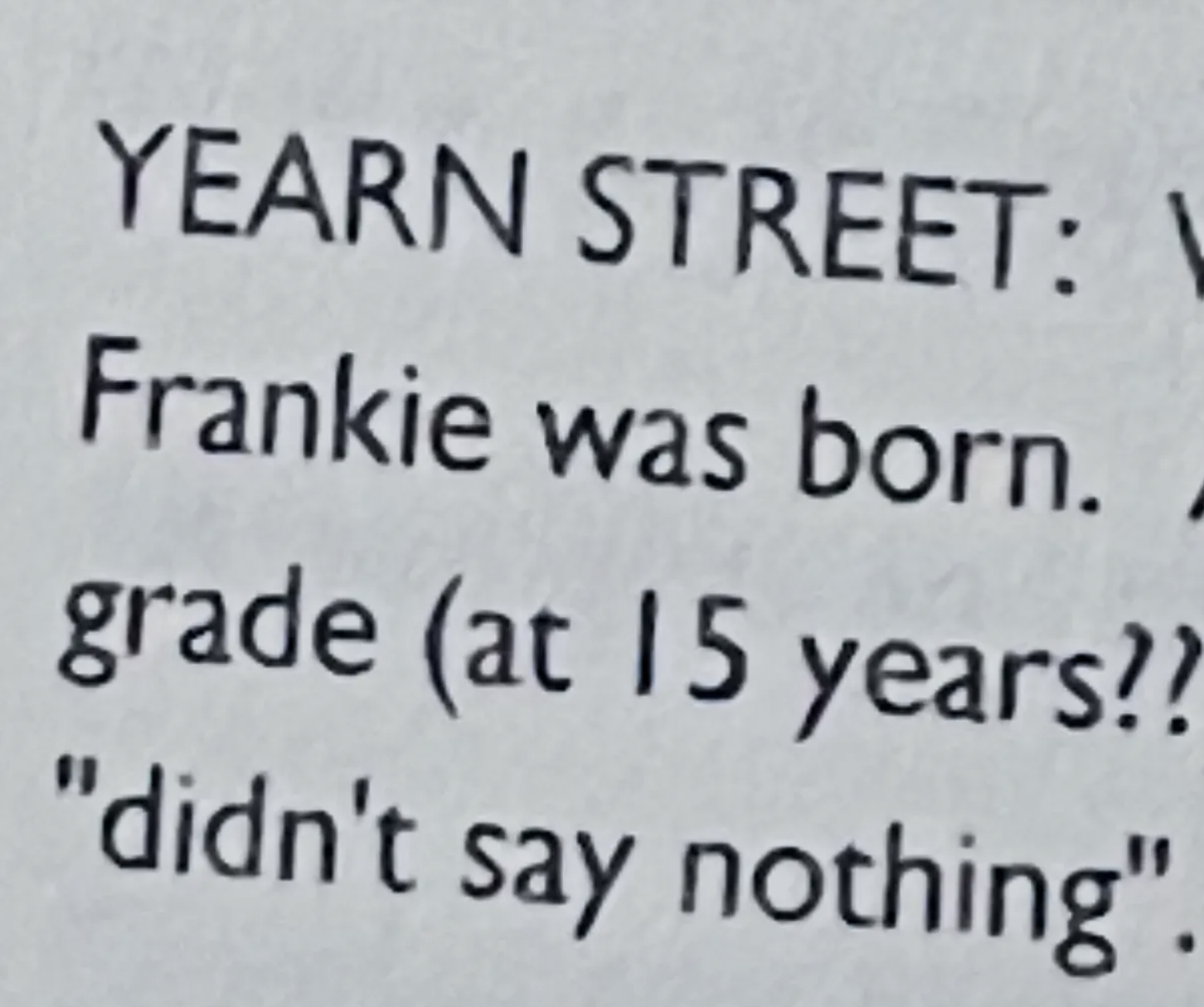
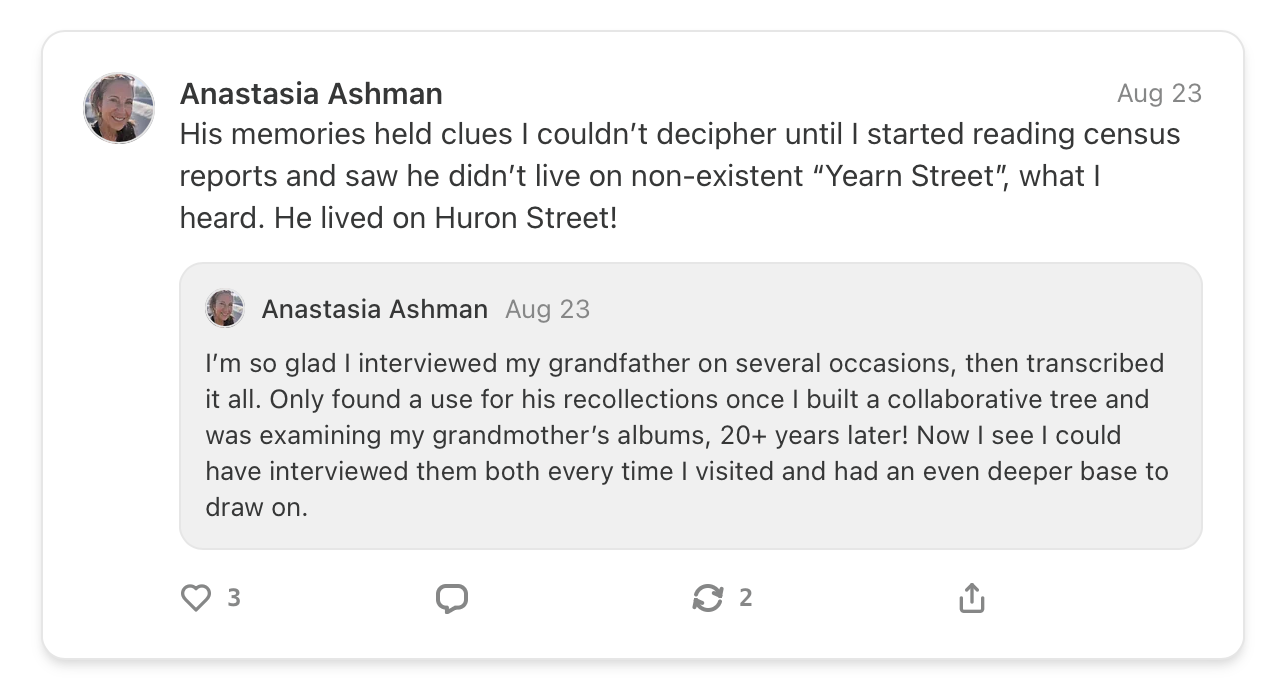
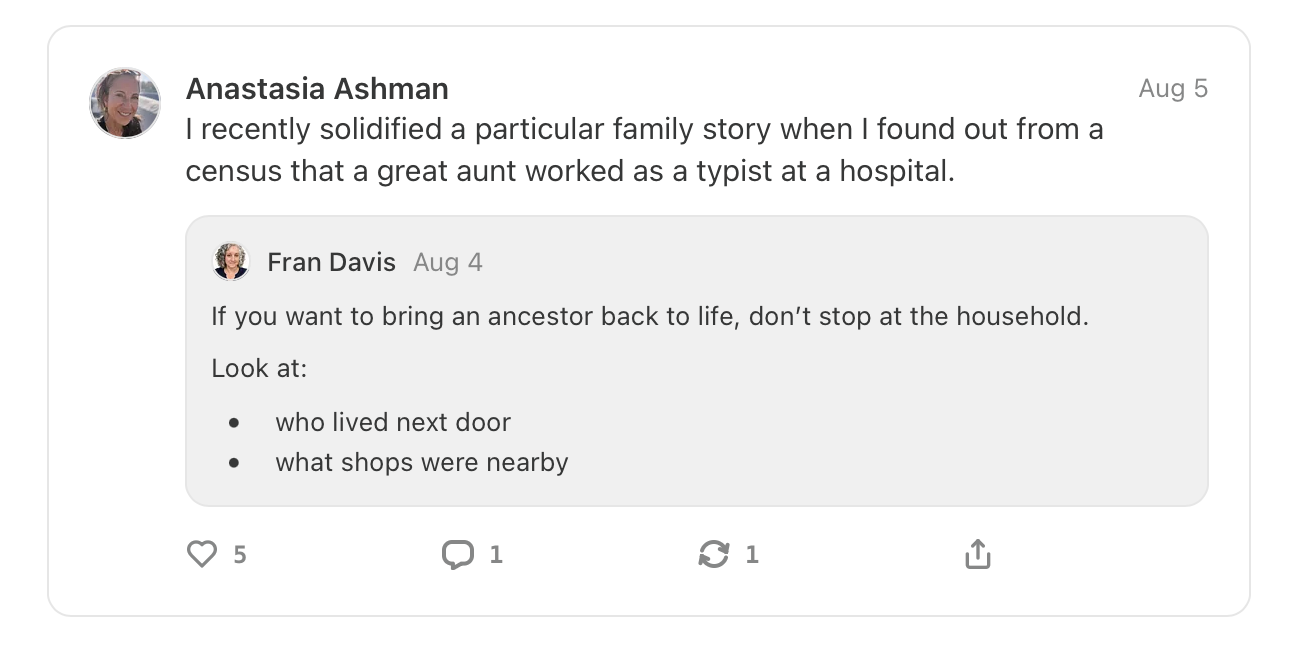
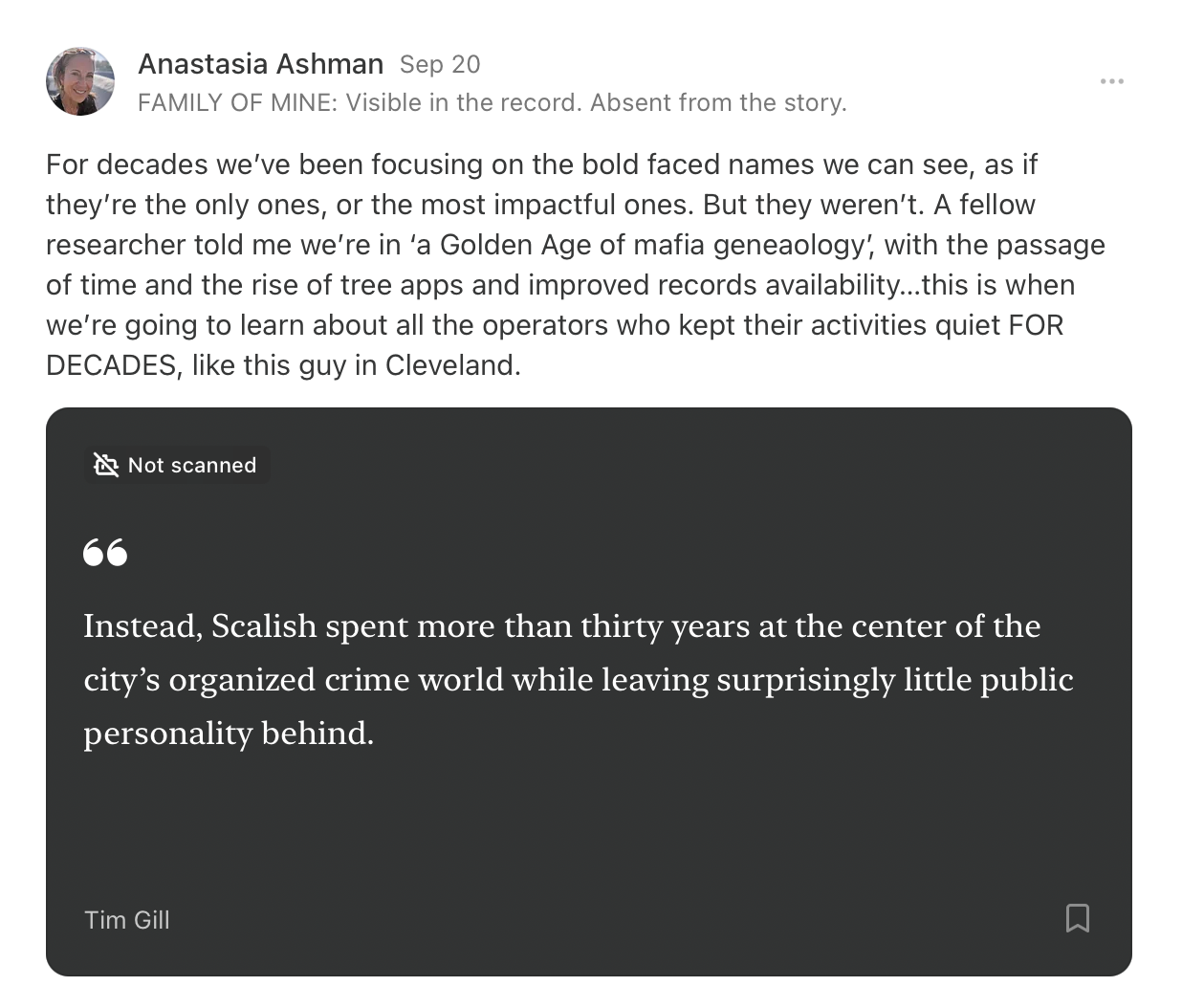
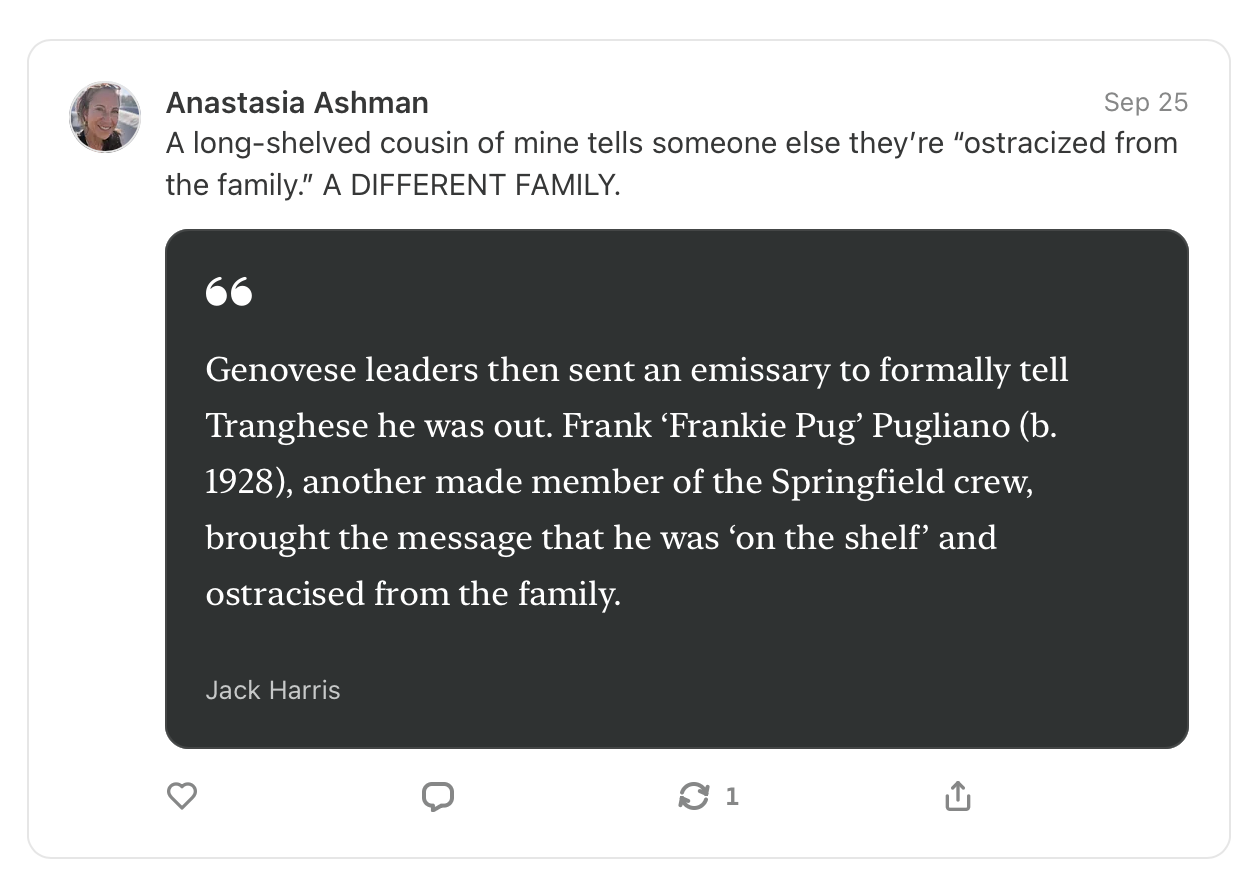
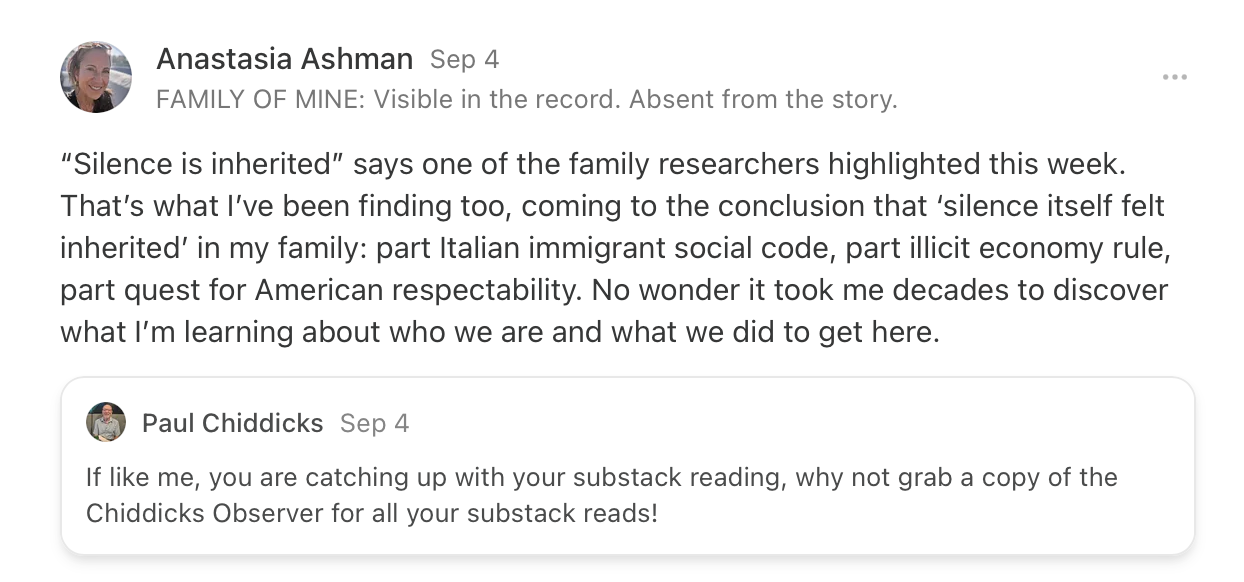
One afternoon, I read every death certificate filed in Chicago Heights, Illinois, in 1928.
I was researching relatives who had lived and worked in this industrial town south of Chicago. But I wasn't looking for one particular name that day. I wanted to know more about the place itself.
The certificates recorded causes of death, ages, and inquests. Some contained the verdict "person or persons unknown." That phrase appeared repeatedly.
Reading the certificates together gave me a different view of Chicago Heights from the one I could have assembled by collecting records for individual relatives.
It also raised questions about the town my family had known, and the conditions in which they had lived.
The Places Between the Records
Much of my research for Family of Mine begins with a person. But following that person often takes me somewhere unexpected.
In 1924, my cousin Dominic, a Chicago Heights bootlegger and jazz-club owner, married Rae, a Kentucky singer who worked for him.
They married in Jeffersonville, Indiana, across the Ohio River from Louisville. No family or friends appear to have been present.
Why Jeffersonville?
Learning that the town had a thriving quickie-marriage business gave me some context. It didn't explain their decision, but it made the location itself worth investigating.
The marriage was no longer just an event in two people's lives. It belonged to a particular place, with its own customs and commercial arrangements.
I am finding this happens frequently. An address or business name that initially seems incidental turns out to be worth following.
What a Photograph Doesn't Explain
My inherited family albums contain photographs of people whose names I know, people I have identified through research, and people I still cannot place.
One cherished wedding portrait remains unidentified. I initially thought I knew who the couple were. I was wrong.
A newly discovered relative circulated the photograph among other family members. Another woman sent a wedding portrait from her own family, dated 1922, for comparison.
The collars suggested that my photograph was earlier.
That was useful. It also meant reconsidering the people I had thought might be in it.
Photographs can be persuasive, especially when they belong to your own family. But recognizing a face, guessing a date, or believing you know the occasion is not the same as establishing an identification.
Sometimes the useful result of research is eliminating an answer.
What Was Within Walking Distance?
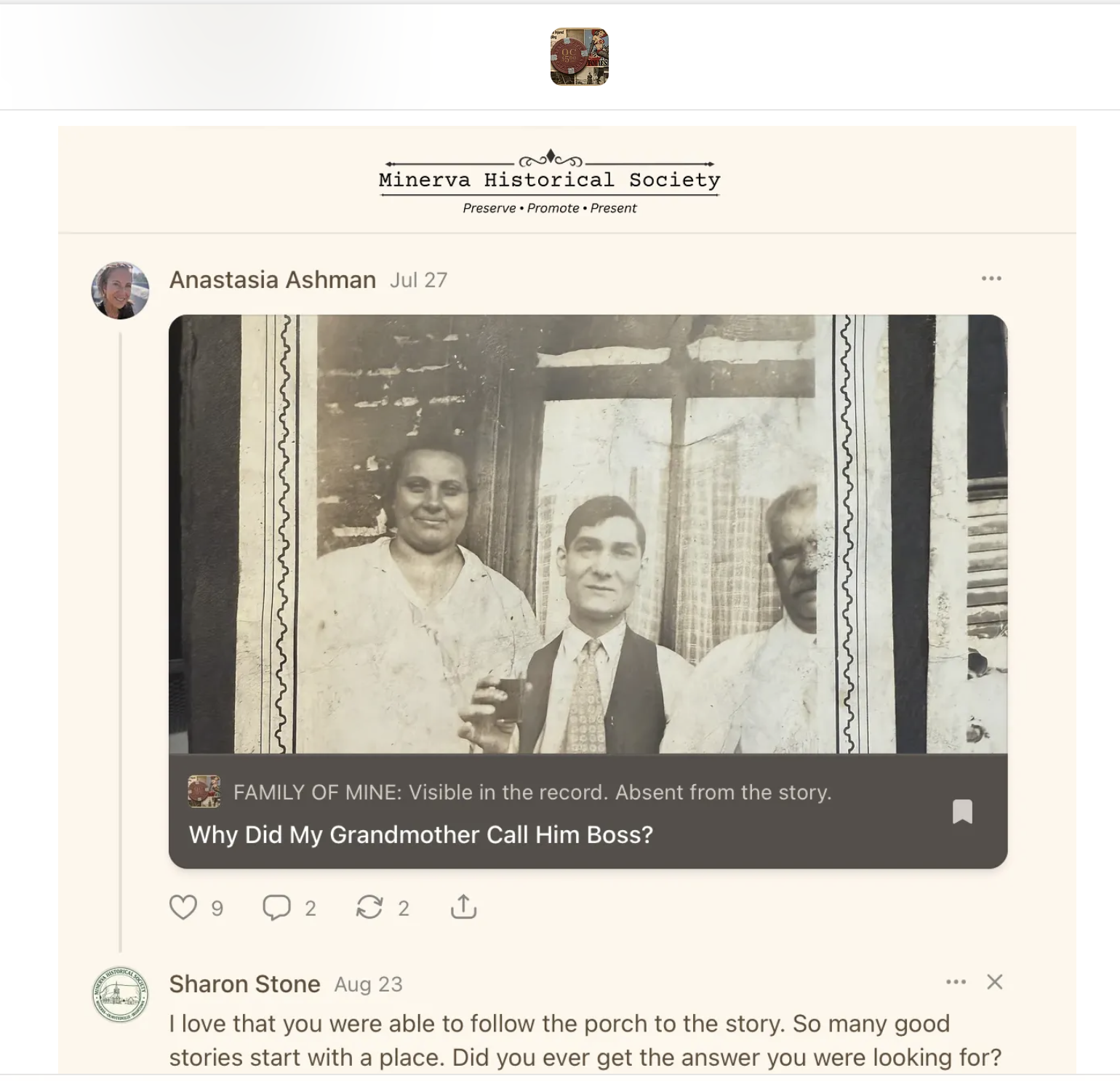
One photograph in my grandmother's albums shows my Calabrian great-grandparents on a Chicago porch in 1929.
A handwritten caption identifies their Sicilian landlord as Boss Arrigo.
That name, and particularly the word Boss, sent me looking beyond the people in the photograph.
Who was Arrigo? What did he own? Who lived in his building? What did the neighborhood look like at the time?
I've become interested in reconstructing the geography around my relatives. Not just their addresses, but the businesses, properties, and other people within walking distance.
A neighborhood map can bring relationships into view that are difficult to recognize when each person appears on a separate family-history record.
It doesn't establish that everyone knew everyone else. Proximity is something to investigate, not proof of a relationship.
But it gives me a more useful question to ask than simply whether two people shared a surname.
The Family Story I Didn't Inherit
My grandfather's novena cards are another kind of evidence.
He collected them at daily Mass and put them everywhere, including inside the frames of family photographs. Eventually, the cards obscured our faces.
We used to think this was primarily an expression of his religious devotion. Now I understand it as a way he expressed his love and concern for us.
No official document would have told me that. I needed the family photographs, the objects themselves, and my memory of how he used them.
Other parts of the family history require an almost opposite approach. There are people, businesses, and relationships preserved in public records that barely registered in the stories I grew up with.
A relative who married a rodeo queen. A family business documented by the Library of Congress. People who lived only a couple of hours away and were never part of our family life.
I can establish that they existed and that we were related. Understanding why I knew nothing about them is more difficult.
Beyond the Family Tree
Family of Mine began as an attempt to reconstruct a South Italian family history across generations and continents.
The family tree is essential to that work. But it cannot account for the world in which these people lived.
For that, I have needed property records, city directories, newspapers, court documents, photographs, death certificates, maps, and government investigative files. I have also needed to return repeatedly to the albums and interviews I inherited.
The question has changed as the research has developed.
I still want to know who these people were and what happened to them. I also want to understand the businesses they operated, the institutions they dealt with, the neighborhoods they inhabited, and the forms of power they lived alongside.
Some of this history was recorded in considerable detail.
It just wasn't passed down to me.
That is the distance I'm trying to close.
For a look at the discoveries and fellow researchers that sent me back to these records, read Back to the Archive: When the Clues Started Connecting.
The Awning Steals My Attention
A family album may tell you who somebody wanted remembered. The background can tell you where they actually were.
The photograph was supposed to be about three girls.
My mother, at five years old, stands in the middle, flanked by two of her young aunts only a few years older than she was. It’s Little Italy, Chicago, about 1940. They are dressed for school, or whatever girls dressed for, facing the camera and squinting into the light.
For a long time, I saw three little girls. Then the background began to matter more.
Behind the girls were parked cars, a hydrant, houses, storefronts and a striped awning across the street. None of it had been included deliberately. It was simply what happened to be there when someone raised the camera.
I enlarged the photograph.
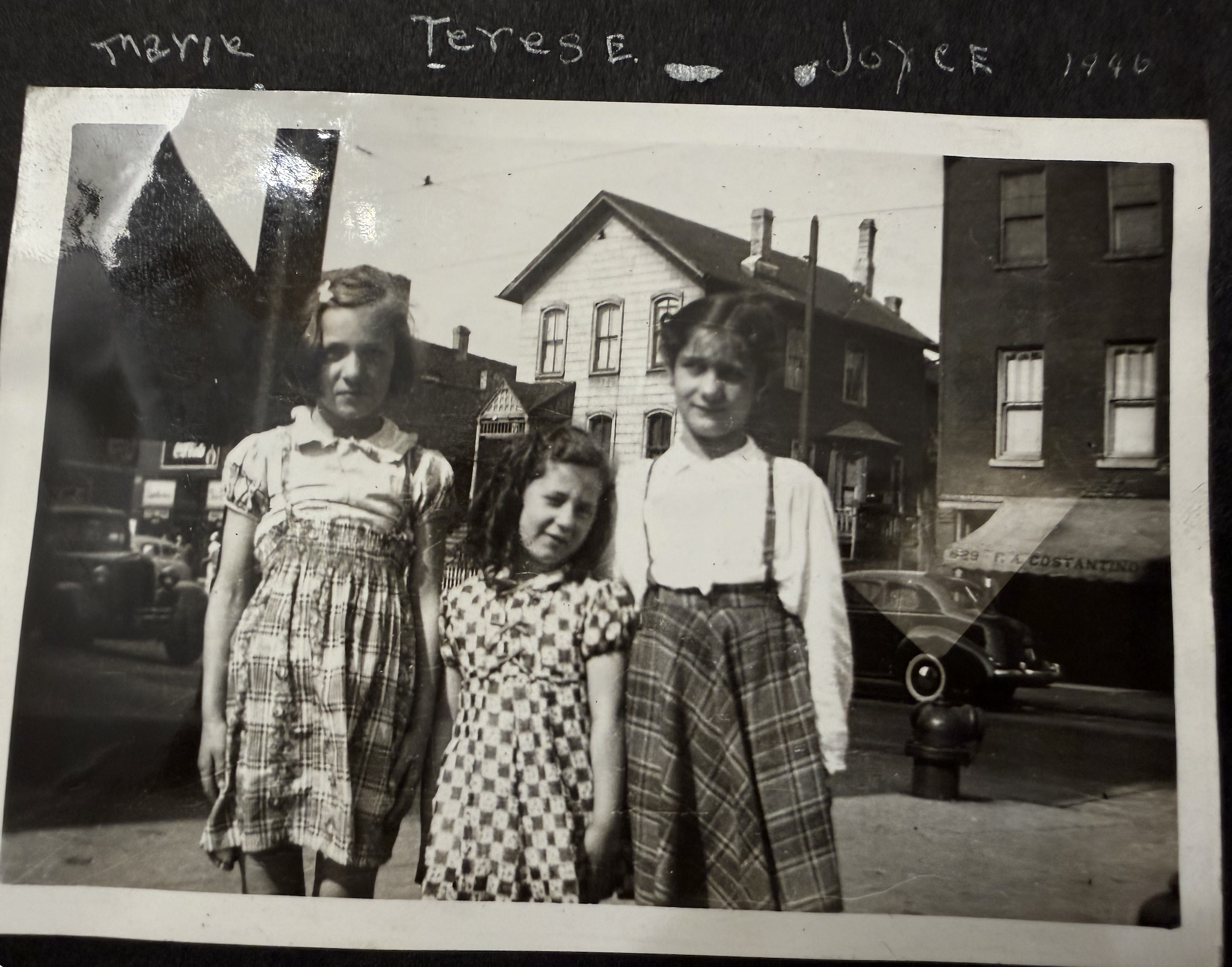
From my grandmother’s album, © 2026 Anastasia Ashman.
On the awning I could make out a number:
629
Then a name:
F. A. Costantino?
It was the number that stopped me.
A census record had recently placed for me that my grandmother lived at 628 South Racine Street on Chicago’s Near West Side.
The storefront in the photograph was 629.
The camera had been pointed almost directly across the street from the homestead.
Suddenly this was no longer just a family photograph taken somewhere in the old Italian neighborhood. It had coordinates.
The background became the evidence
No one taking that picture in 1940 cared whether the address across the street was legible.
They wanted the children.
Yet decades later, the incidental details became more useful to me.
The awning fixed the location. The census supplied the opposite address. Together they put my mother on a particular piece of sidewalk.
Once I knew where she was standing, I went looking for the block.
It no longer exists.
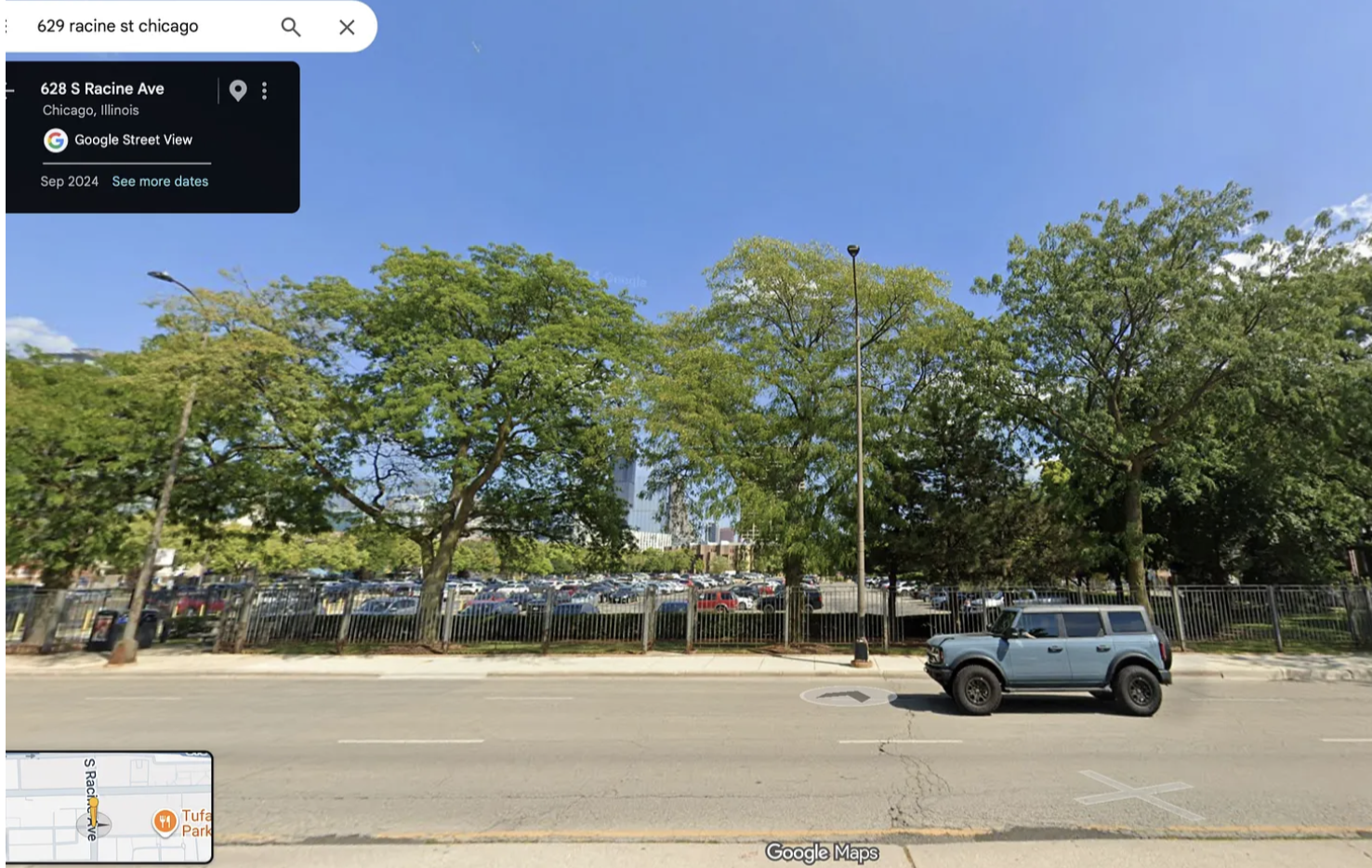
This is where 629 Racine Street was in 1940. It’s now a parking lot for the University of Illinois. Via Google Maps.
The site of 629 South Racine is now part of a radically altered landscape. The building is gone. So are the neighboring structures visible behind the girls.
Much of Chicago’s Near West Side was demolished and remade during the urban-renewal era, including the construction of the University of Illinois Chicago’s Circle Campus. The displacement of residents and destruction of the surrounding neighborhood are well documented by UIC’s Near West Side Renewal Project.
I had known that history in general terms.
That is different from discovering that one of the vanished sidewalks was my mother’s.
Family albums record more than families
Since making this discovery, I have started inspecting old photographs differently.
I still look at the people. But I also look around them.
Street numbers.
Store signs.
License plates.
Porches.
Window lettering.
Cars.
The edge of another building.
Anything that might have seemed too ordinary to identify at the time.
Family photographs are full of this accidental information. They preserve a version of the built world precisely because nobody thought the built world was the subject.
Another photograph in my archive helped start the entire Family of Mine project. My grandmother had written beneath it:
I came to concentrate on the mysterious “Boss Arrigo.”
But that photograph was doing something else at the same time. It recorded a Chicago building where family life and commerce occupied the same address, with apartments above and businesses below.
The caption pointed me toward a man.
The image preserved an environment.
That distinction now seems important.
A family album may tell you who somebody wanted remembered. The background can tell you where they actually were.
And sometimes the city removes the second thing before anyone realizes it mattered.
The buildings disappeared from Racine Street.
The photograph did not.
308 Nightclubs for 14,000 People
I knew nothing about Calumet City until my family story led me to nearby Chicago Heights.
Calumet City sits right on the Illinois-Indiana state line, in the middle of a region I had mostly understood through industry: steel mills, factories, rail lines, refineries, workers moving back and forth across municipal boundaries that meant less economically than they did on a map.
Then I found a January 1941 spread in Life about Calumet City nightlife.
Population: 14,000.
Bars and taverns: 308.
That works out to almost one drinking establishment for every forty-five residents.
I grew up in a university town with more coffee shops than bars, so perhaps my scale is distorted. But 308 still seemed like a lot.
Way too many for the local population alone.
Which made me stop looking at the clubs themselves and ask a different question.
Who was keeping them in business?
The answer started to come into focus when I looked at what surrounded Calumet City and Chicago Heights.
Steel mills. Factories. Rail yards. Industrial plants. Thousands of men working shifts that started and ended at all hours.
This was not a nine-to-five landscape.
A worker finishing late at night did not necessarily want to go home to bed. Someone getting off before dawn did not need entertainment to wait until evening.
And apparently it didn’t.
One of the musicians working the Calumet City circuit was Sun Ra.
I once got to see him at the Village Vanguard in New York. Sun Ra!
Years later, he remembered playing the Calumet City clubs from evening until nearly dawn. The schedule sounds punishing from the musician’s side. The shows were staggered, so when one club paused for an intermission, a performer could move to another and play there.
The entertainment kept circulating.
One room slowed down. Another picked up.
The night did not end just because one set did.
That detail made the whole place look different to me.
On one stretch of State Street, twenty-six taverns and nightclubs occupied just two blocks.
Some stayed open for most of the day and night.
Many employed B-girls whose job included getting male customers to buy more drinks.
That is the kind of detail that makes the economics visible.
A customer was not simply buying liquor.
He was buying time.
Liquor. Music. Gambling. Food. Cigarettes. Women. Company. Spectacle.
I had been encountering all of these things separately in the records.
A tavern here. A nightclub there. A gambling room. Jukeboxes. A restaurant. A hotel. A floor show.
Taken one at a time, they looked like nightlife. Together, they began to look like an economy.
And not just any economy, an entertainment economy built right next to the industrial one.
The factories and mills produced wages. They also produced exhaustion, odd hours, transient populations, single men, married men away from home, salesmen, drivers, travelers and workers whose lives were organized around shifts instead of evenings.
The clubs were positioned to absorb some of that money.
Not necessarily in one dramatic night.
A drink here. A meal there. A few songs. A bet. Cigarettes. Another drink. Another room.
The point is not that every steelworker spent his paycheck on State Street.
I cannot know that, and I do not want to invent him.
The point is that an entertainment district this dense had to be feeding on something larger than Calumet City itself.
The industrial belt supplied the customers.
And geography mattered.
If you worked in Chicago Heights or somewhere nearby, you did not have to drive thirty miles into Chicago to find a night out.
Nightlife came to you.
That may be the part I had been missing.
I had been looking at the men who ran things.
The owners. The operators. The gamblers. The people moving liquor, money, machines and influence.
But none of that explains itself.
Supply requires demand.
And around Chicago Heights and Calumet City, industry seems to have created both the money and the schedule for an after-dark economy to thrive.
My 5th Great-Uncle Died In The Duke’s Licorice Factory
A death record from Calabria connects my relative, a duke, and a black candy that somehow made it to the Smithsonian…
Nobody in my family ever told me a story about Francesco. I had heard the name Salerno from my grandfather. They were legendary, those Salernos. What did he tell me? I cannot recall a thing.
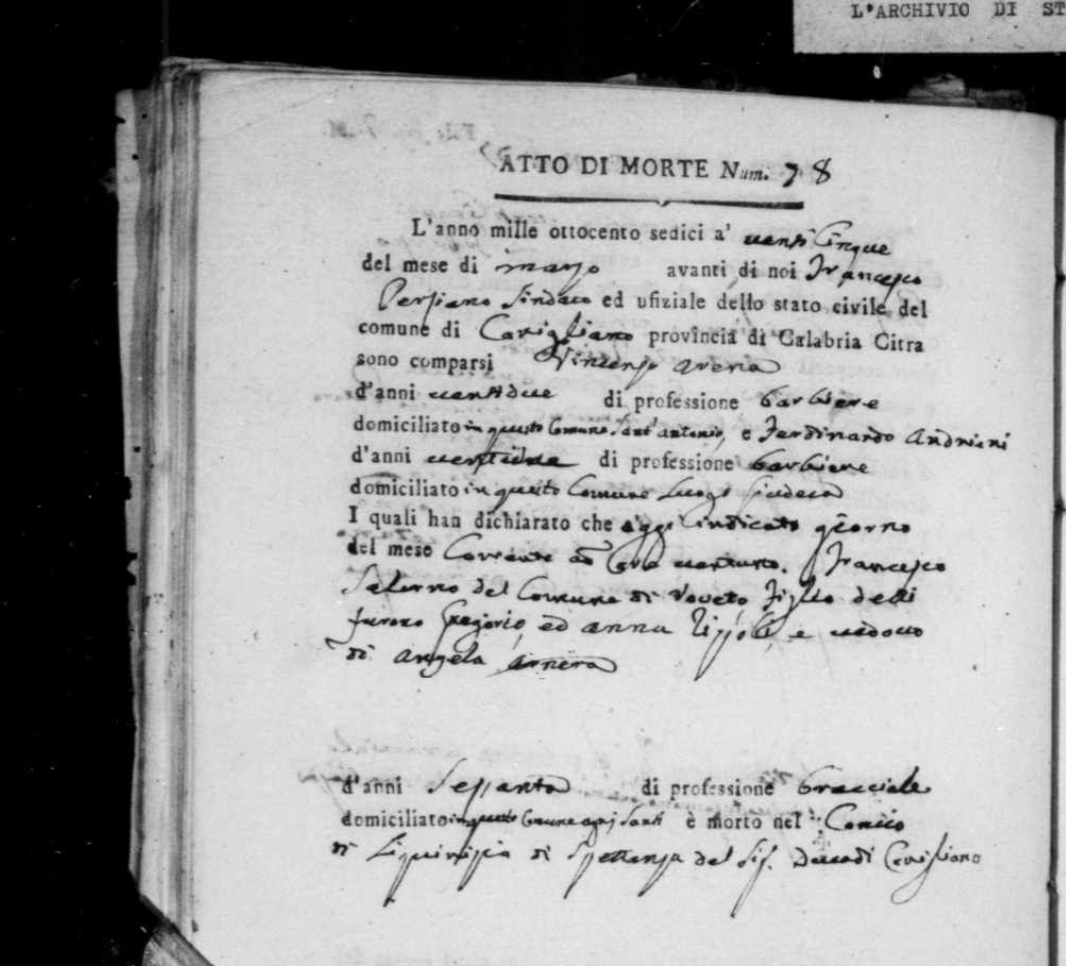
Francesco Salerno’s death record in the National Archives of Cosenza
But I know where Francesco died.
He spent his last day in a licorice workshop belonging to the Duke of Corigliano.
On January 5, 1817, Francesco was sixty years old and working as a laborer when he died in the concio della liquirizia, the Duke’s licorice-processing workshop in Calabria.
Naturally, I stopped researching Francesco and started researching licorice.
My sisters and I were licorice fiends so I’m not a newcomer to licorice. No one ever connected our fixation on this candy to a family story. The duke was news.
It turns out this was not some eccentric duke making candy in his kitchen. A century earlier, the Duke of Corigliano had established one of Calabria’s earliest conci, helping turn the wild licorice root there into a regional industry.
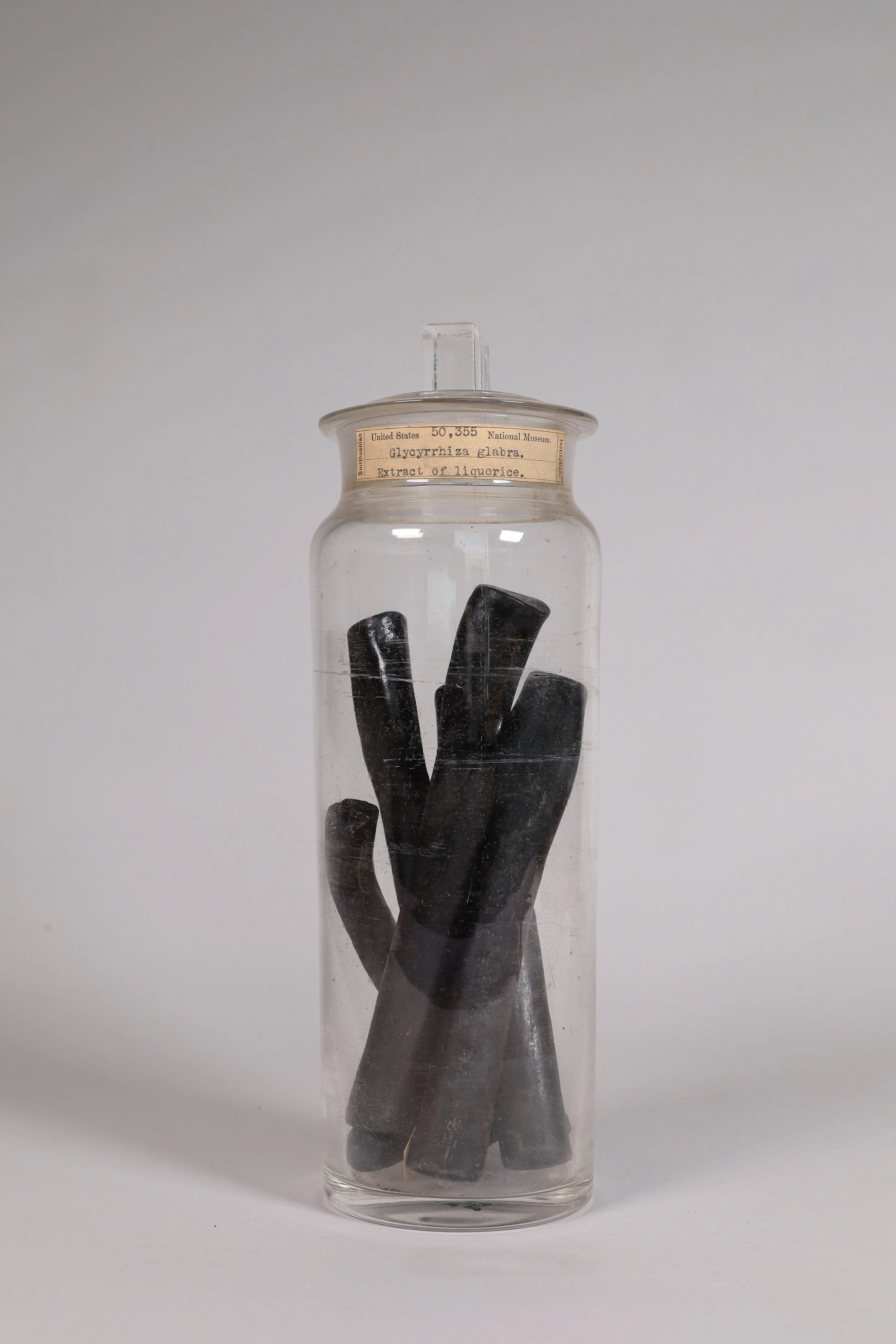
Duca di Corigliano Licorice Sticks, at the National Museum of American History, Smithsonian Institution. These date to about 1885, nearly seventy years after Francesco died in the Duke of Corigliano’s licorice workshop.
And then I found this exhibit at the Smithsonian: Duca di Corigliano Licorice Sticks.
These sticks were made seven decades after Francesco died, carrying the same Corigliano name into the American historical record.
I have no story about Francesco. But I know where he spent his final day. I know what factory he died in and what they did there: crushing, boiling, extracting sweet black liquid from roots.
And I now know exactly where in Calabria I need to go.

Getting answers I wasn’t looking for, Summer 2026
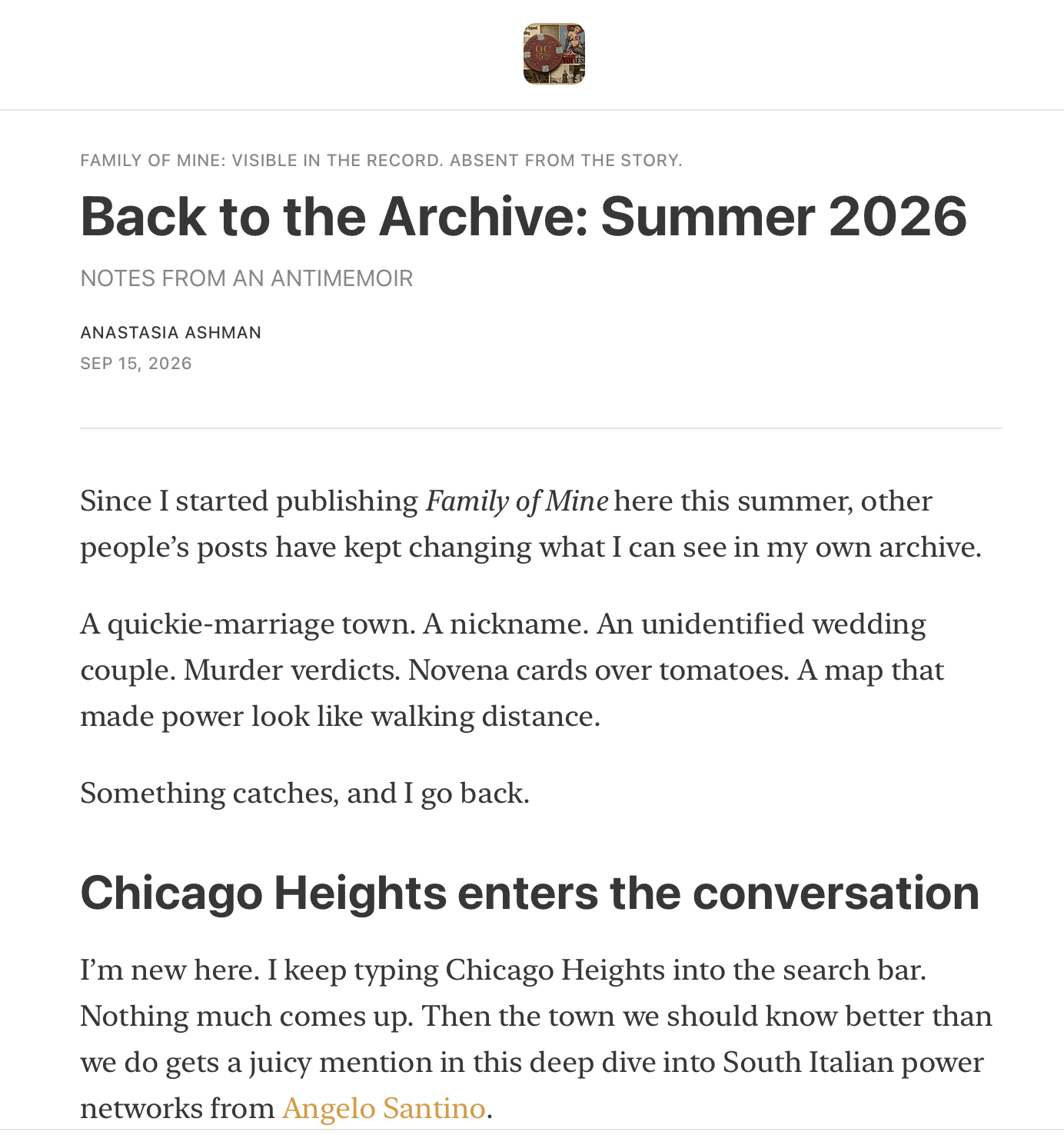
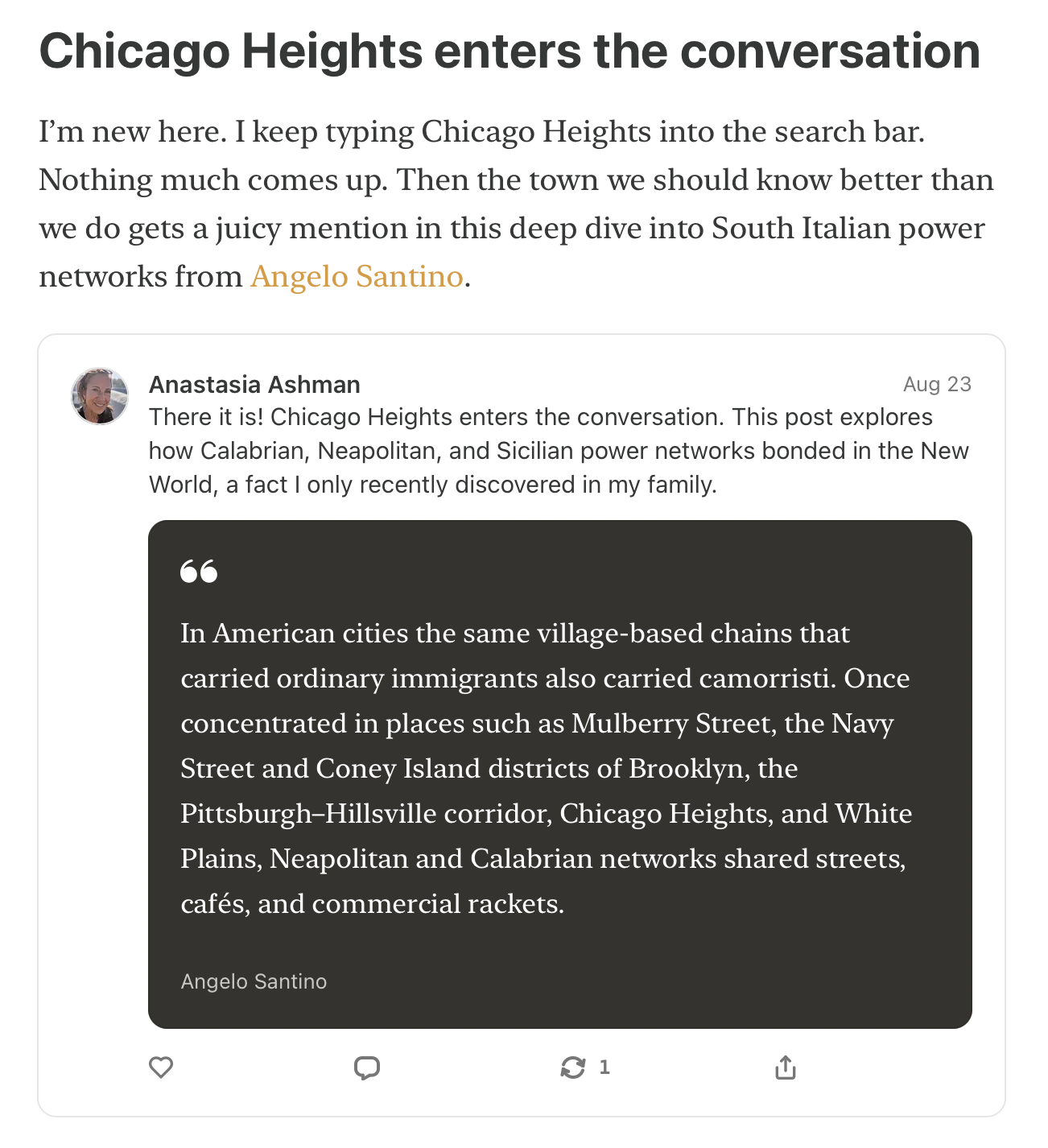
I’m new over on Substack. I keep typing Chicago Heights into the search bar, looking for my people. Nothing much comes up. Then the town we should know better than we do gets a juicy mention in this deep dive into South Italian power networks.
It’s been a season of annotated conversations. Since I started publishing Family of Mine on Substack this summer, other people’s posts have kept changing what I can see in my own archive.
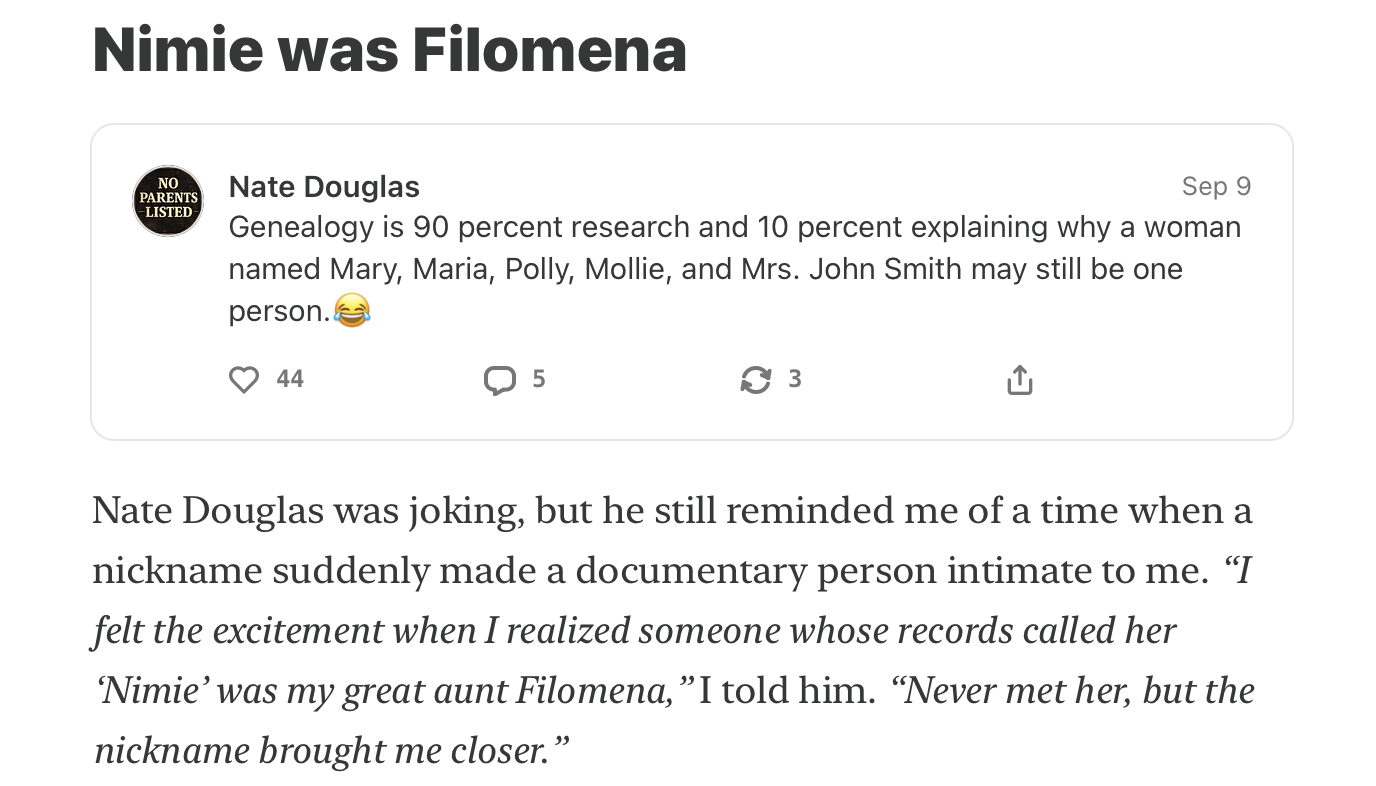
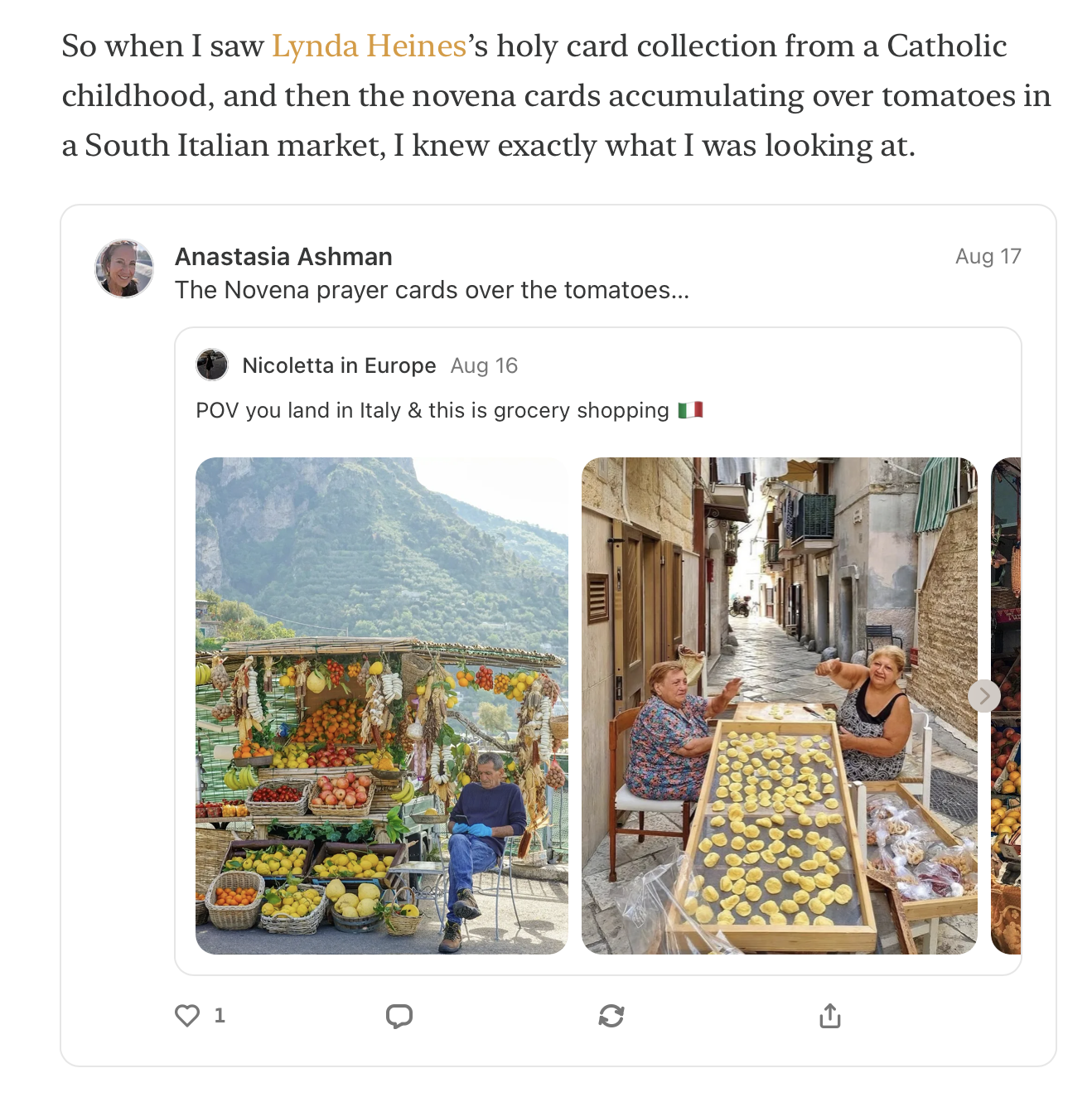
A quickie-marriage town. A nickname. An unidentified wedding couple. Murder verdicts. Novena cards over tomatoes. A map that made power look like walking distance.
Something catches, and I go back.
Here’s where you can read the whole thing at Substack. Please visit!
And here’s a selection from it:
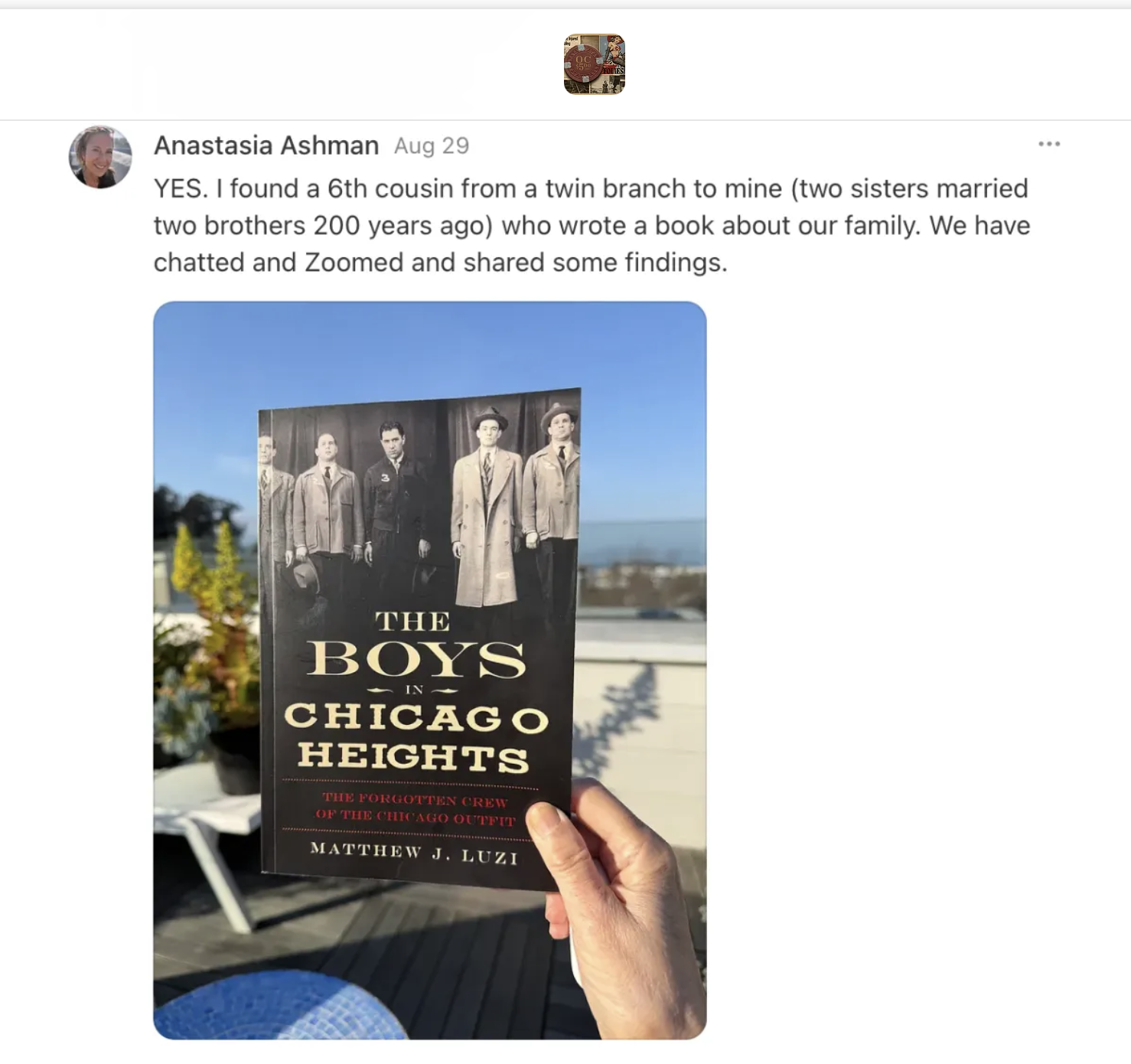
Chicago Heights enters the conversation
I’m new over on Substack. I keep typing Chicago Heights into the search bar, looking for my people. Nothing much comes up. Then the town we should know better than we do gets a juicy mention in this deep dive into South Italian power networks.
Getting an inside look at Jeffersonville
Jeffersonville is another town I didn’t expect to matter.
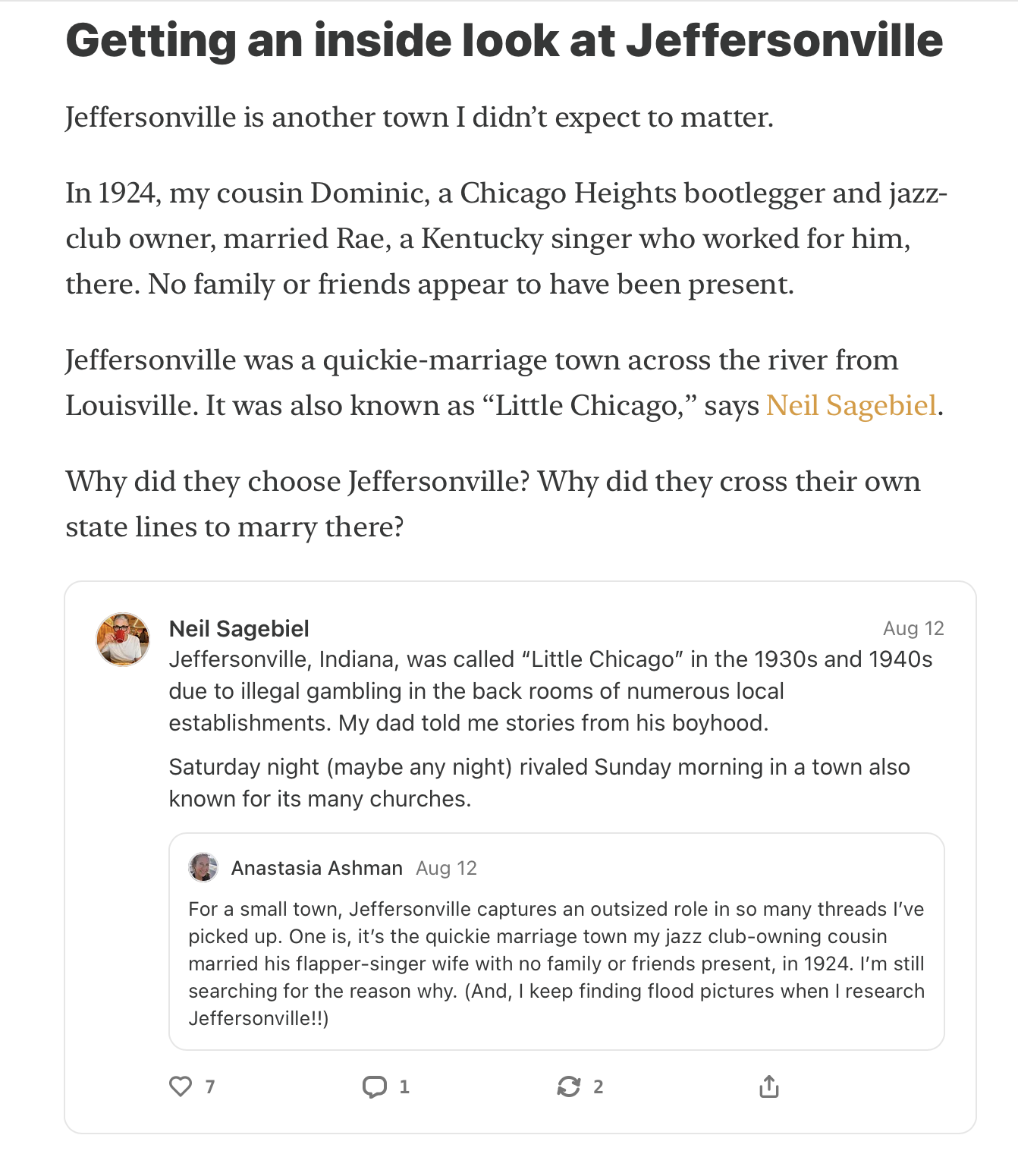
In 1924, my cousin Dominic, a Chicago Heights bootlegger and jazz-club owner, married Rae, a Kentucky singer who worked for him, there. No family or friends appear to have been present.
Jeffersonville was a quickie-marriage town across the river from Louisville. It was also known as “Little Chicago.”
Why did they choose Jeffersonville? Why did they cross their own state lines to marry there?
For a small town, Jeffersonville captures an outsized role in so many threads I’ve picked up. One is, it’s the quickie marriage town my jazz club-owning cousin married his flapper-singer wife with no family or friends present, in 1924. I’m still searching for the reason why. (And, I keep finding flood pictures when I research Jeffersonville!!) - me
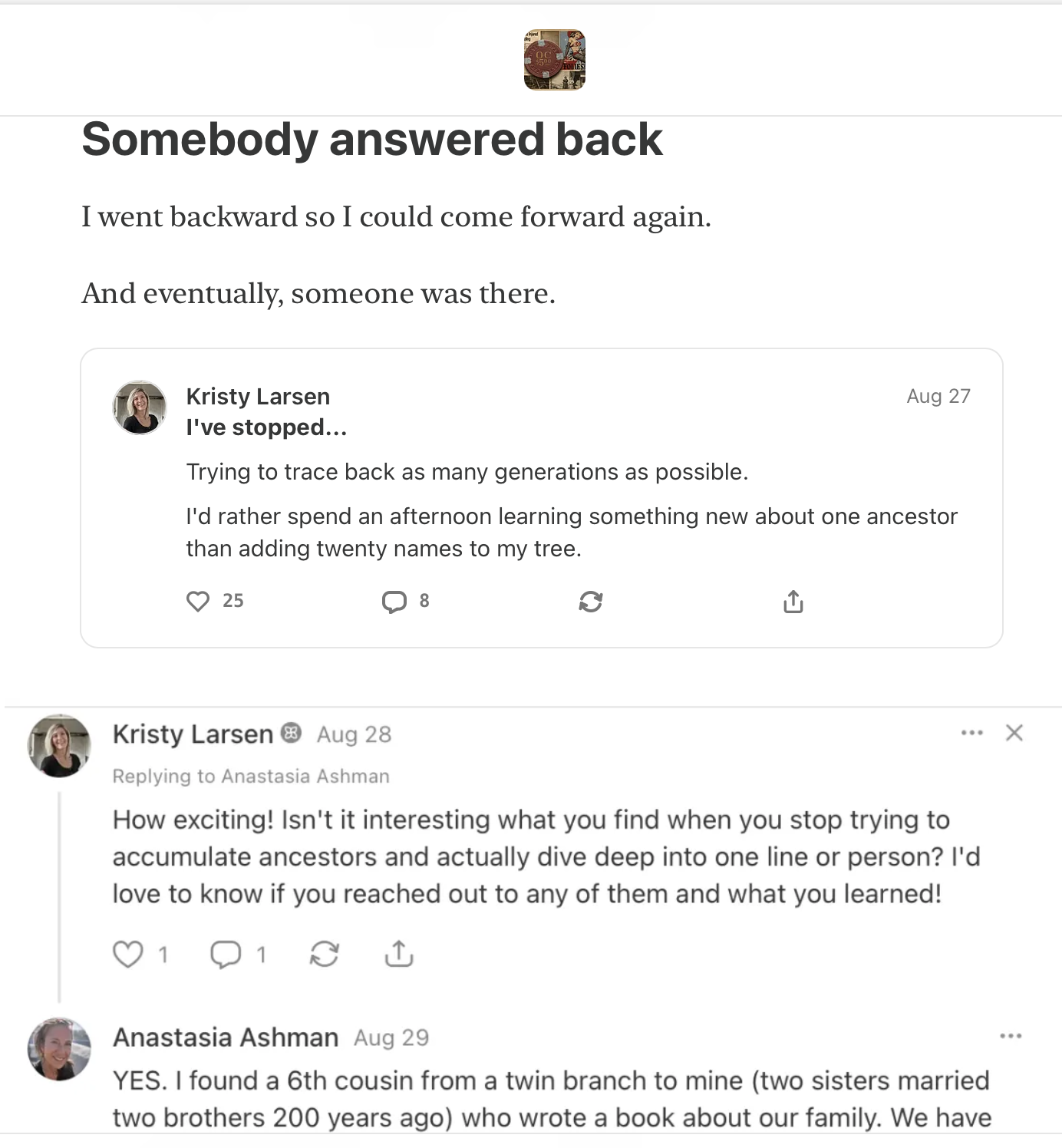
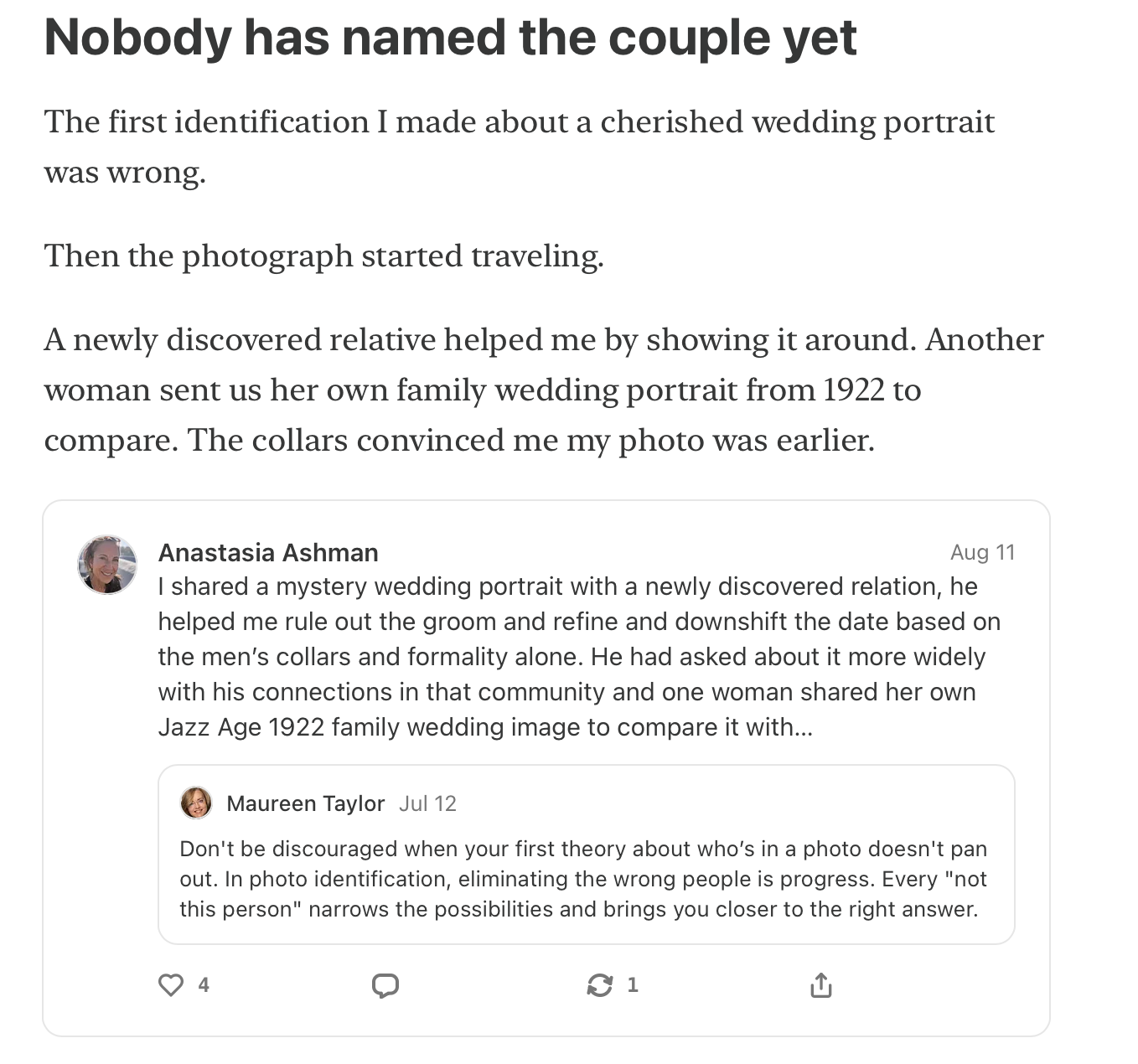
Nobody has named the couple yet
The first identification I made about a cherished wedding portrait was wrong.
Then the photograph started traveling.
A newly discovered relative helped me by showing it around. Another woman sent us her own family wedding portrait from 1922 to compare. The collars convinced me my photo was earlier.
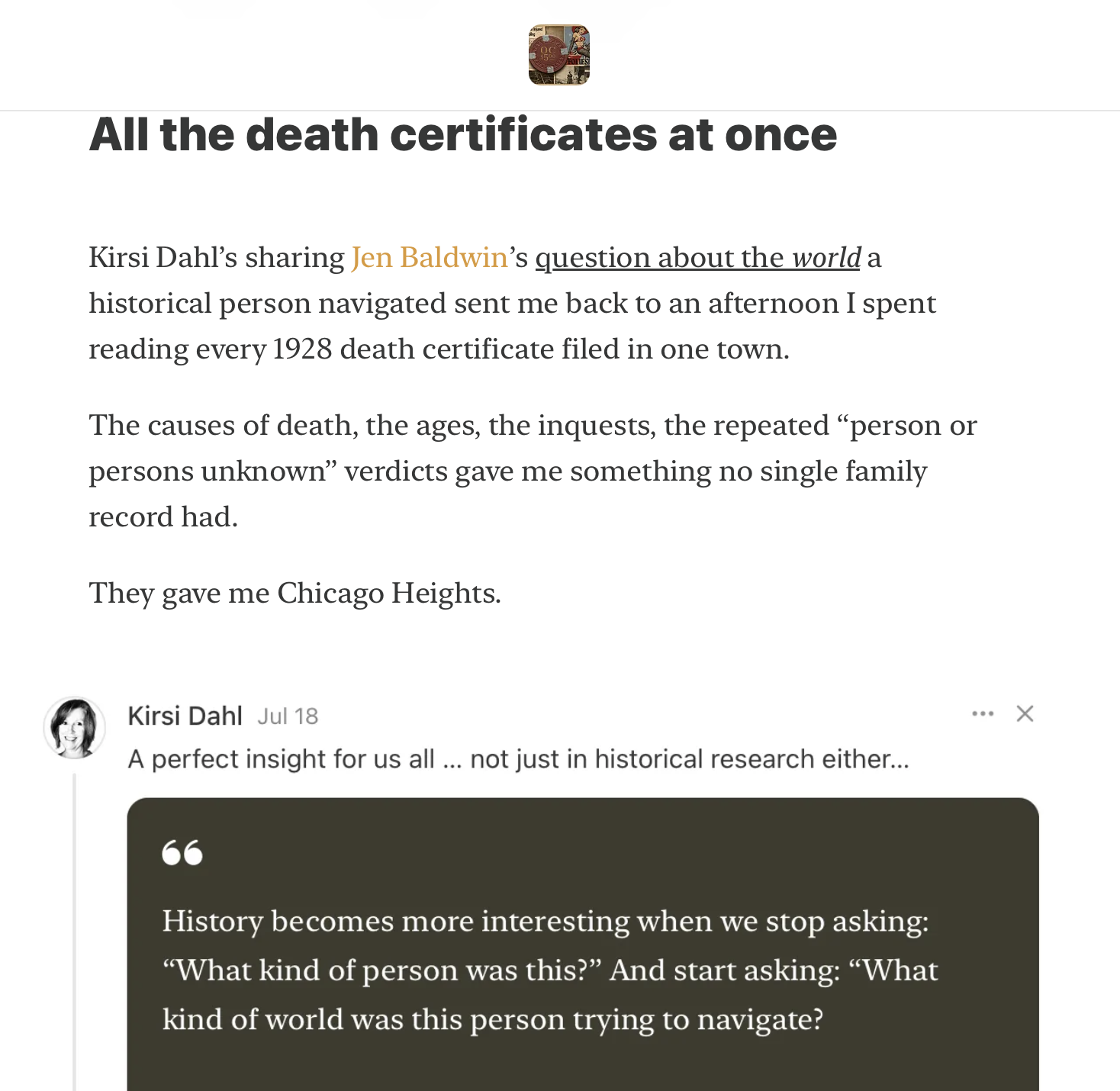
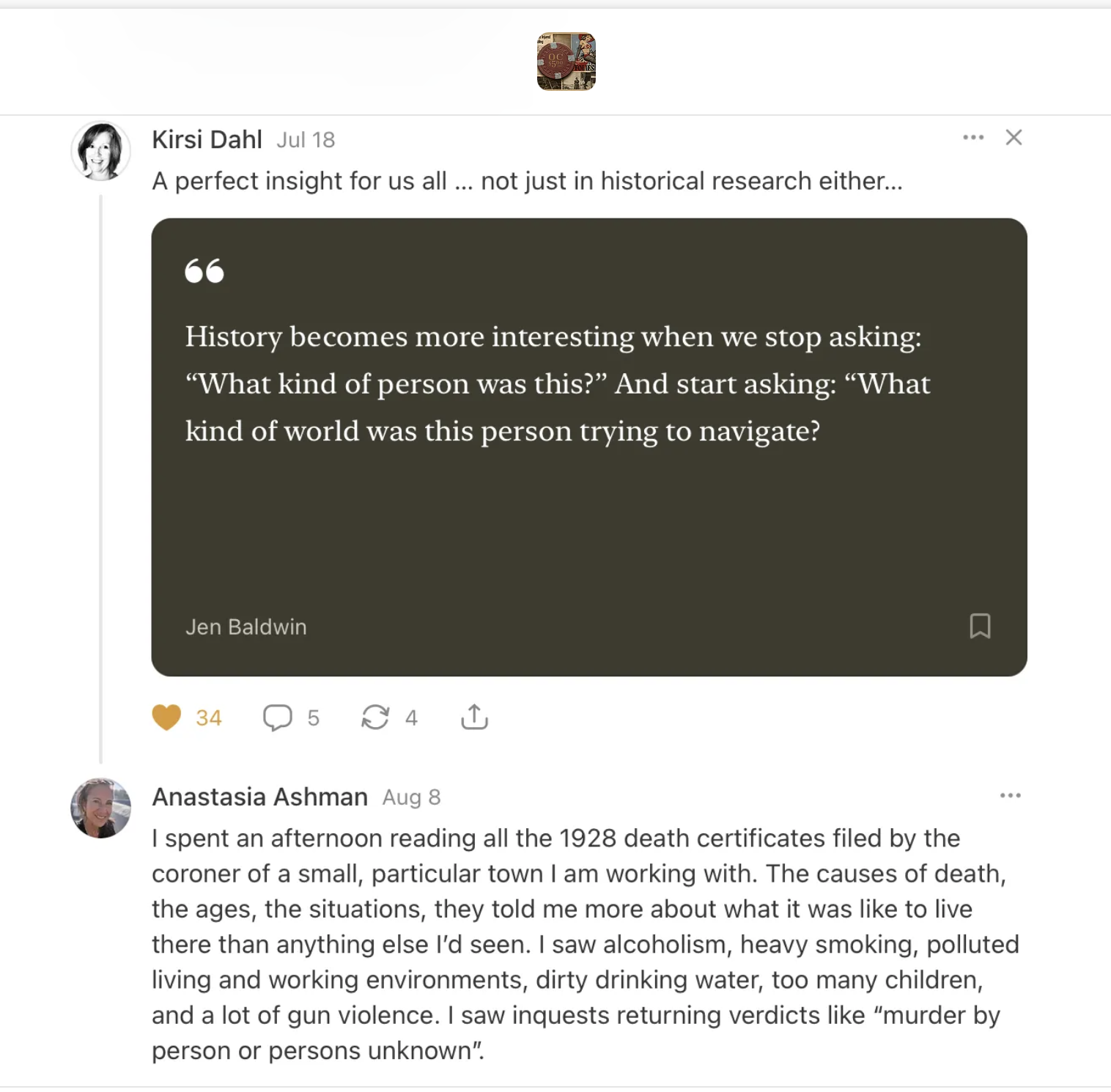
A question about the actual world a historical person navigated sent me back to an afternoon I spent reading every 1928 death certificate filed in one town.
The causes of death, the ages, the inquests, the repeated “person or persons unknown” verdicts gave me something no single family record had.
They gave me Chicago Heights.
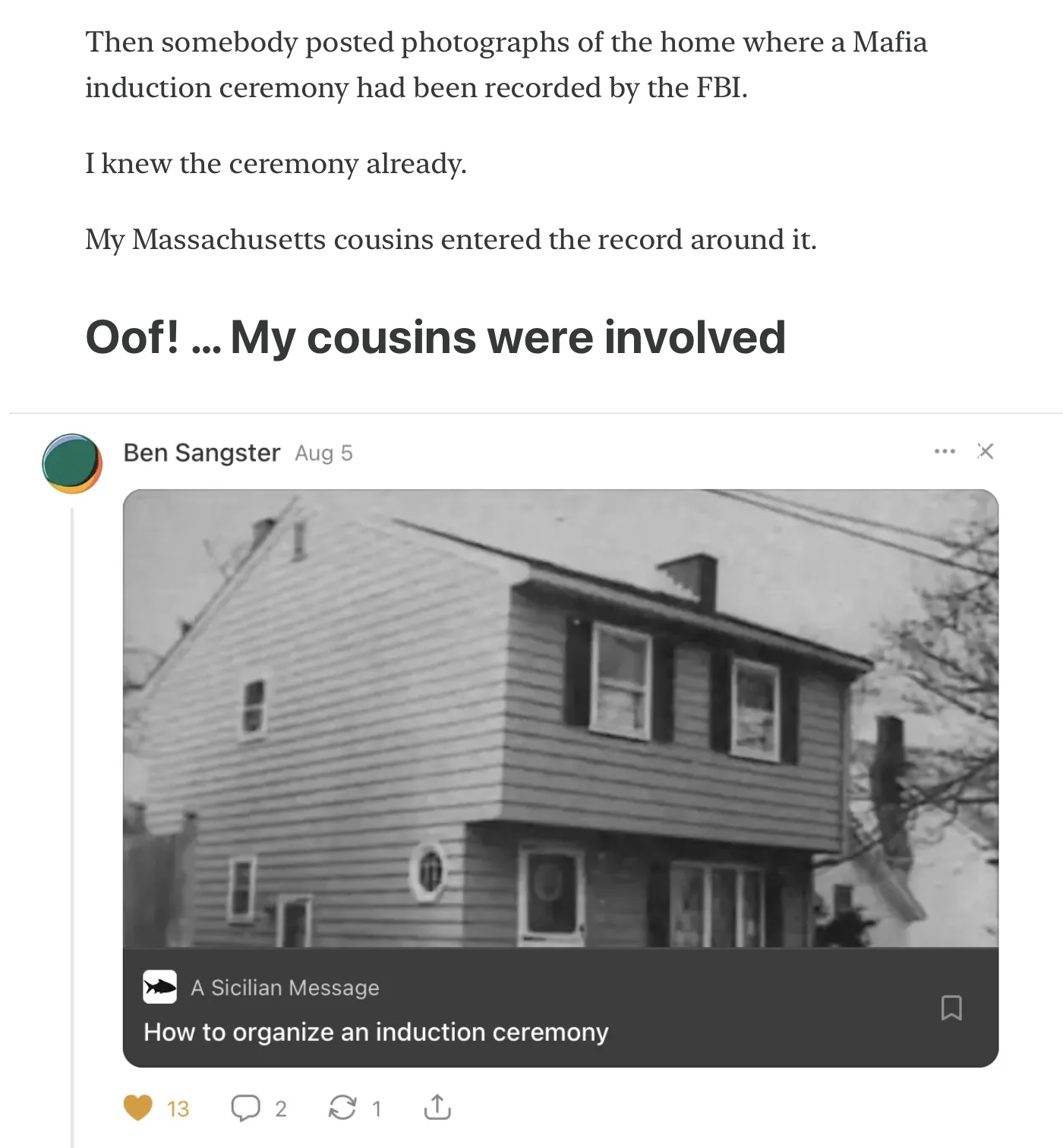
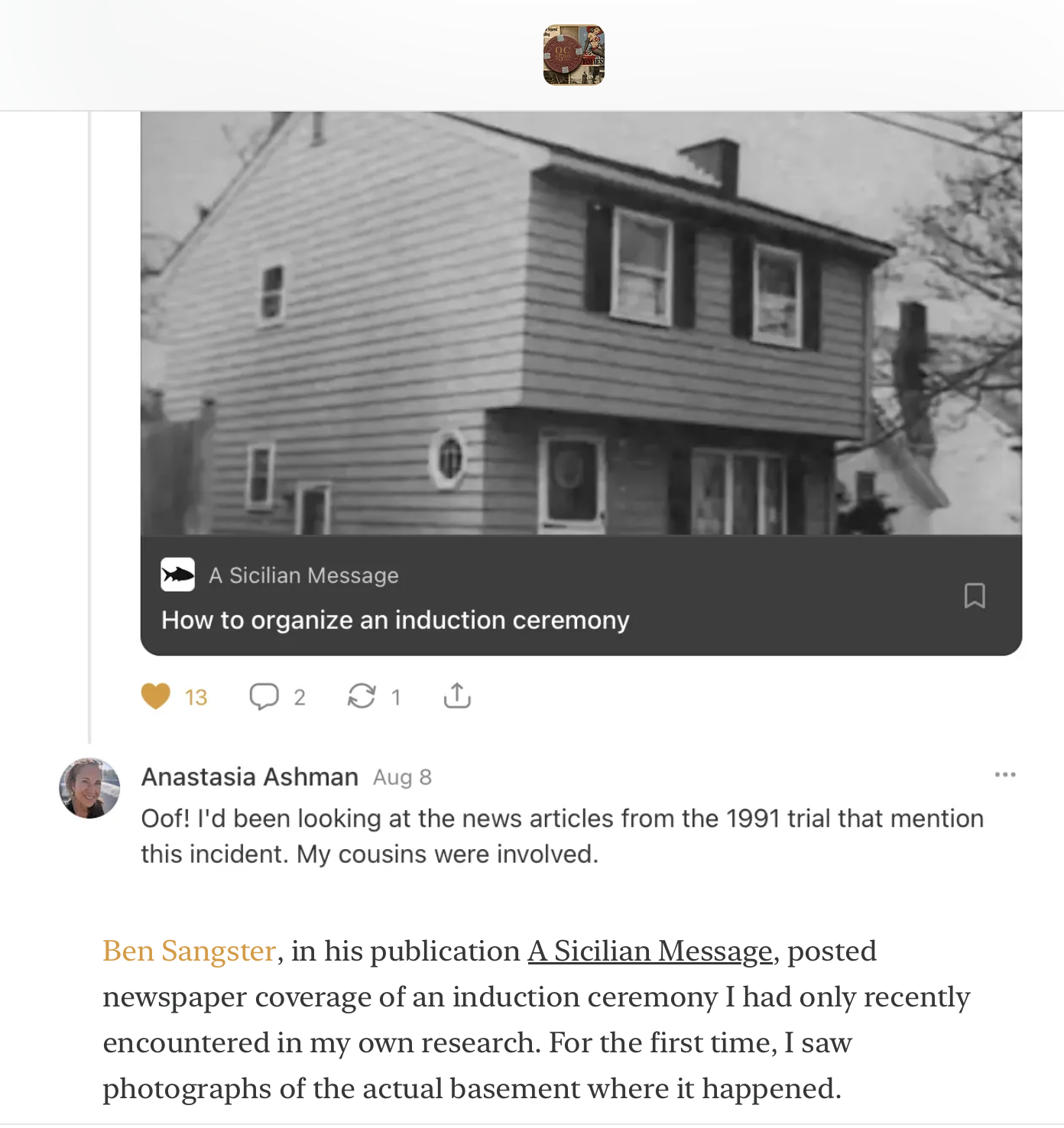
Oof! … My cousins were involved
Then somebody posted photographs of the home where a Mafia induction ceremony had been recorded by the FBI.
I knew the ceremony already.
My cousins entered the record around it.
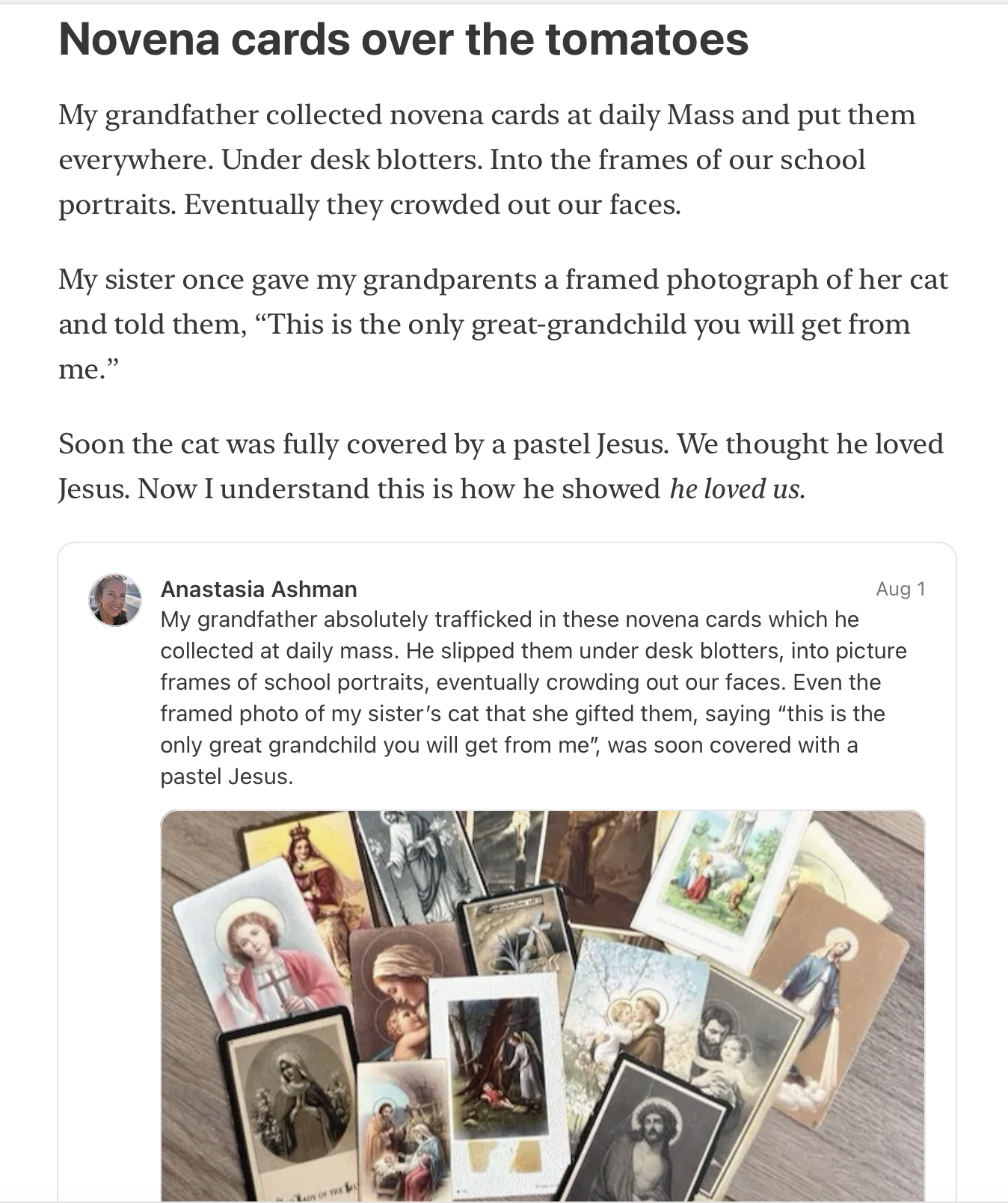
Novena cards over the tomatoes
My grandfather collected novena cards at daily Mass and put them everywhere. Under desk blotters. Into the frames of our school portraits. Eventually they crowded out our faces.
My sister once gave my grandparents a framed photograph of her cat and told them, “This is the only great-grandchild you will get from me.”
Soon the cat was fully covered by a pastel Jesus. We thought he loved Jesus. Now I understand this is how he showed he loved us.
My grandfather absolutely trafficked in these novena cards which he collected at daily mass. He slipped them under desk blotters, into picture frames of school portraits, eventually crowding out our faces. Even the framed photo of my sister’s cat that she gifted them, saying “this is the only great grandchild you will get from me”, was soon covered with a pastel Jesus. - me
Assembled. After the fact.
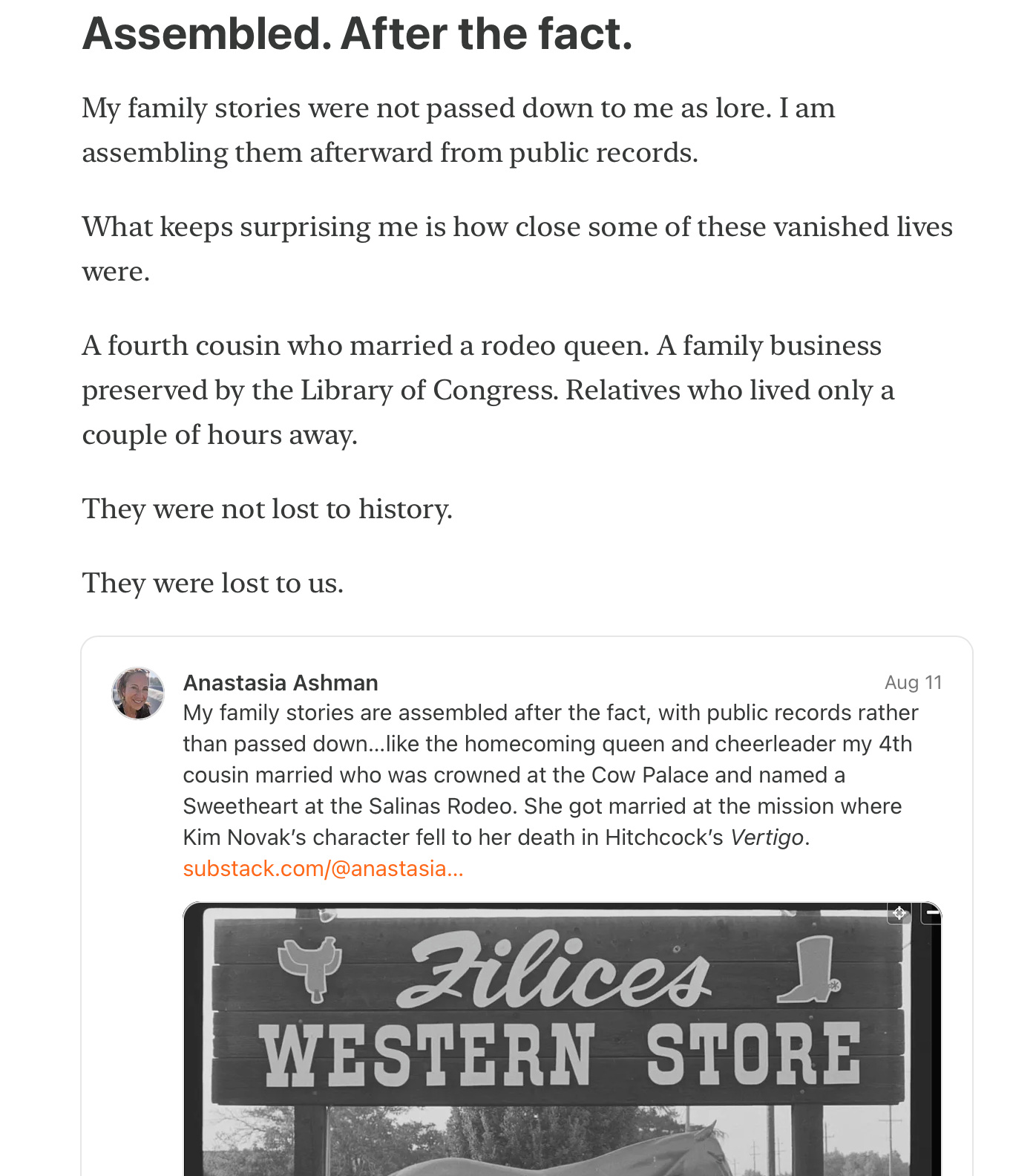
My family stories were not passed down to me as lore. I am assembling them afterward from public records.
What keeps surprising me is how close some of these vanished lives were.
A fourth cousin who married a rodeo queen. A family business preserved by the Library of Congress. Relatives who lived only a couple of hours away.
They were not lost to history.
They were lost to us.
Power networks within walking distance
So much was within walking distance.
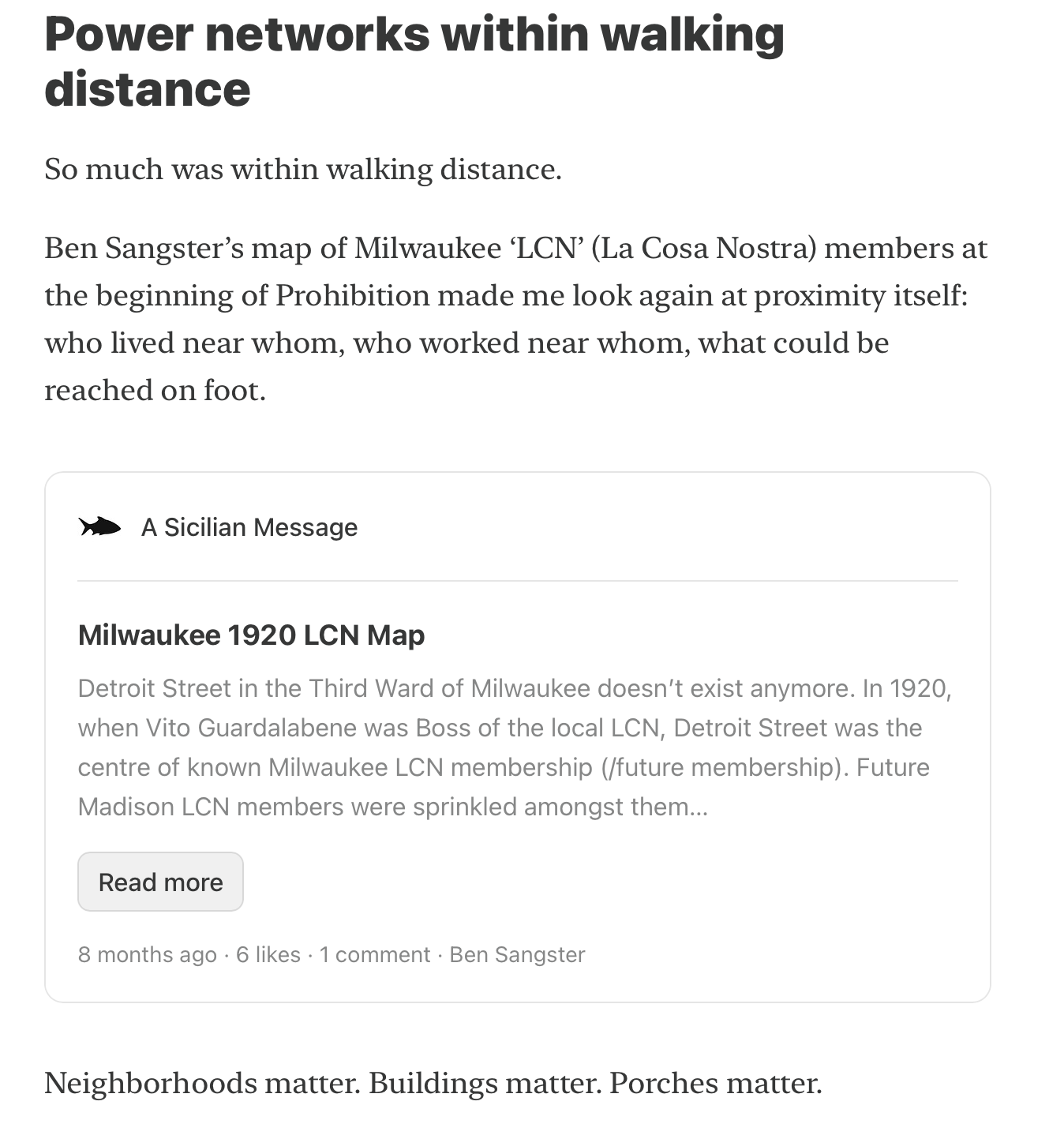
Ben Sangster’s map of Milwaukee LCN members at the beginning of Prohibition made me look again at proximity itself: who lived near whom, who worked near whom, what could be reached on foot.
Neighborhoods matter. Buildings matter. Porches matter.
I went straight back to the 1929 porch.
To my Calabrian great-grandparents and their Sicilian landlord.
Boss Arrigo.
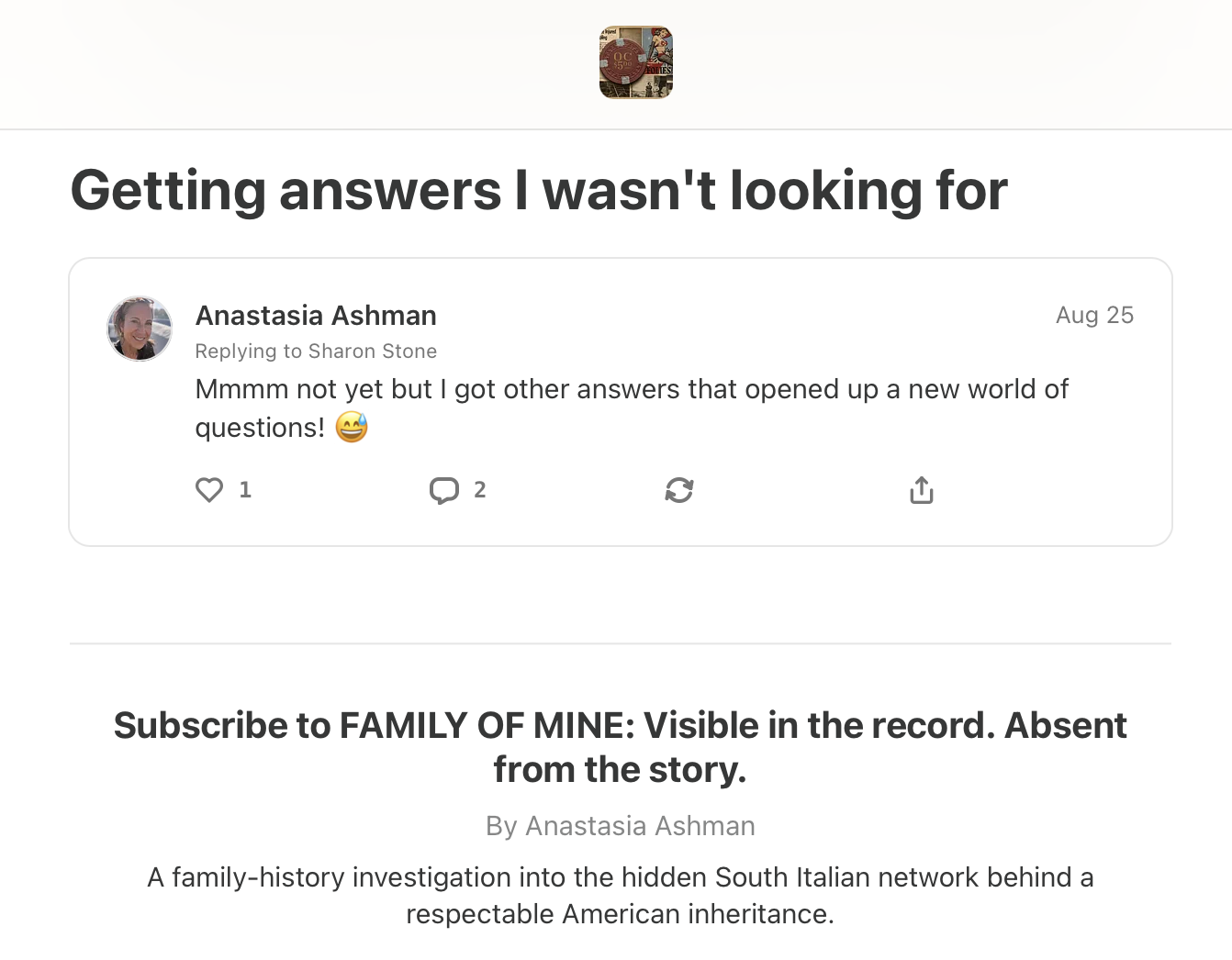
Did I get the answers I was looking for, someone asked me.
Getting answers I wasn't looking for
My Grandfather Wore A Diamond Horseshoe Pin
For years, this was a photograph of my grandfather as a young man among others in my grandmother’s albums.
Studio portrait. Newsboy cap. Dark overcoat. Striped tie. Seventeen? Eighteen? He looks serious, but not solemn. Carefully dressed in street garb without looking formal.
If I dated this right, he had left school and was working as a grocery store clerk.
Then I enlarged the photograph on my phone.
Fastened to his luscious striped silk tie was a tiny sparkly horseshoe.
I had never noticed it.
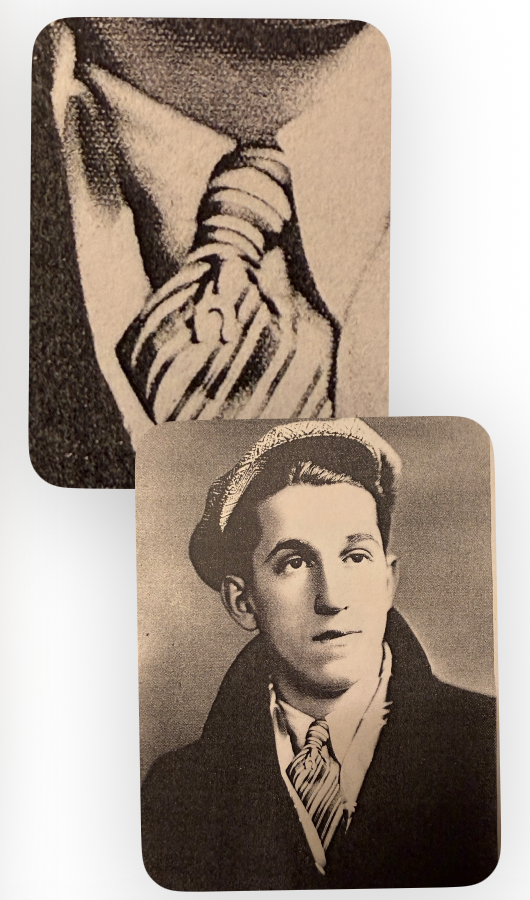
My grandfather around 1930, when he was a young grocery clerk in Chicago. © 2026 Anastasia Ashman
It appears to be silver or platinum and set with small clear stones. Rhinestones, perhaps. I hope. Diamonds, perhaps. The photograph cannot tell me.
It is not subtle.
Once I saw it, the portrait changed.
The coat and cap belong to an ordinary young working man. The pin introduces something else. A little flash. A little luck. A little display.
And, apparently, another horse.
And piece of jewelry doesn’t prove anything.
But this has become a recurring finding in my family photographs. Evidence of something I can’t explain.
A pinkie ring appears in more than one photograph.
Men turn up in good suits.
There are tenements in the background sometimes, yes, but also cars positioned just inside the picture.
There are formal portraits, jewelry, carefully chosen clothes, the small signals people use when they want to present themselves as having arrived, or at least as being on their way.
The written records are much less expressive.
A census might say clerk.
My family did not leave behind explanations saying, Here is how we got from there to here. No running account of the economic changes that carried one generation from immigrant neighborhoods and modest occupations toward property, cars, better clothes and, eventually, descendants growing up thousands of miles away in California.
What survived instead were the surfaces. Photographs. Clothes. Houses. Cars. Jewelry.
A horseshoe can mean luck.
Gambling. Horses.
It can mean nothing: I liked this pin.
I don’t know what it meant to my grandfather.
But I know he chose to wear it for the photograph.
And I know I did not see it until I began looking at these pictures differently.
The archive had not hidden the pin from me.
It had been sitting in plain sight.
I just had not yet learned to look for that unexplained something in the picture.
No Museum-Quality Scans For Me
I needed to properly scan my grandmother’s old photograph albums to do them justice. It was a project to do before I could do much else with them.
High resolution. Careful handling, white gloves, even! Useful, consistent file names. The whole museum-quality project.
I never did it.
What actually unlocked the albums was my iPhone.
I started taking quick photographs of the pages. Nothing fancy. In a bright diffusely lit room, I tried to steady the phone at a 90 degree angle to the prints.
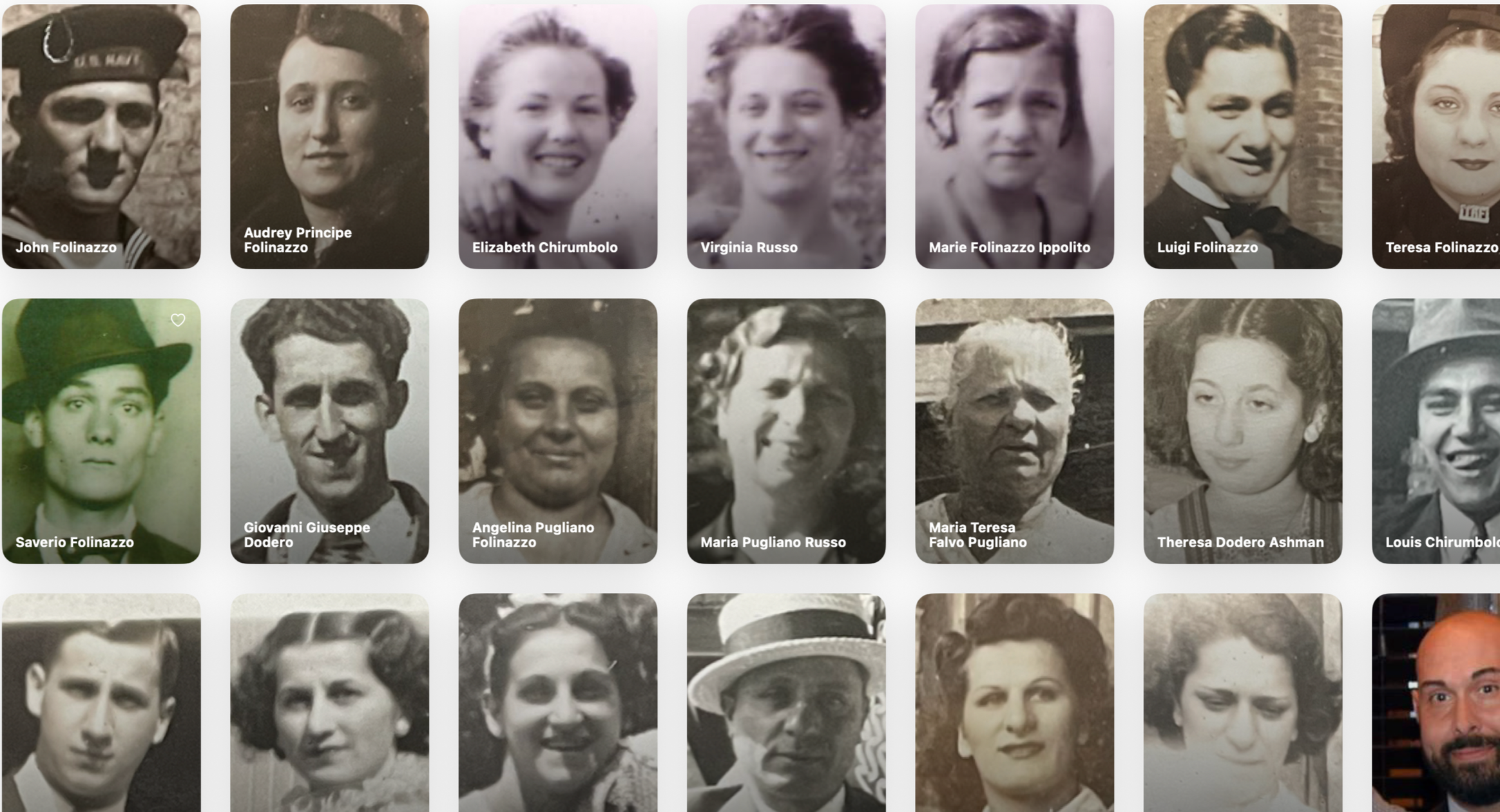
Once the pictures were in iPhoto, I could enlarge them, crop individual faces, reorder them, compare photographs from different albums and use iPhoto’s facial recognition to suggest possible matches. © 2026 Anastasia Ashman
Suddenly I was looking at the pictures all the time.
That mattered.
As my genealogy research moved farther back — eventually eight or ten generations in some branches — the photographs and the family tree began working together. A name in a record could lead me back to a face. A face I had seen in my lifetime occurred repeatedly through history.
I began attaching identified photographs to people in the tree and getting much more familiar with who belonged to whom.
The proper scanning project still exists somewhere in my future.
But the fast, dirty version is what got the research moving.
My Cousin Married A Rodeo Queen
History waits for the person who cares.
Finally, a couple years ago, I looked at my own family.
I never knew we are part of living California history.
…or that we’re in the Library of Congress (LOC)? I stumbled on cousins with a place in its American Folklife Center.
Geneaology work had led me back to a Calabrian mountain village in 1803, to a branch of my tree that eventually grew to sit thousands of miles away, right in my grandparent’s back yard.
Not the back porch in Little Italy.
Instead this cold trail led from my grandfather’s grandfather’s brother and took me down to around Gilroy, that place with the Garlic Festival. Down to the tiny hamlet of San Martin, on an agricultural stretch of the old Camino Real that once connected Spanish missions running the length of the state. Just south of my grandparents' place in the valley of San Jose.
Helen married my fourth cousin Tony, whose Filice surname rings a distant bell.
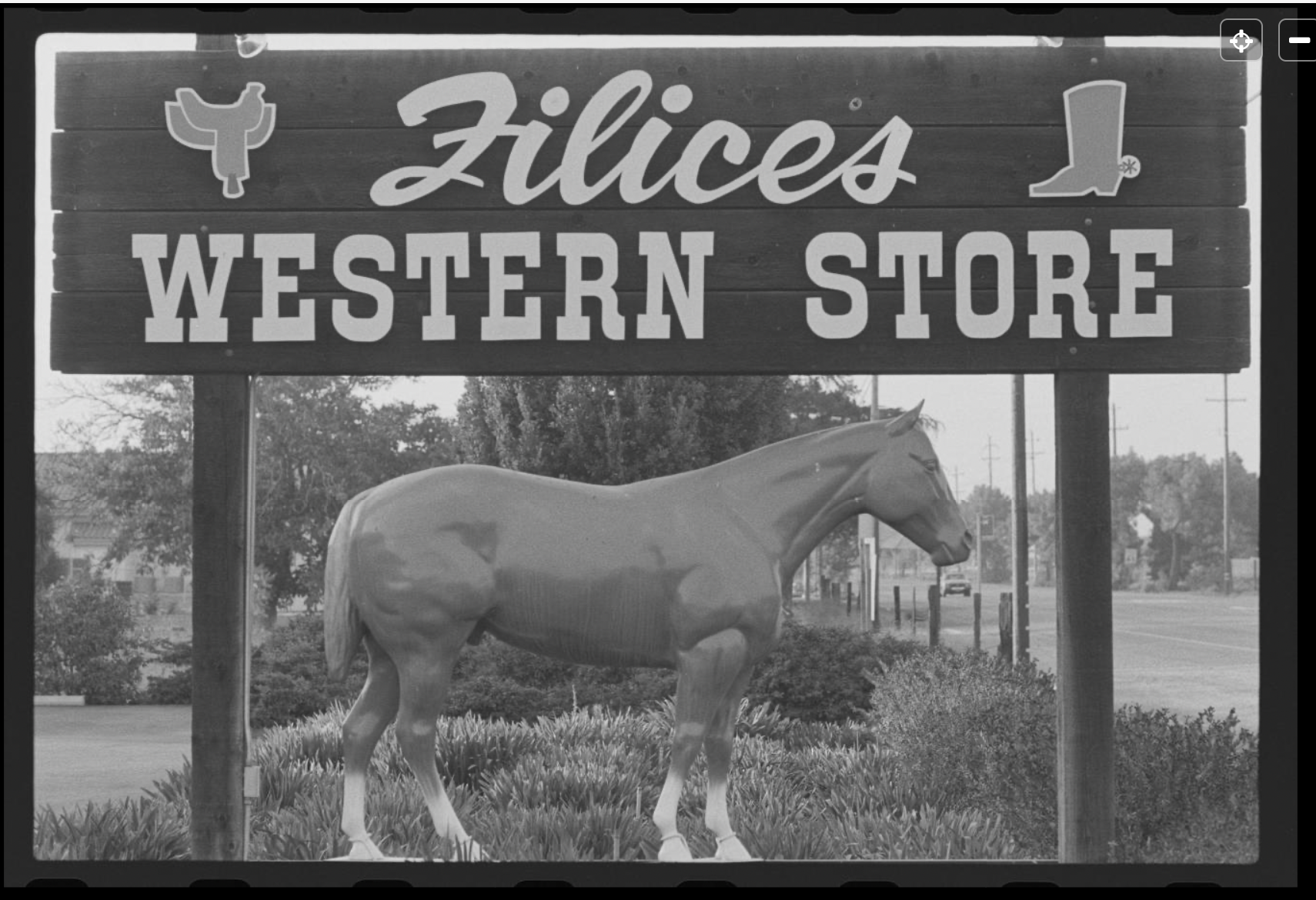
Outside of FILICE'S WESTERN STORE from The Library of Congress, photographed by Ken Light in 1989.
Black and white photographs in the Italian Americans in the West Project collection at the LOC show the outside of FILICE'S WESTERN STORE. The sign is decorated with a saddle on one side and a boot on the other. A big brown fiberglass horse stands under the sign, beckoning drivers in.
Elaine and her western world was not part of my family identity. We were not horsey people.
I imagine we had unknowingly driven past her and Tony’s 40-year old business, known as “a real rancher’s place” selling tack and apparel. Helen Elaine Martin Filice may be new to me but she belongs to California history.
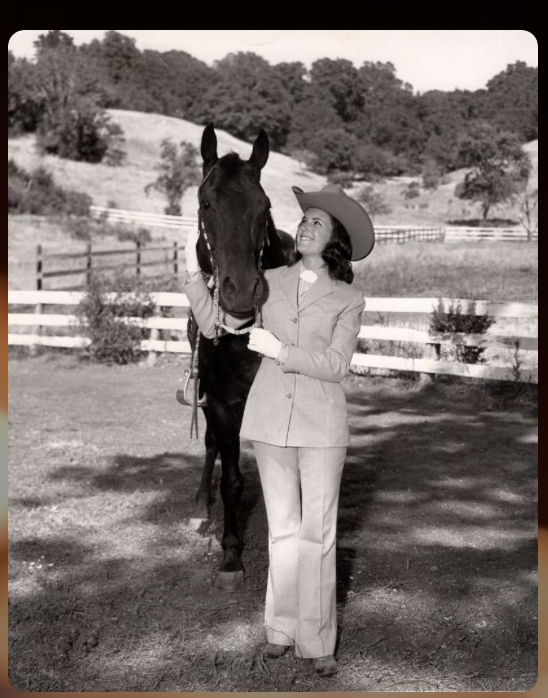
Helen Elaine Martin Filice, Miss Grand National 1965. From her obituary.
A homecoming queen and a cheerleader, Helen became Miss Grand National 1965 at the Cow Palace, and a Sweetheart at the Salinas Rodeo, her recent obituary shares. She is pictured standing with her tall, dark horse. A tailored light-colored suit and wide-brimmed hat, gloved hand resting at the bridle, her face tilted to look her beloved horse in the eye. A whitewashed paddock fence recedes into oak-dotted hills.
Her death notice explains she married my cousin Tony at Mission San Juan Bautista, the same site from Hitchcock's film Vertigo where Kim Novak's character fell to her death from the bell tower.
Google Street View tells me the horse statue is still there, painted stark white. The store is a Boot Barn now.
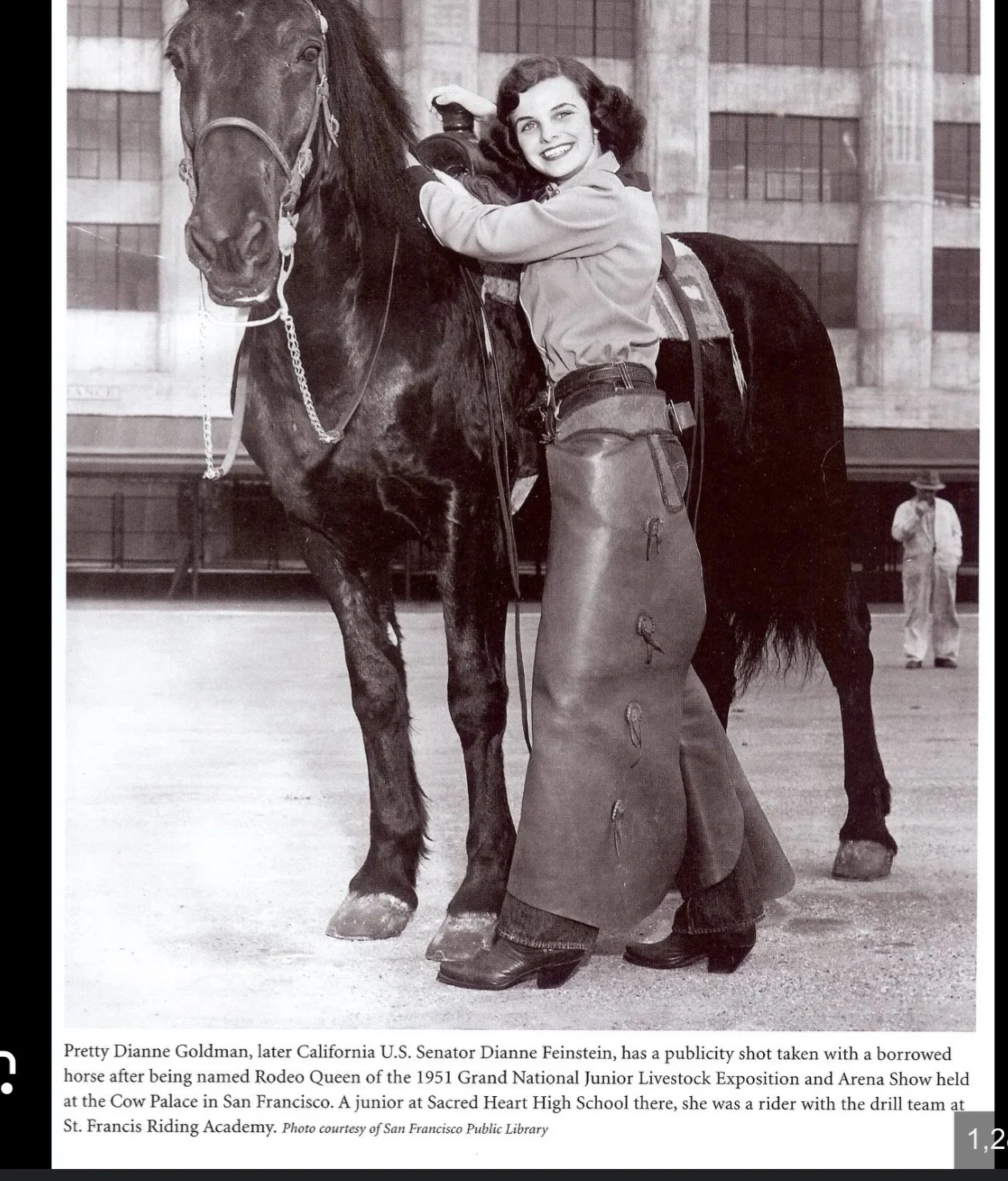
Before Helen was crowned Rodeo Queen another local highschooler, in chaps and cowboy boots, won the title at the Cow Palace. She would go on to become a supervisor, a mayor, and a U.S. senator. (Image from CowPalace.com)
The Cow Palace is familiar to me, but not as a rodeo venue. As a teenager I blew up balloons for a Rolling Stones concert there.
Helen’s fiberglass horse outlasted the family members who put it there. We’re lucky it kept marking that stretch of western road. Now I know we are horsey people after all.

Father, Mother + Boss Arrigo
Family of Mine reconstructs a South Italian network spanning migration, neighborhood commerce, political power, and organized crime, then follows how its history was stripped away as its outcomes became respectable American inheritance.
A family photograph preserved the title. The explanation did not survive with it.
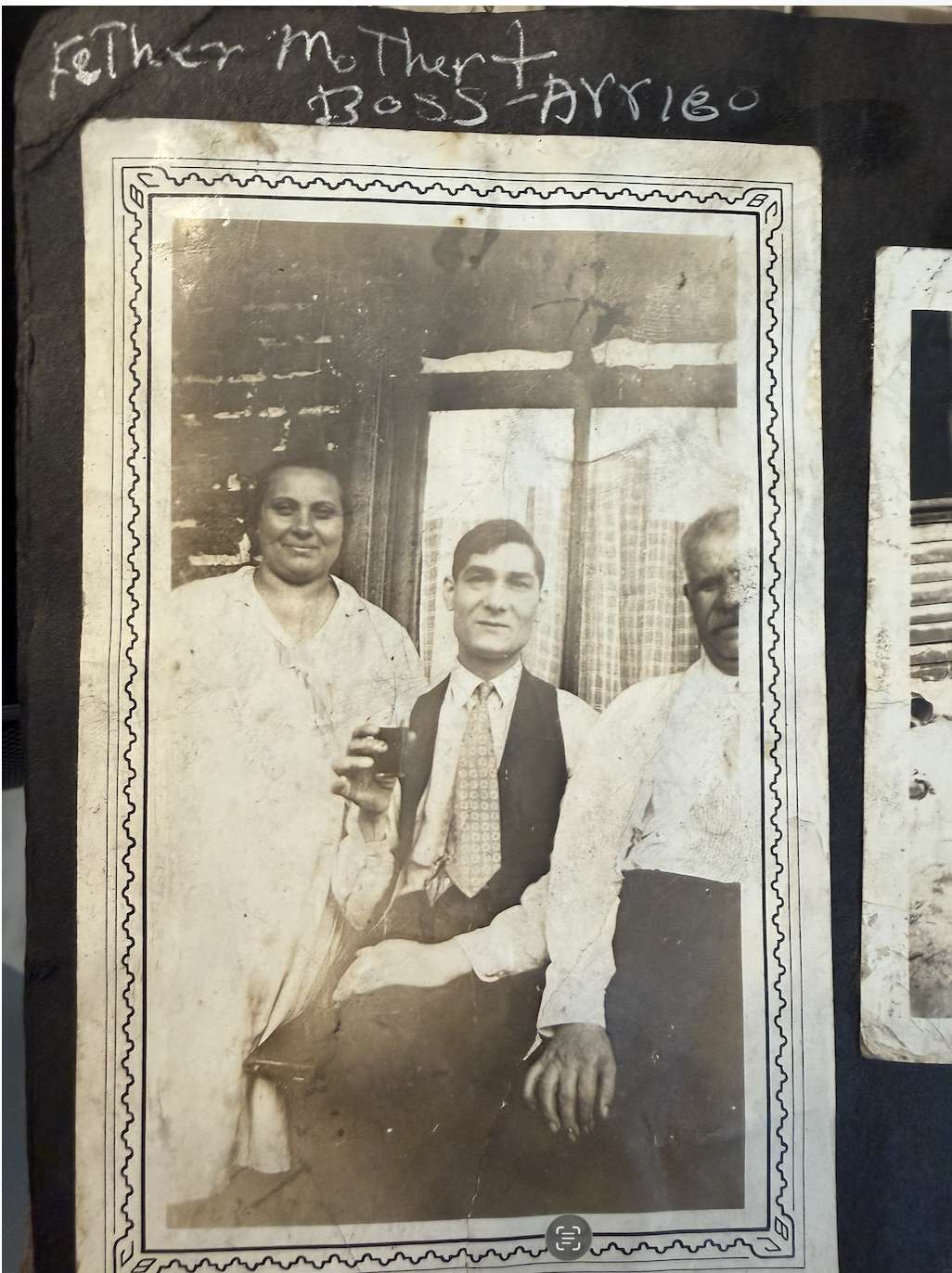
1929, Little Italy, Chicago. © 2026 Anastasia Ashman
The handwritten caption above one photograph in my grandmother’s album reads:
Father Mother + Boss Arrigo.
As a child, I would stop at this page and wonder about the final name.
Why Boss?
Boss of what?
The photograph shows my great-grandmother standing beside two seated men. My great-grandfather sits in the middle. The older, mustachioed man on the right is half cut out of frame, and identified only by his surname and title.
Nothing else in the album explains who he was, what authority he held or why my grandmother expected the word Bossto be understood. This is where the project begins: not with something I remember, but with something the family record preserved and could no longer explain.
The photograph preserved the moment, the people, and the title but not the world that made the title meaningful.
Decades passed. Recently, I dug into this photo. My research placed this 1929-dated scene in Chicago on the back porch of my grandmother’s building. For the first time, I looked up the address shown in the Census reports. A mixed-use brick structure on South Racine Avenue with a four story wooden porch on the rear. Two Sicilian Arrigo brothers purchased the property in 1910 and lived there with their families. My great-grandparents rented an apartment in the building for decades. It stood on a major commercial artery between in Chicago’s Near West Side, in the immigrant neighborhood called Little Italy. The building still stands today and is landmarked on the National Register of Historic Places as the Jennie Foley-Victor A. Arrigo Building.
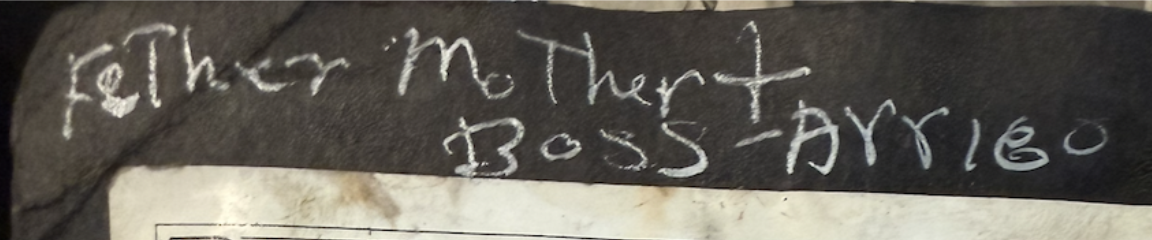
My grandmother’s scrawl
Those facts answered where the photograph had been taken and established one relationship between the families.
They did not explain the caption.
That gap became one of the starting points for my book-in-progress, Family of Mine.
This is not a story passed down. It’s assembled after the fact.
What began as family-history research grew into Family of Mine, a narrative nonfiction investigation using photographs, genealogy, newspapers, government files and physical places to recover a history that survived without its explanation.
This blog shares individual pieces of that investigation. The book connects the larger system; here, each post begins with one photograph, object, document, place, sentence or question.
The first clue was a single word written above a family photograph:
Boss.
Research notes from Family of Mine, a narrative nonfiction investigation using photographs, genealogy, public records and institutional archives to examine migration, informal economies and the making of American respectability.