They Put the Police Chief in a Cell
In January 1929, a sweeping raid on Chicago Heights began not with a still or gambling room, but at the police station. Outside authorities demanded the keys, locked up the police chief when he objected, and took control before moving through the city. Following my family’s businesses block by block, I found myself mapping something else too: local power.
Chicago Heights, Illinois, 1929. A federal raid began with the local police.
A Town I'm Reconstructing
There's a railroad running north to south through Chicago Heights, Illinois, about thirty miles south of Chicago.
I've been building a map of the town from the records connected to my family. Groceries, butcher shops, restaurants, filling stations, hotels, saloons and clubs. The businesses were often connected through people as well as commerce.
Some addresses appear again and again, in different decades and different documents. Put them on a map and you can see how much activity was concentrated within walking distance.
Much of that Chicago Heights is gone.
But the police station is still in the same location, near the railroad tracks.
I hadn't paid much attention to it until I came across a newspaper report from January 1929.
The Police Station Was the First Target
On January 7, 1929, the Capital Journal in Salem, Oregon, reported a major raid on Chicago Heights.
The operation involved 100 federal agents and twelve squads of Chicago police. They had assembled at dawn on Chicago's South Side, carrying warrants prepared after months of investigation.
Their targets included illegal liquor operations and gambling establishments.
The officers didn't begin by searching the saloons, warehouses or other businesses.
They went directly to the local police station.
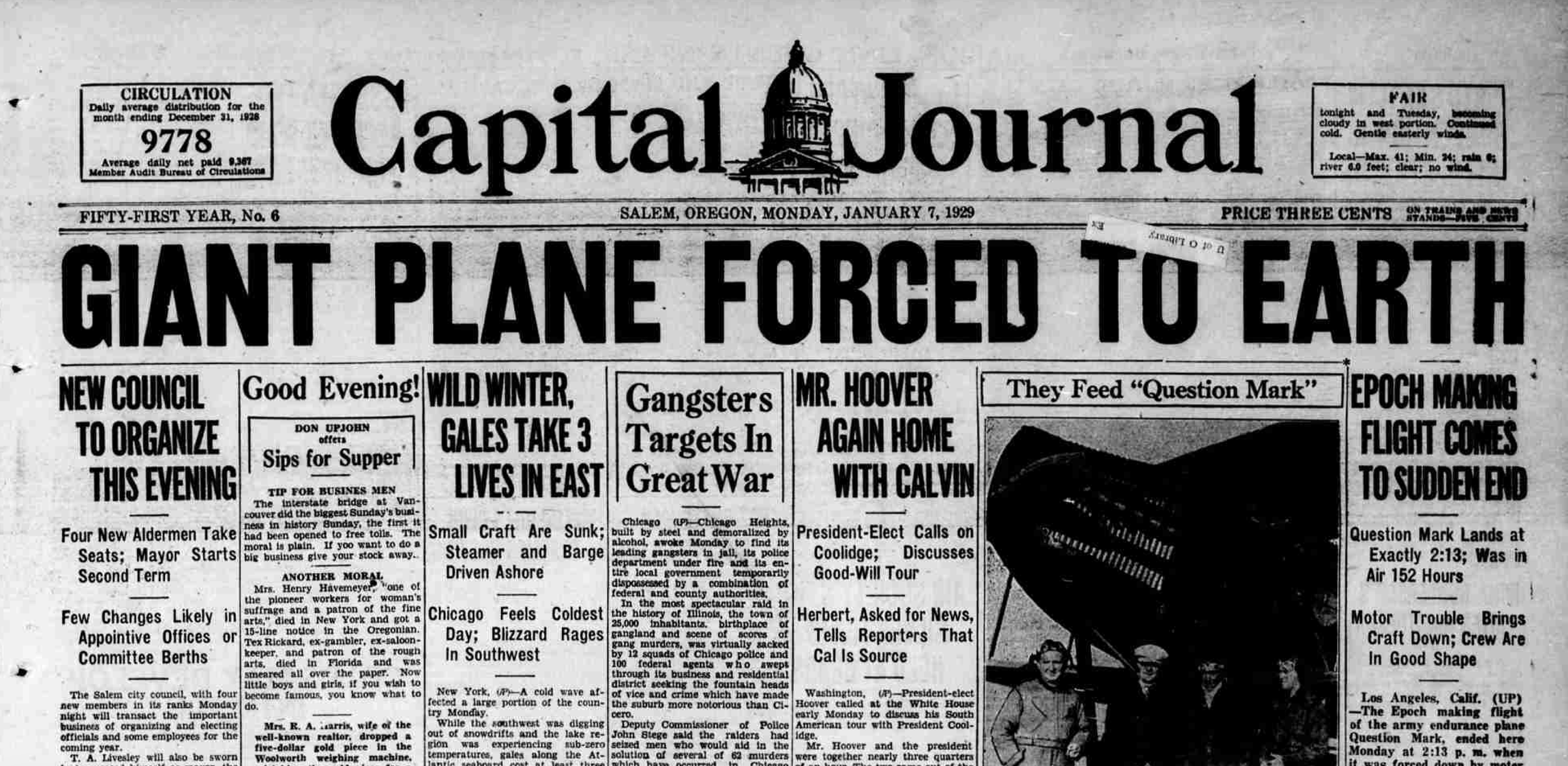
“Gangsters Targets in Great War.” The Capital Journal, Salem, Oregon, January 7, 1929, p. 1. Historic Oregon Newspapers, University of Oregon Libraries.
Chicago Deputy Police Commissioner John Stege demanded the keys to City Hall and the jail.
The Chicago Heights police chief objected.
He and his desk sergeant were put in a cell.
Other Chicago Heights officers were detained as they arrived at the station or returned from their beats.
With the local police temporarily in custody, the outside officers conducted searches across the city. The newspaper reported twenty homes forcibly entered and the seizure of weapons and ammunition.
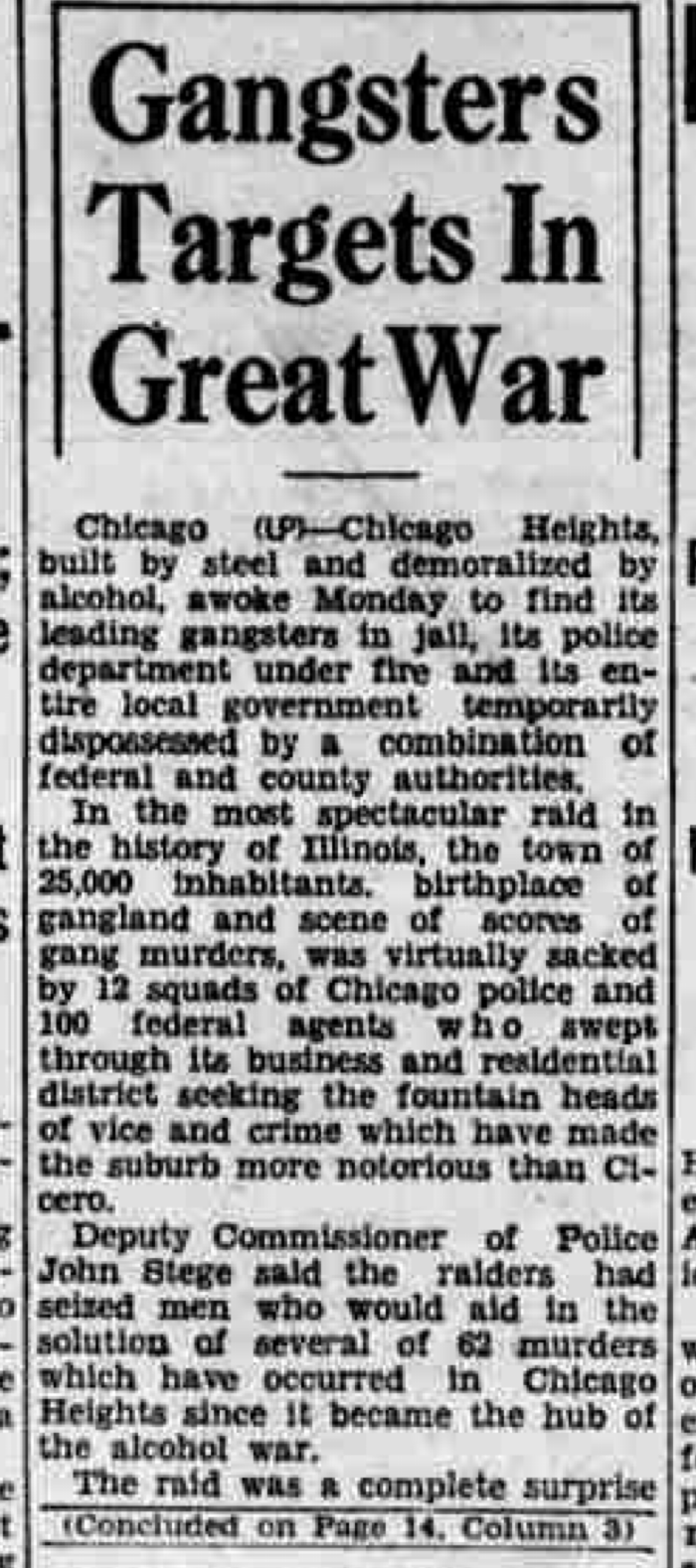
“Gangsters Targets in Great War.” The Capital Journal, Salem, Oregon, January 7, 1929, p. 1. Historic Oregon Newspapers, University of Oregon Libraries.
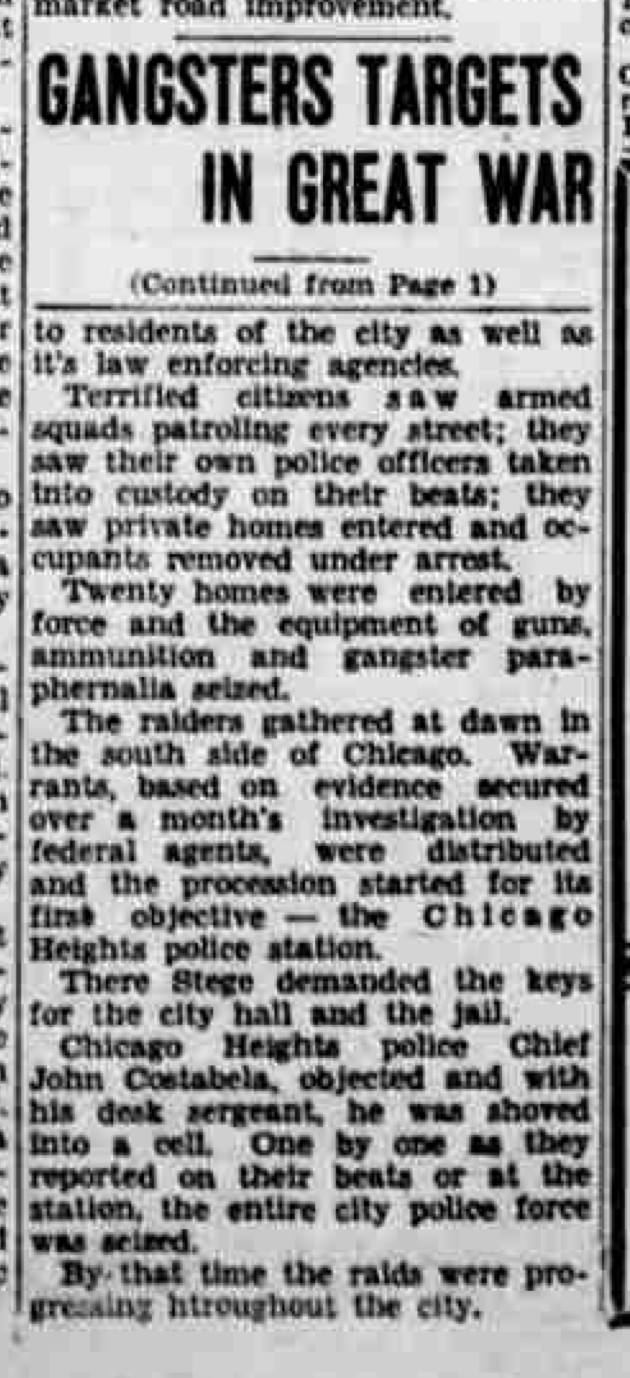
The raiders' arrival at the Chicago Heights police station, the demand for the keys, and the detention of local officers. The Capital Journal, January 7, 1929, p. 14. Historic Oregon Newspapers, University of Oregon Libraries.
Who Was Policing Chicago Heights?
What interests me is the order of operations.
The federal authorities had spent months investigating illegal activity in Chicago Heights. When they were ready to act, one of their first concerns was the local police department.
The newspaper doesn't establish what the Chicago Heights officers knew, why the raiders detained them, or what happened to them afterward.
Those are separate questions.
But the raid makes something visible that is harder to find in ordinary business records: a conflict between the authorities responsible for enforcing the law in the same territory.
That's especially interesting to me because my research has moved well beyond identifying individual relatives. I'm reconstructing the economic and social world in which they lived, including the businesses, relationships and arrangements that made that world function.
The municipal government was part of it.
Police departments, local officials and city institutions exercised authority over the same streets where those businesses operated.
On that January morning, outside officers arrived and took control of the local police station before proceeding with their searches.
The report doesn't name any of my relatives. Nor does it explain the relationship between Chicago Heights government and the commercial world I'm tracing.
But it gives me another set of questions to bring to the records.
I can locate businesses on a map. I can follow proprietors, employees and customers from one address to another.
Now I want to know who held power over those streets, how that power was exercised, and whose interests it served.
The FBI Was Interested in the Beauty Salon
A problem with following my family through public records is that the records rarely stay inside the family.
A name leads to an address.
The address leads to a business.
The business leads to somebody else.
That is how I ended up deep in a federal file, staring at the name of a beauty salon.
Park Lane Beauty Salon.
Then it appeared again.
1135 West 127th Street
Park Lane was at 1135 West 127th Street in Calumet Park, just south of Chicago.
The first time I saw it in the file, I barely registered it.
There were hundreds of pages. Names, addresses, cars, telephone calls, businesses, trips.
A beauty salon did not seem particularly important.
Then the FBI mentioned it again.
And again.
By October 1964, an investigator for the Illinois Crime Commission had gone into Park Lane looking for a woman connected to the file.
He interviewed one of the employees.
She gave him almost nothing.
The woman he wanted, she said, was vacationing in Italy.
Then she refused to tell him her name.
That was the entire exchange.
And it made it into the federal record.
I keep coming back to it.
An investigator walks into a neighborhood beauty salon asking questions.
An employee tells him that the person he wants is on another continent.
Then she stops talking.
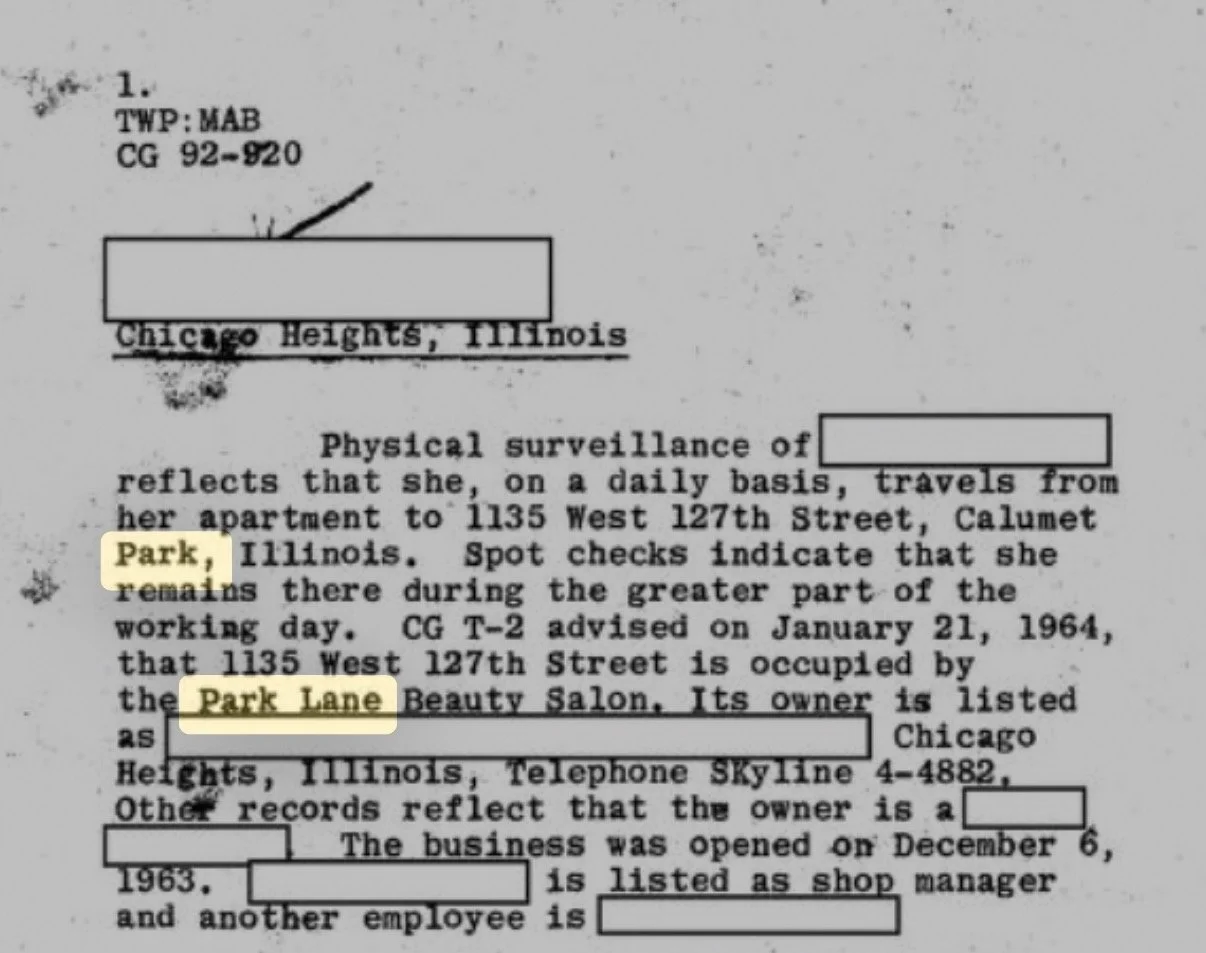
An FBI report records daily travel to Park Lane Beauty Salon and notes that the business opened Dec. 6, 1963. FBI File 92-5793, Chicago Field Office File 92-920. Federal Bureau of Investigation. Scan via Internet Archive. Emphasis my own.
The file preserves the refusal.
The salon kept coming back
Once I noticed Park Lane, I started seeing it everywhere.
A report noted who managed it.
Another recorded where that person was living.
Another described who was believed to own the business.
Another put the license in somebody else's name.
Investigators went to the salon looking for people.
Informants talked about its customers.
Travel appeared.
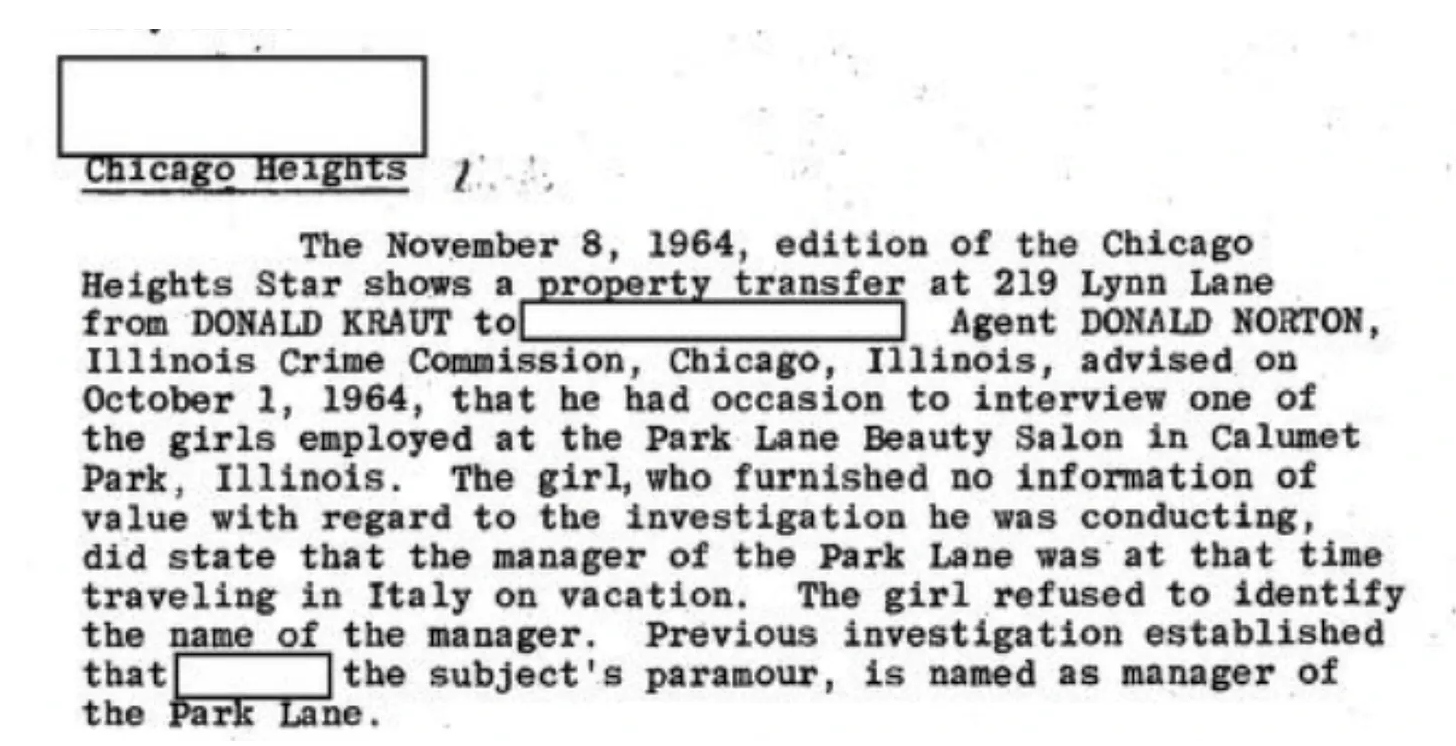
An FBI report records Illinois Crime Commission investigator questioning an employee of Park Lane Beauty Salon in October 1964. FBI File 92-5793, Chicago Field Office File 92-920, report dated Dec. 18, 1964, p. 8. Federal Bureau of Investigation. Scan via Internet Archive.
Telephone calls appeared.
So did local gossip.
None of these fragments explains the salon by itself.
Together, they made me realize I had been reading the file incorrectly.
I had been looking for events.
The file was recording relationships.
A perfectly ordinary business
A beauty salon is an unusually intimate kind of neighborhood business.
People sit there for an hour.
They talk.
They know who has gone away, who is back, who is seeing whom, who has moved, who owns what.
They notice cars.
They notice absences.
They know who has gone to Italy.
The FBI file does not call any of that an archive.
But it becomes one.
The Bureau collected information from employees, investigators, informants and business records.
It noted addresses.
It noted movements.
It noted who could be found where.
And then, in the middle of all that, a woman working in a beauty salon says the manager is in Italy.
No, she will not tell you her name.
That sentence survives more than sixty years.
Looking past the obvious records
When I started Family of Mine, I thought the useful records would be the obvious ones.
Birth certificates.
Marriage records.
Census pages.
Immigration files.
Property records.
The documents designed to tell you who someone was.
But the further I go, the more interested I become in records that were never meant to preserve a family story at all.
A photograph keeps a street.
A death record keeps a workplace.
And a federal file keeps a beauty salon.
Not because anyone thought I would come looking for it.
Because somebody once asked a question there.
And somebody else decided not to answer.
The Records Around the Family
Family history research doesn't stop with names and dates. In the archives of Chicago Heights and beyond, I began finding the businesses, neighborhoods, relationships, and institutions that surrounded my relatives, and a much larger history than the one my family passed down.
One afternoon, I read every death certificate filed in Chicago Heights, Illinois, in 1928.
I was researching relatives who had lived and worked in this industrial town south of Chicago. But I wasn't looking for one particular name that day. I wanted to know more about the place itself.
The certificates recorded causes of death, ages, and inquests. Some contained the verdict "person or persons unknown." That phrase appeared repeatedly.
Reading the certificates together gave me a different view of Chicago Heights from the one I could have assembled by collecting records for individual relatives.
It also raised questions about the town my family had known, and the conditions in which they had lived.
The Places Between the Records
Much of my research for Family of Mine begins with a person. But following that person often takes me somewhere unexpected.
In 1924, my cousin Dominic, a Chicago Heights bootlegger and jazz-club owner, married Rae, a Kentucky singer who worked for him.
They married in Jeffersonville, Indiana, across the Ohio River from Louisville. No family or friends appear to have been present.
Why Jeffersonville?
Learning that the town had a thriving quickie-marriage business gave me some context. It didn't explain their decision, but it made the location itself worth investigating.
The marriage was no longer just an event in two people's lives. It belonged to a particular place, with its own customs and commercial arrangements.
I am finding this happens frequently. An address or business name that initially seems incidental turns out to be worth following.
What a Photograph Doesn't Explain
My inherited family albums contain photographs of people whose names I know, people I have identified through research, and people I still cannot place.
One cherished wedding portrait remains unidentified. I initially thought I knew who the couple were. I was wrong.
A newly discovered relative circulated the photograph among other family members. Another woman sent a wedding portrait from her own family, dated 1922, for comparison.
The collars suggested that my photograph was earlier.
That was useful. It also meant reconsidering the people I had thought might be in it.
Photographs can be persuasive, especially when they belong to your own family. But recognizing a face, guessing a date, or believing you know the occasion is not the same as establishing an identification.
Sometimes the useful result of research is eliminating an answer.
What Was Within Walking Distance?
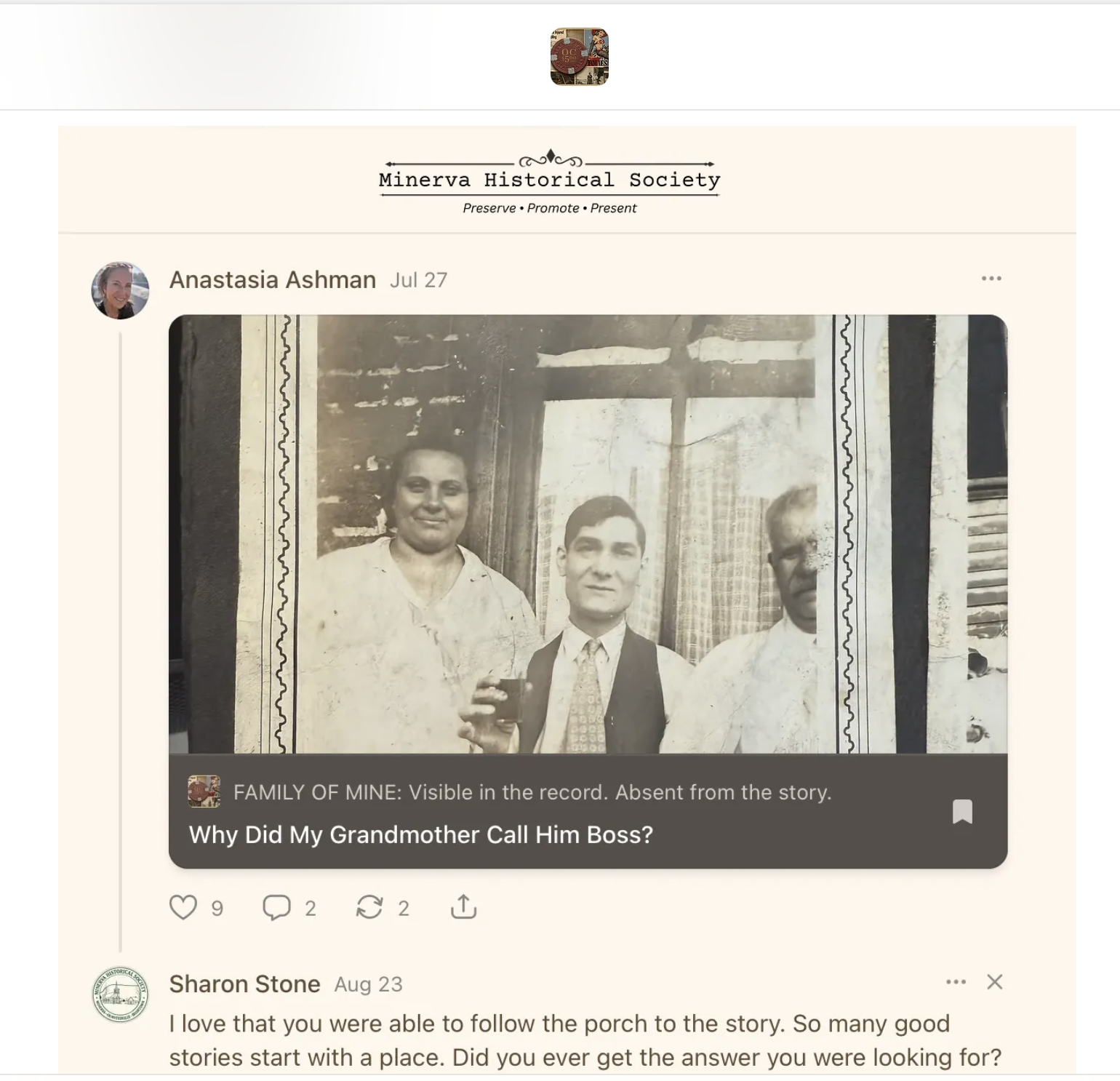
One photograph in my grandmother's albums shows my Calabrian great-grandparents on a Chicago porch in 1929.
A handwritten caption identifies their Sicilian landlord as Boss Arrigo.
That name, and particularly the word Boss, sent me looking beyond the people in the photograph.
Who was Arrigo? What did he own? Who lived in his building? What did the neighborhood look like at the time?
I've become interested in reconstructing the geography around my relatives. Not just their addresses, but the businesses, properties, and other people within walking distance.
A neighborhood map can bring relationships into view that are difficult to recognize when each person appears on a separate family-history record.
It doesn't establish that everyone knew everyone else. Proximity is something to investigate, not proof of a relationship.
But it gives me a more useful question to ask than simply whether two people shared a surname.
The Family Story I Didn't Inherit
My grandfather's novena cards are another kind of evidence.
He collected them at daily Mass and put them everywhere, including inside the frames of family photographs. Eventually, the cards obscured our faces.
We used to think this was primarily an expression of his religious devotion. Now I understand it as a way he expressed his love and concern for us.
No official document would have told me that. I needed the family photographs, the objects themselves, and my memory of how he used them.
Other parts of the family history require an almost opposite approach. There are people, businesses, and relationships preserved in public records that barely registered in the stories I grew up with.
A relative who married a rodeo queen. A family business documented by the Library of Congress. People who lived only a couple of hours away and were never part of our family life.
I can establish that they existed and that we were related. Understanding why I knew nothing about them is more difficult.
Beyond the Family Tree
Family of Mine began as an attempt to reconstruct a South Italian family history across generations and continents.
The family tree is essential to that work. But it cannot account for the world in which these people lived.
For that, I have needed property records, city directories, newspapers, court documents, photographs, death certificates, maps, and government investigative files. I have also needed to return repeatedly to the albums and interviews I inherited.
The question has changed as the research has developed.
I still want to know who these people were and what happened to them. I also want to understand the businesses they operated, the institutions they dealt with, the neighborhoods they inhabited, and the forms of power they lived alongside.
Some of this history was recorded in considerable detail.
It just wasn't passed down to me.
That is the distance I'm trying to close.
For a look at the discoveries and fellow researchers that sent me back to these records, read Back to the Archive: When the Clues Started Connecting.
308 Nightclubs for 14,000 People
I knew nothing about Calumet City until my family story led me to nearby Chicago Heights.
Calumet City sits right on the Illinois-Indiana state line, in the middle of a region I had mostly understood through industry: steel mills, factories, rail lines, refineries, workers moving back and forth across municipal boundaries that meant less economically than they did on a map.
Then I found a January 1941 spread in Life about Calumet City nightlife.
Population: 14,000.
Bars and taverns: 308.
That works out to almost one drinking establishment for every forty-five residents.
I grew up in a university town with more coffee shops than bars, so perhaps my scale is distorted. But 308 still seemed like a lot.
Way too many for the local population alone.
Which made me stop looking at the clubs themselves and ask a different question.
Who was keeping them in business?
The answer started to come into focus when I looked at what surrounded Calumet City and Chicago Heights.
Steel mills. Factories. Rail yards. Industrial plants. Thousands of men working shifts that started and ended at all hours.
This was not a nine-to-five landscape.
A worker finishing late at night did not necessarily want to go home to bed. Someone getting off before dawn did not need entertainment to wait until evening.
And apparently it didn’t.
One of the musicians working the Calumet City circuit was Sun Ra.
I once got to see him at the Village Vanguard in New York. Sun Ra!
Years later, he remembered playing the Calumet City clubs from evening until nearly dawn. The schedule sounds punishing from the musician’s side. The shows were staggered, so when one club paused for an intermission, a performer could move to another and play there.
The entertainment kept circulating.
One room slowed down. Another picked up.
The night did not end just because one set did.
That detail made the whole place look different to me.
On one stretch of State Street, twenty-six taverns and nightclubs occupied just two blocks.
Some stayed open for most of the day and night.
Many employed B-girls whose job included getting male customers to buy more drinks.
That is the kind of detail that makes the economics visible.
A customer was not simply buying liquor.
He was buying time.
Liquor. Music. Gambling. Food. Cigarettes. Women. Company. Spectacle.
I had been encountering all of these things separately in the records.
A tavern here. A nightclub there. A gambling room. Jukeboxes. A restaurant. A hotel. A floor show.
Taken one at a time, they looked like nightlife. Together, they began to look like an economy.
And not just any economy, an entertainment economy built right next to the industrial one.
The factories and mills produced wages. They also produced exhaustion, odd hours, transient populations, single men, married men away from home, salesmen, drivers, travelers and workers whose lives were organized around shifts instead of evenings.
The clubs were positioned to absorb some of that money.
Not necessarily in one dramatic night.
A drink here. A meal there. A few songs. A bet. Cigarettes. Another drink. Another room.
The point is not that every steelworker spent his paycheck on State Street.
I cannot know that, and I do not want to invent him.
The point is that an entertainment district this dense had to be feeding on something larger than Calumet City itself.
The industrial belt supplied the customers.
And geography mattered.
If you worked in Chicago Heights or somewhere nearby, you did not have to drive thirty miles into Chicago to find a night out.
Nightlife came to you.
That may be the part I had been missing.
I had been looking at the men who ran things.
The owners. The operators. The gamblers. The people moving liquor, money, machines and influence.
But none of that explains itself.
Supply requires demand.
And around Chicago Heights and Calumet City, industry seems to have created both the money and the schedule for an after-dark economy to thrive.

Getting answers I wasn’t looking for, Summer 2026
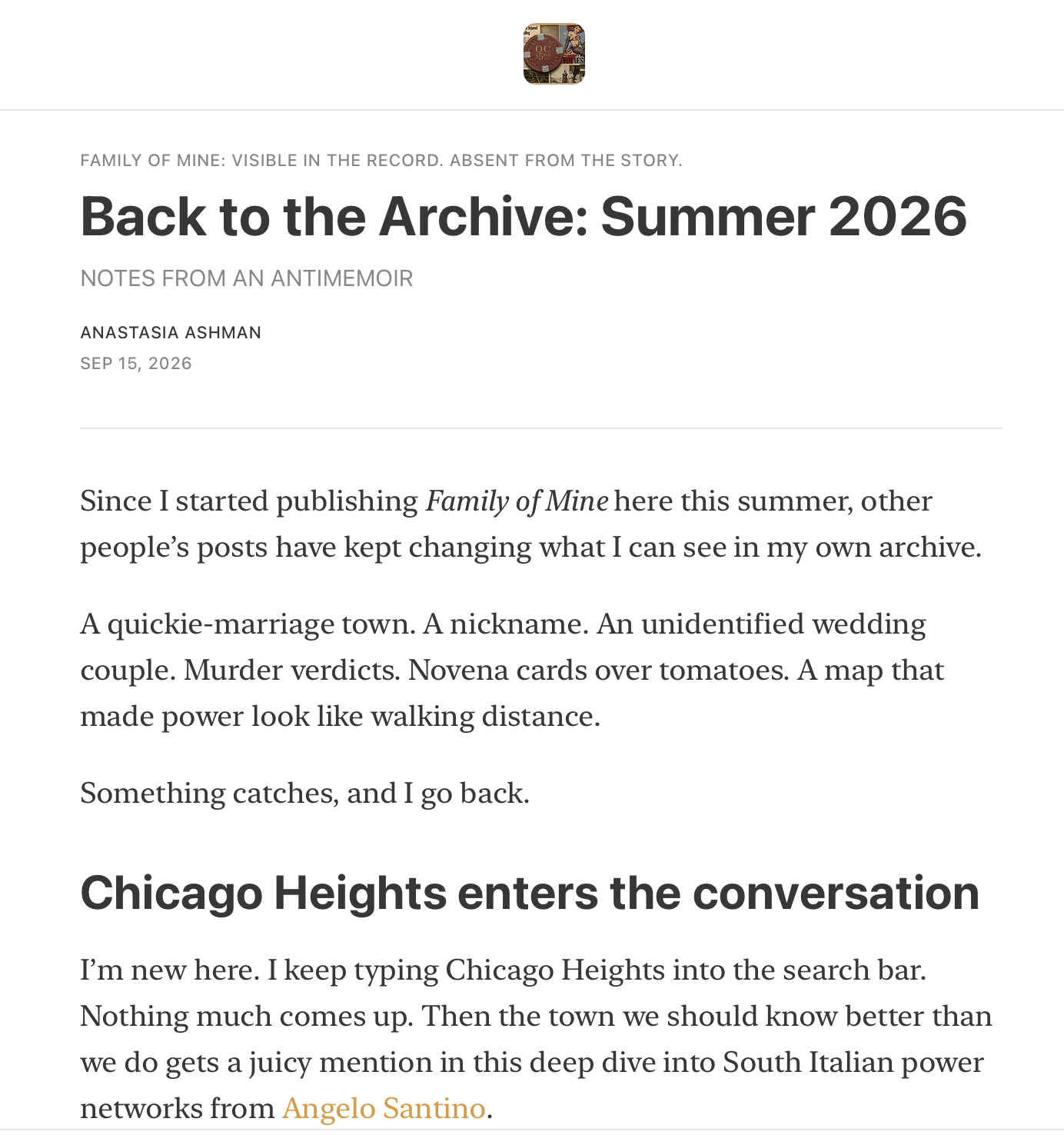
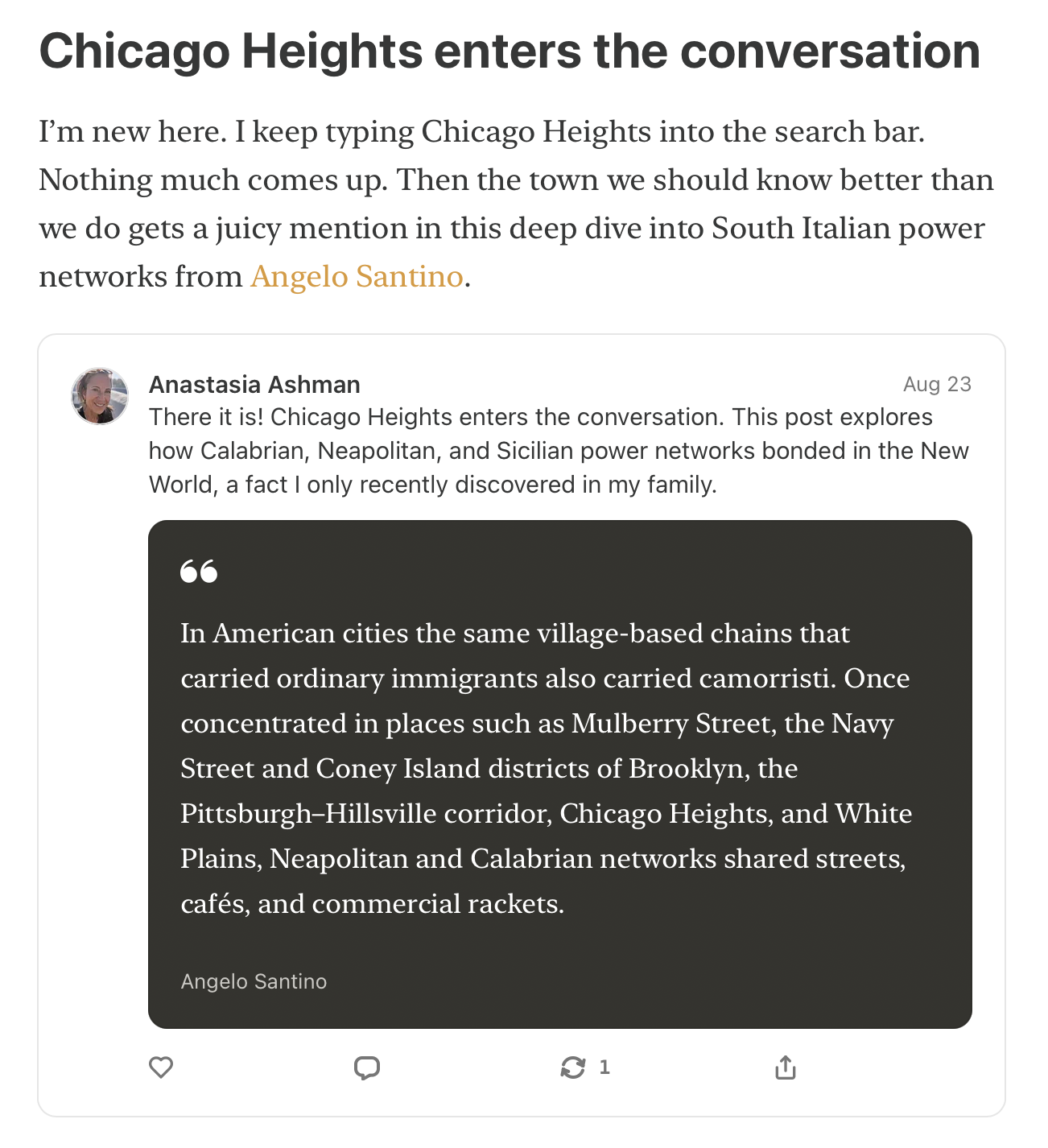
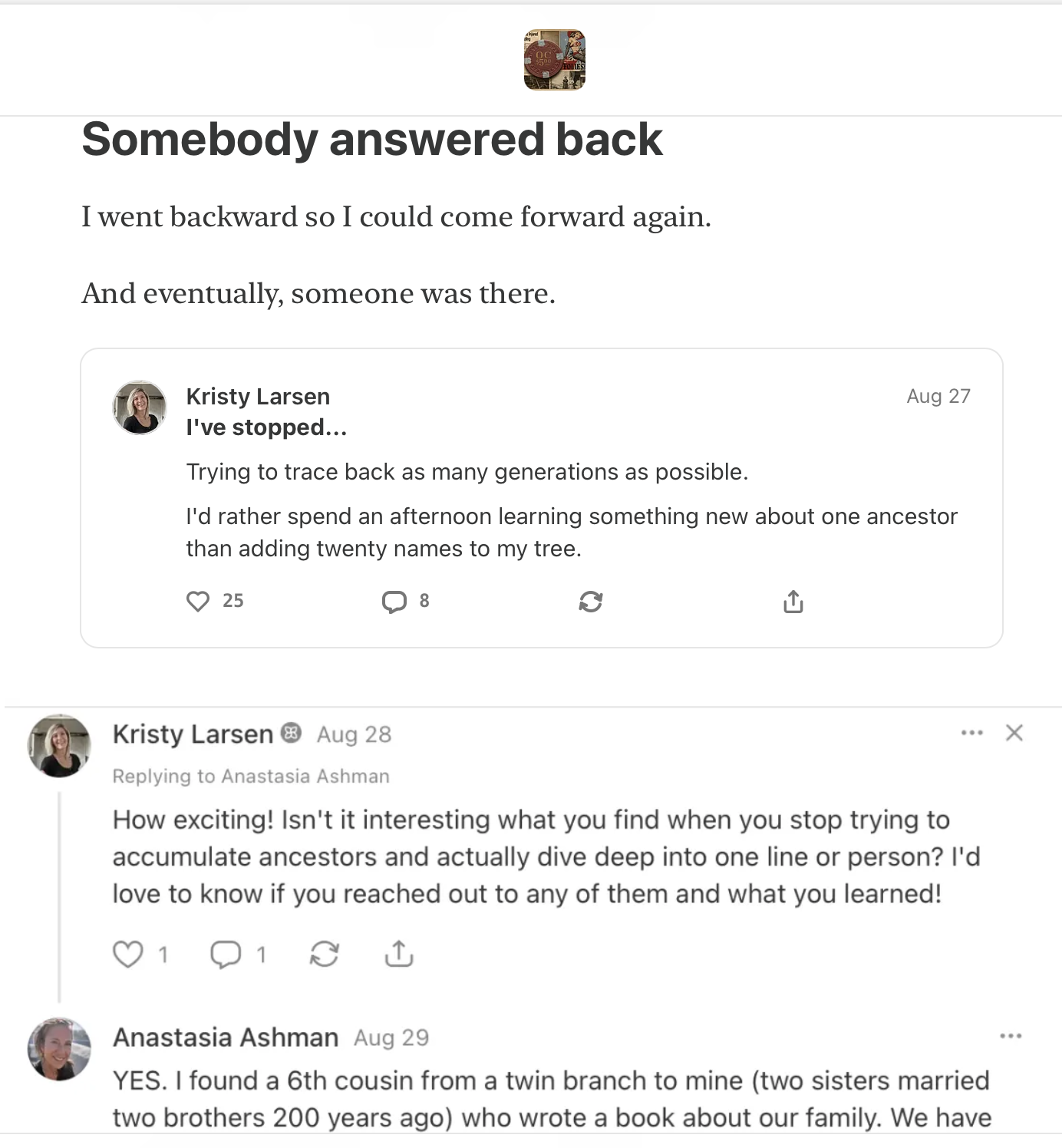
I’m new over on Substack. I keep typing Chicago Heights into the search bar, looking for my people. Nothing much comes up. Then the town we should know better than we do gets a juicy mention in this deep dive into South Italian power networks.
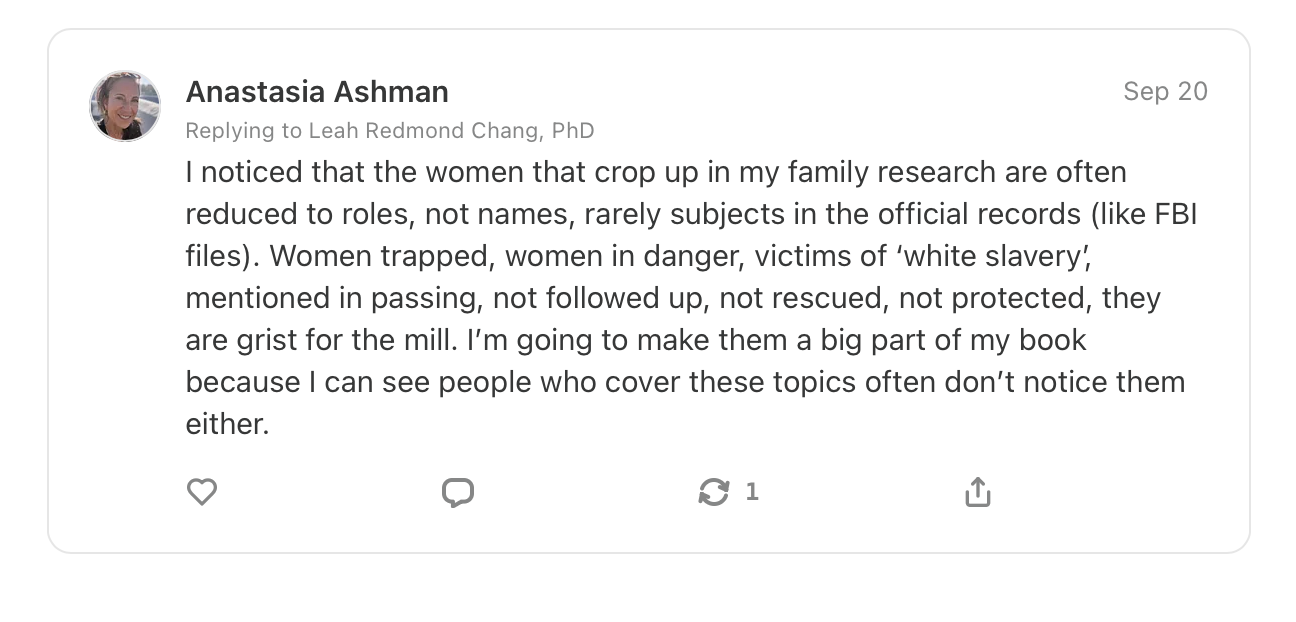
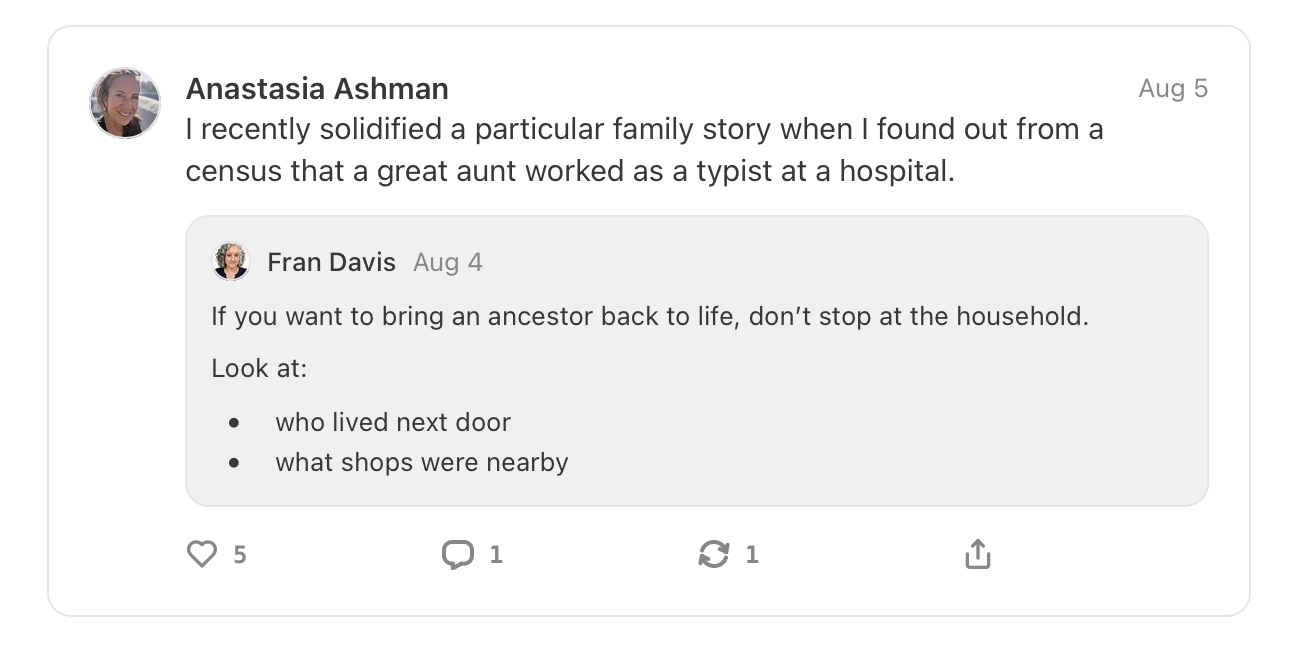
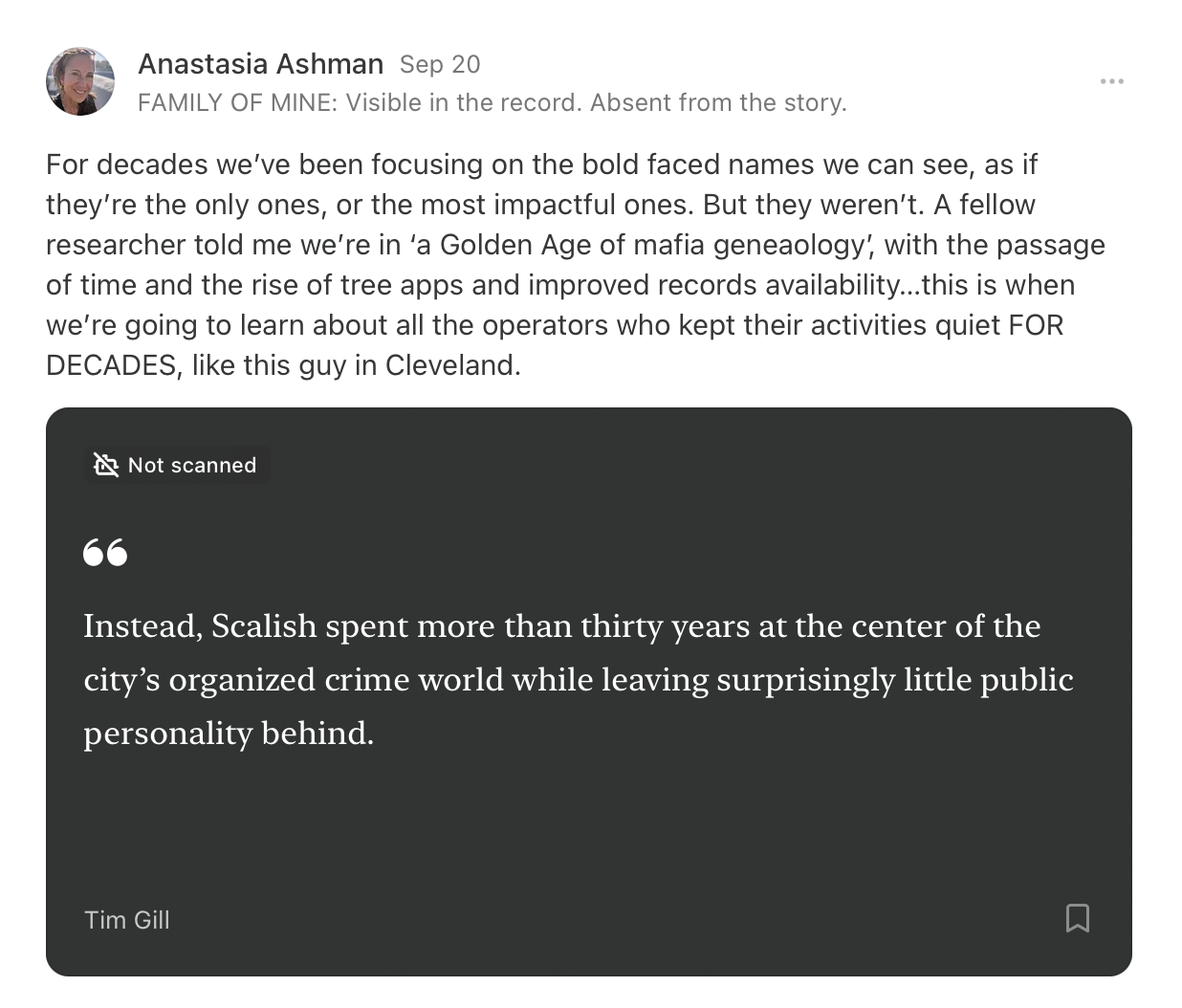
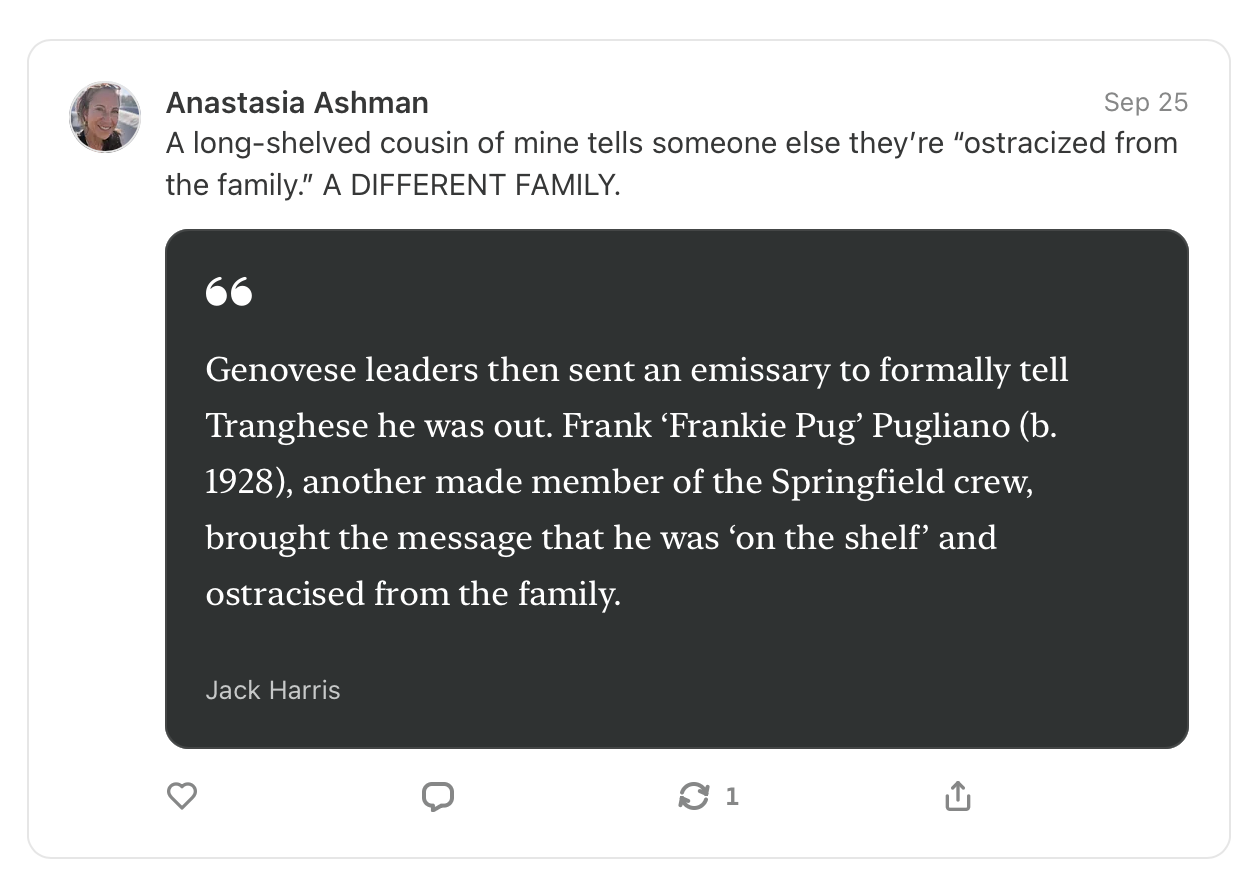
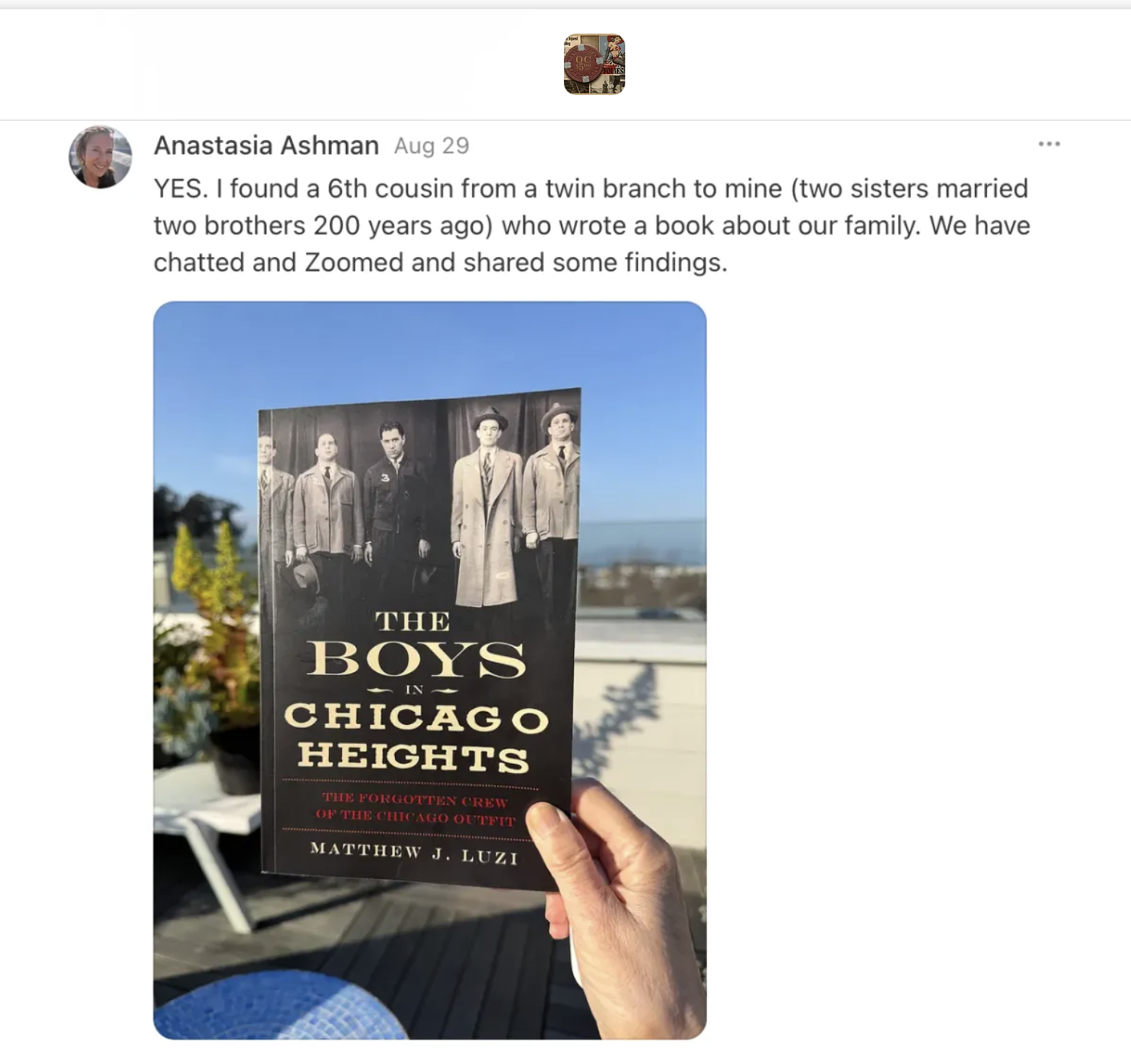
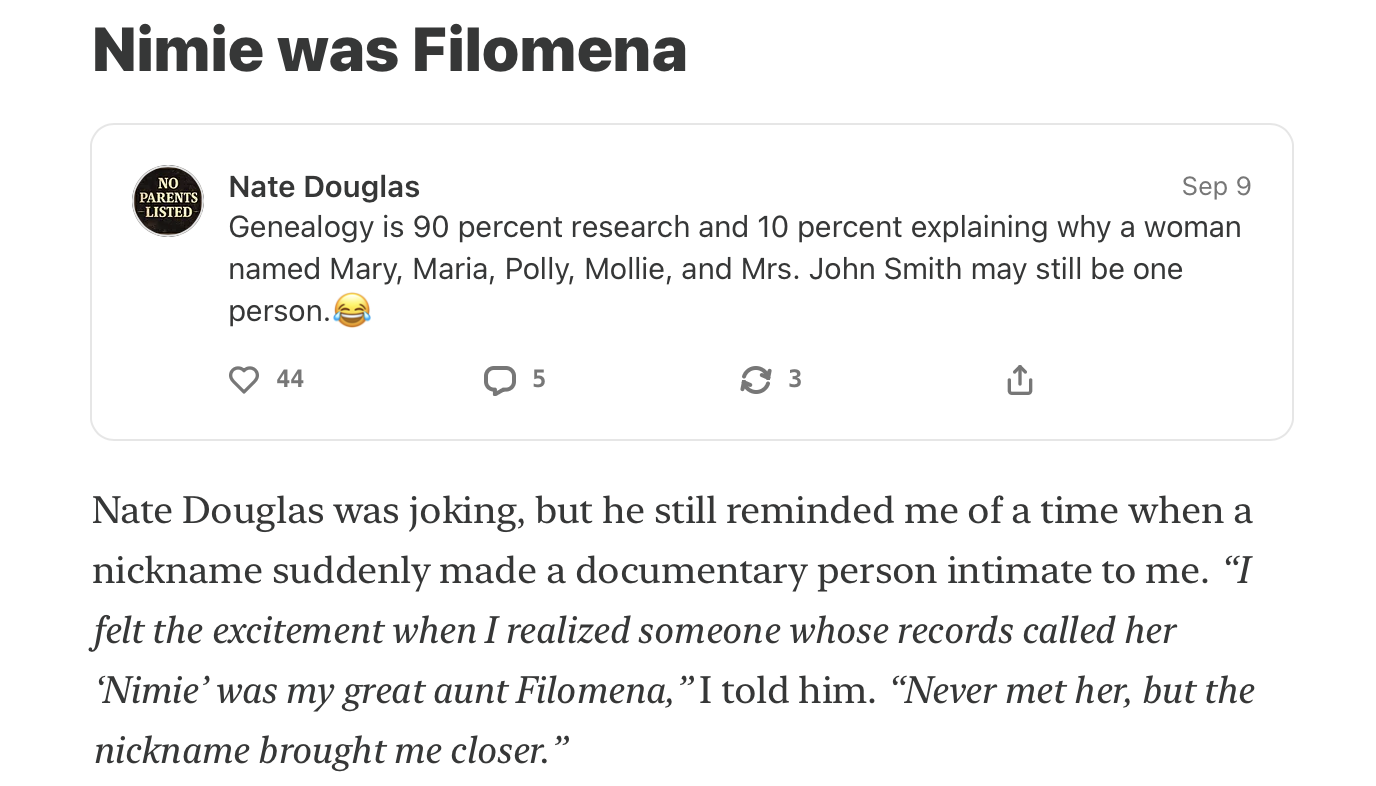
It’s been a season of annotated conversations. Since I started publishing Family of Mine on Substack this summer, other people’s posts have kept changing what I can see in my own archive.
A quickie-marriage town. A nickname. An unidentified wedding couple. Murder verdicts. Novena cards over tomatoes. A map that made power look like walking distance.
Something catches, and I go back.
Here’s where you can read the whole thing at Substack. Please visit!
And here’s a selection from it:
Chicago Heights enters the conversation
I’m new over on Substack. I keep typing Chicago Heights into the search bar, looking for my people. Nothing much comes up. Then the town we should know better than we do gets a juicy mention in this deep dive into South Italian power networks.
Getting an inside look at Jeffersonville
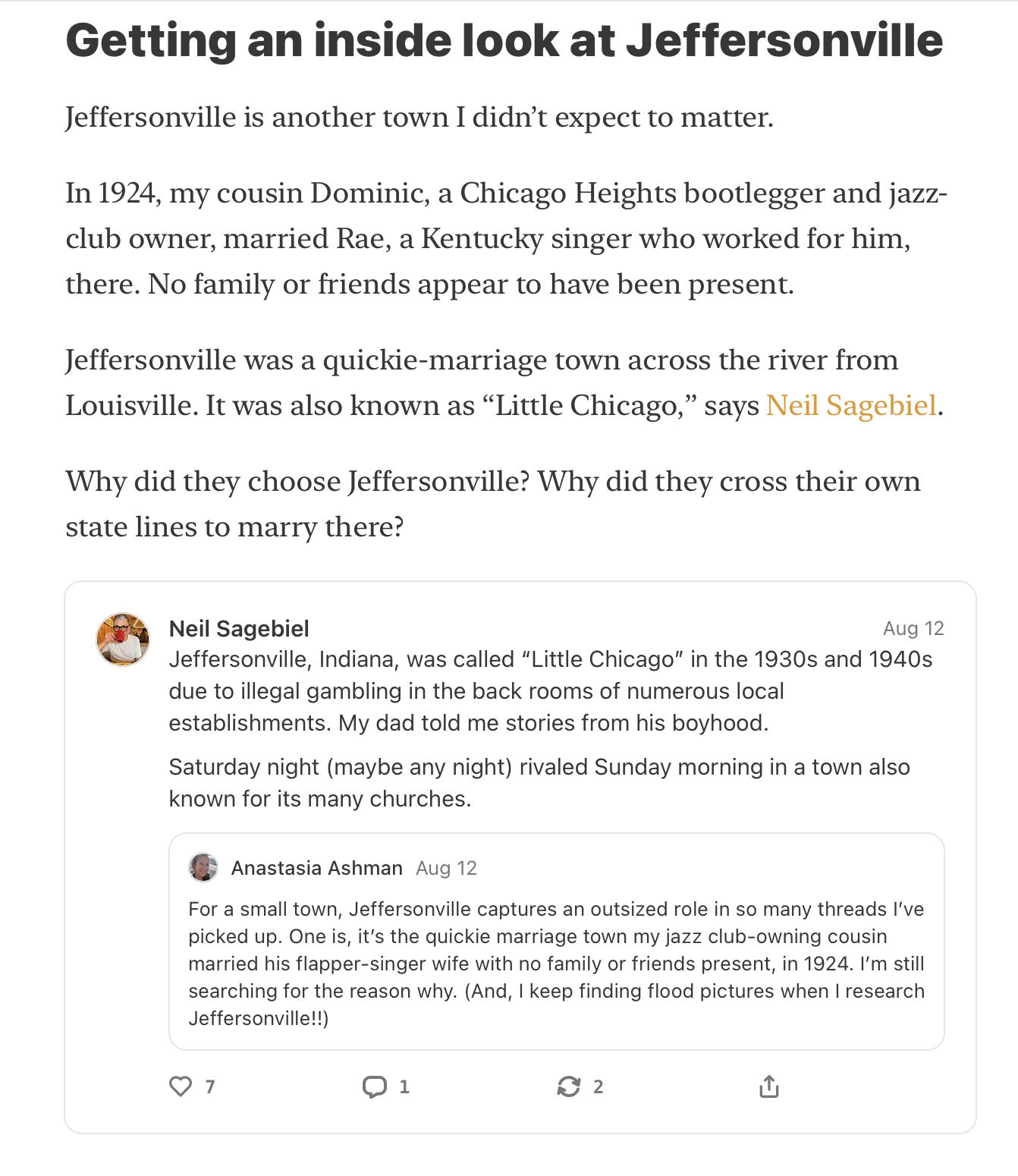
Jeffersonville is another town I didn’t expect to matter.
In 1924, my cousin Dominic, a Chicago Heights bootlegger and jazz-club owner, married Rae, a Kentucky singer who worked for him, there. No family or friends appear to have been present.
Jeffersonville was a quickie-marriage town across the river from Louisville. It was also known as “Little Chicago.”
Why did they choose Jeffersonville? Why did they cross their own state lines to marry there?
For a small town, Jeffersonville captures an outsized role in so many threads I’ve picked up. One is, it’s the quickie marriage town my jazz club-owning cousin married his flapper-singer wife with no family or friends present, in 1924. I’m still searching for the reason why. (And, I keep finding flood pictures when I research Jeffersonville!!) - me
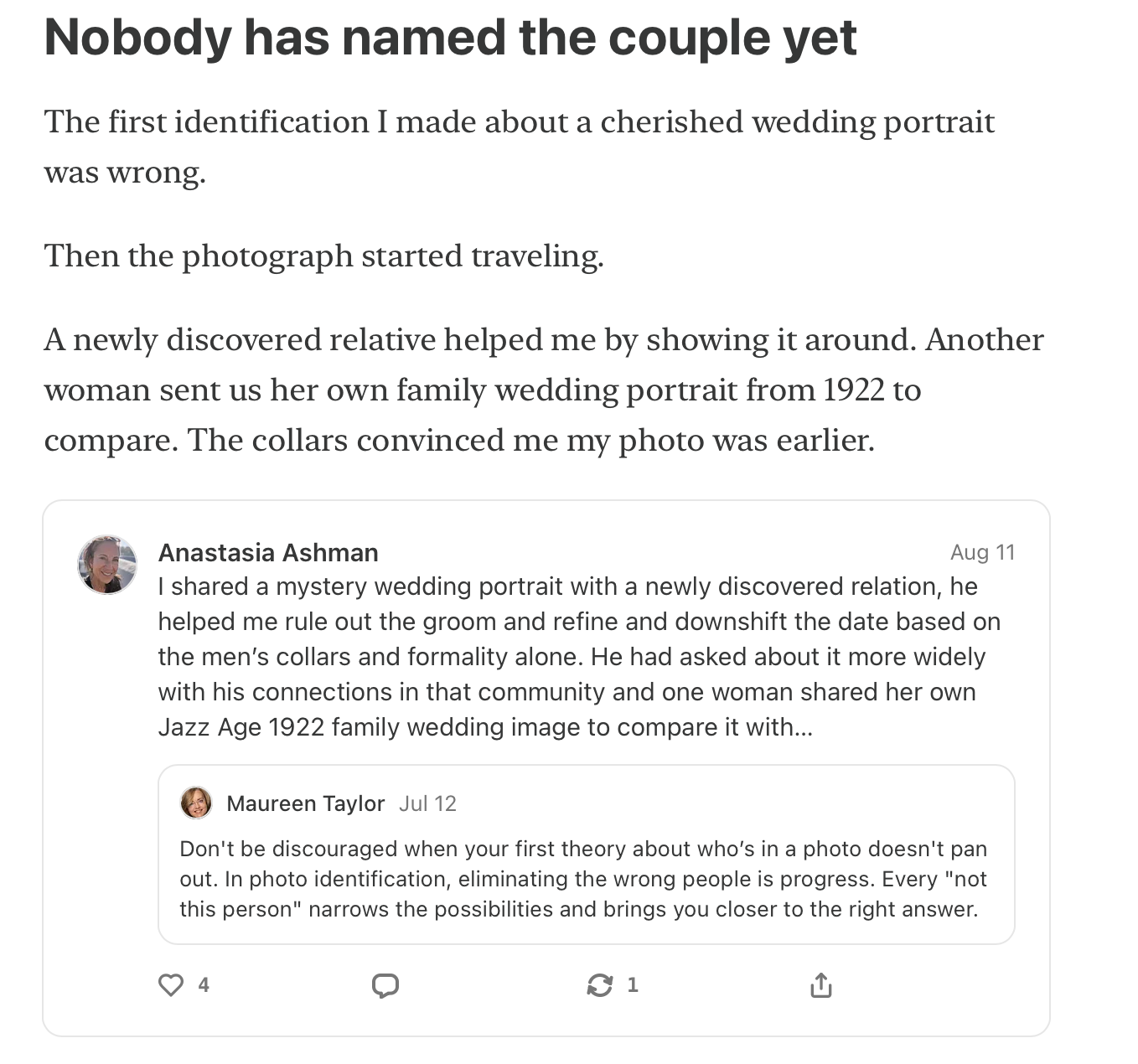
Nobody has named the couple yet
The first identification I made about a cherished wedding portrait was wrong.
Then the photograph started traveling.
A newly discovered relative helped me by showing it around. Another woman sent us her own family wedding portrait from 1922 to compare. The collars convinced me my photo was earlier.
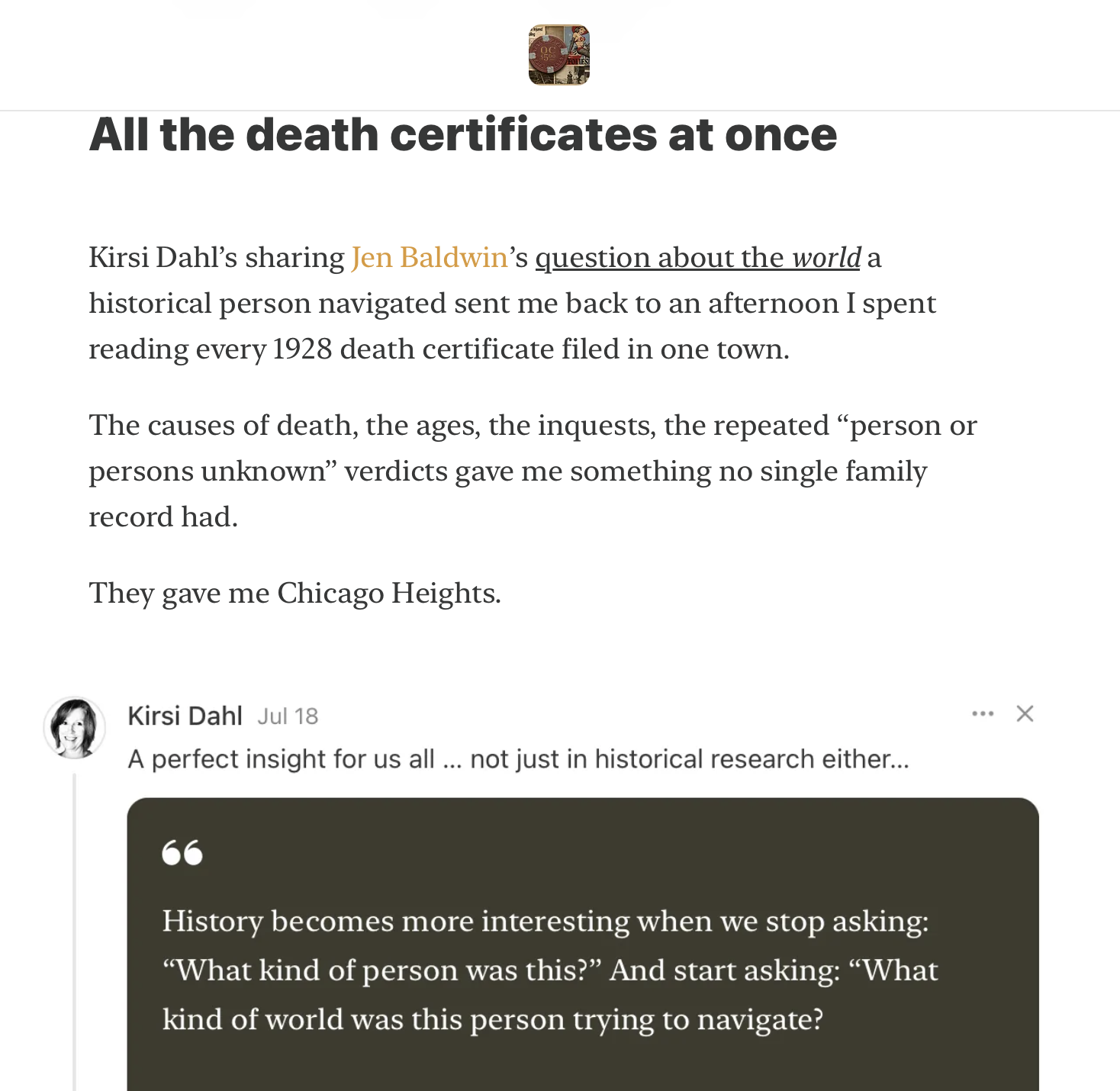
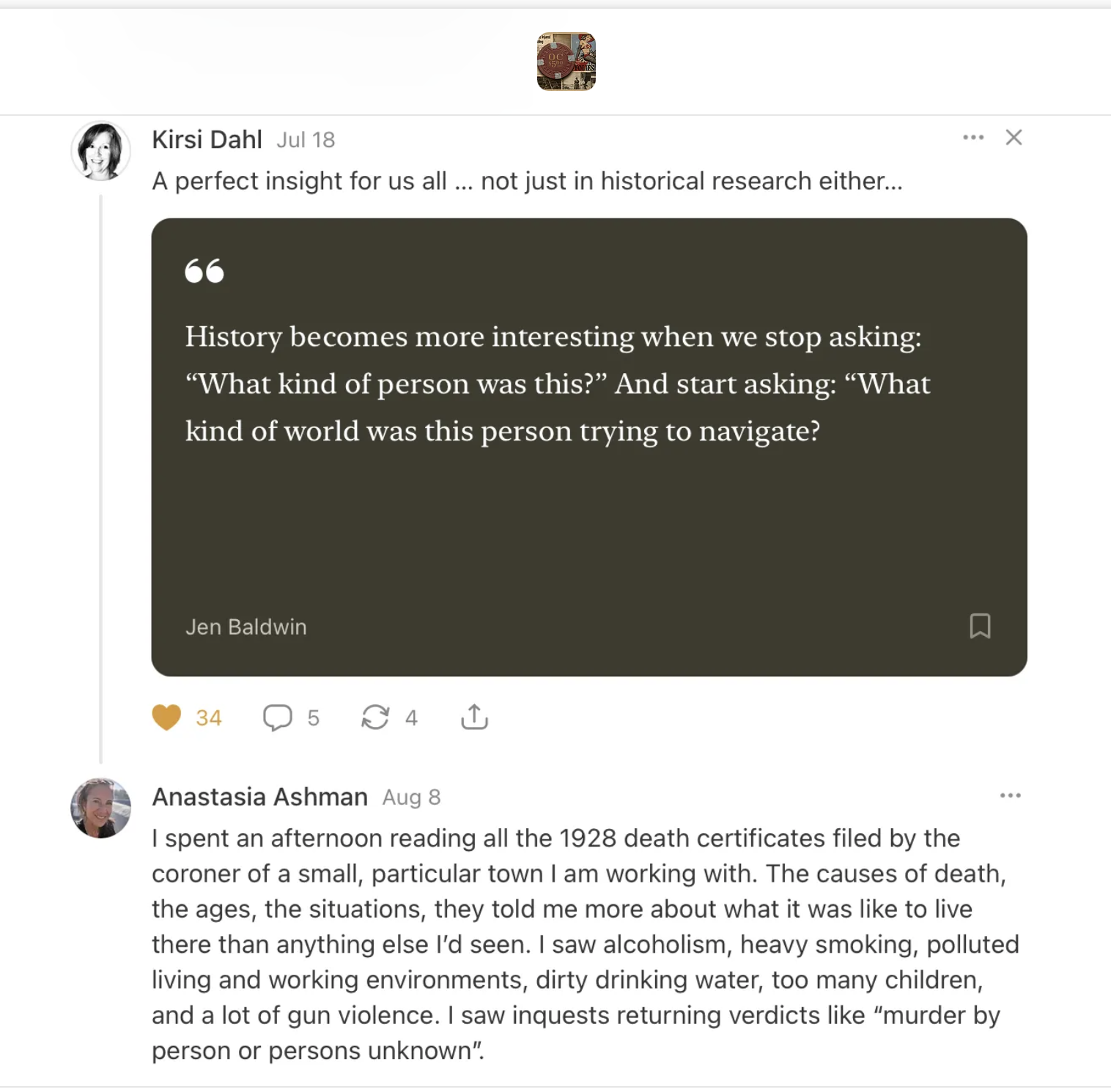
A question about the actual world a historical person navigated sent me back to an afternoon I spent reading every 1928 death certificate filed in one town.
The causes of death, the ages, the inquests, the repeated “person or persons unknown” verdicts gave me something no single family record had.
They gave me Chicago Heights.
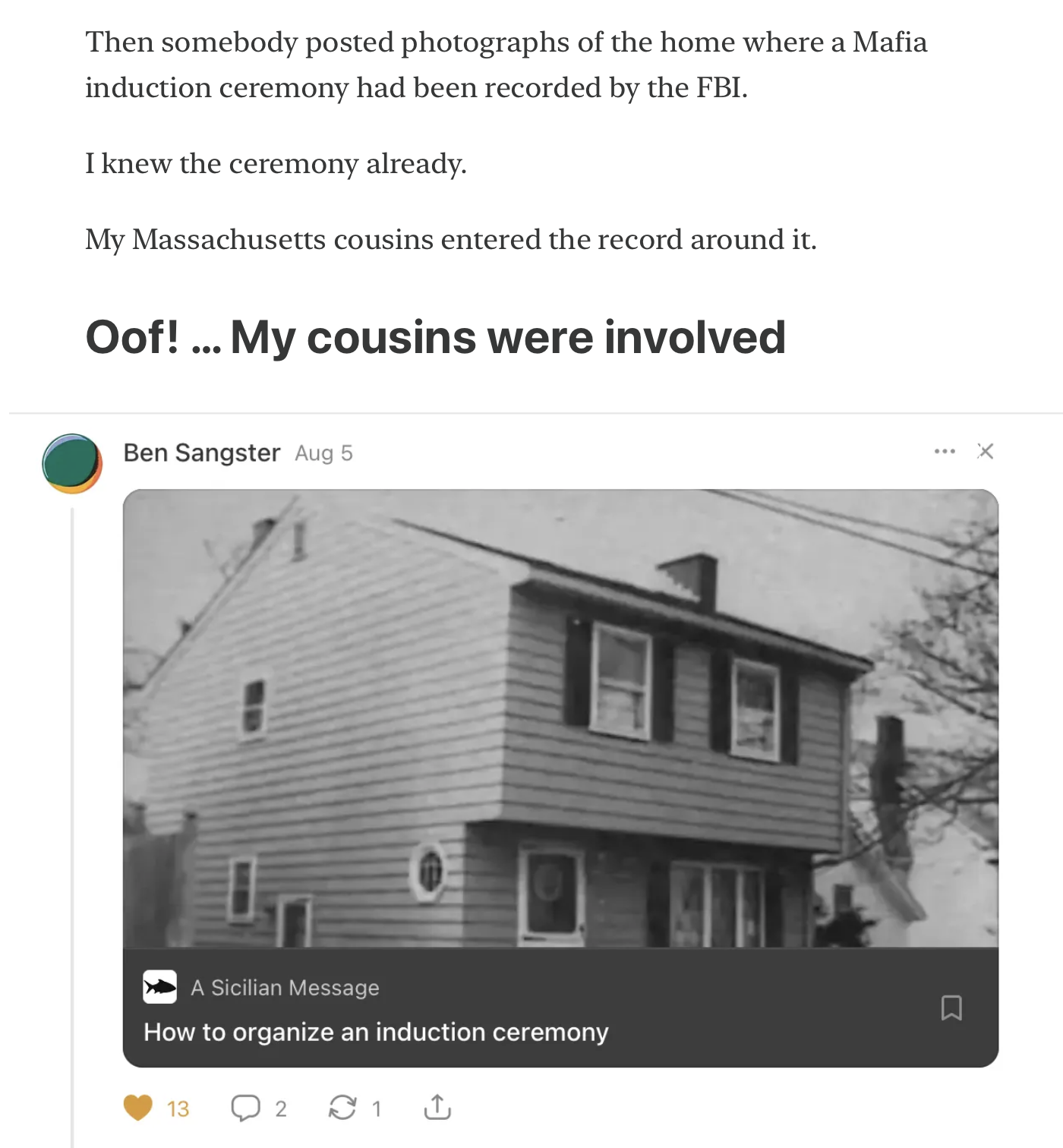
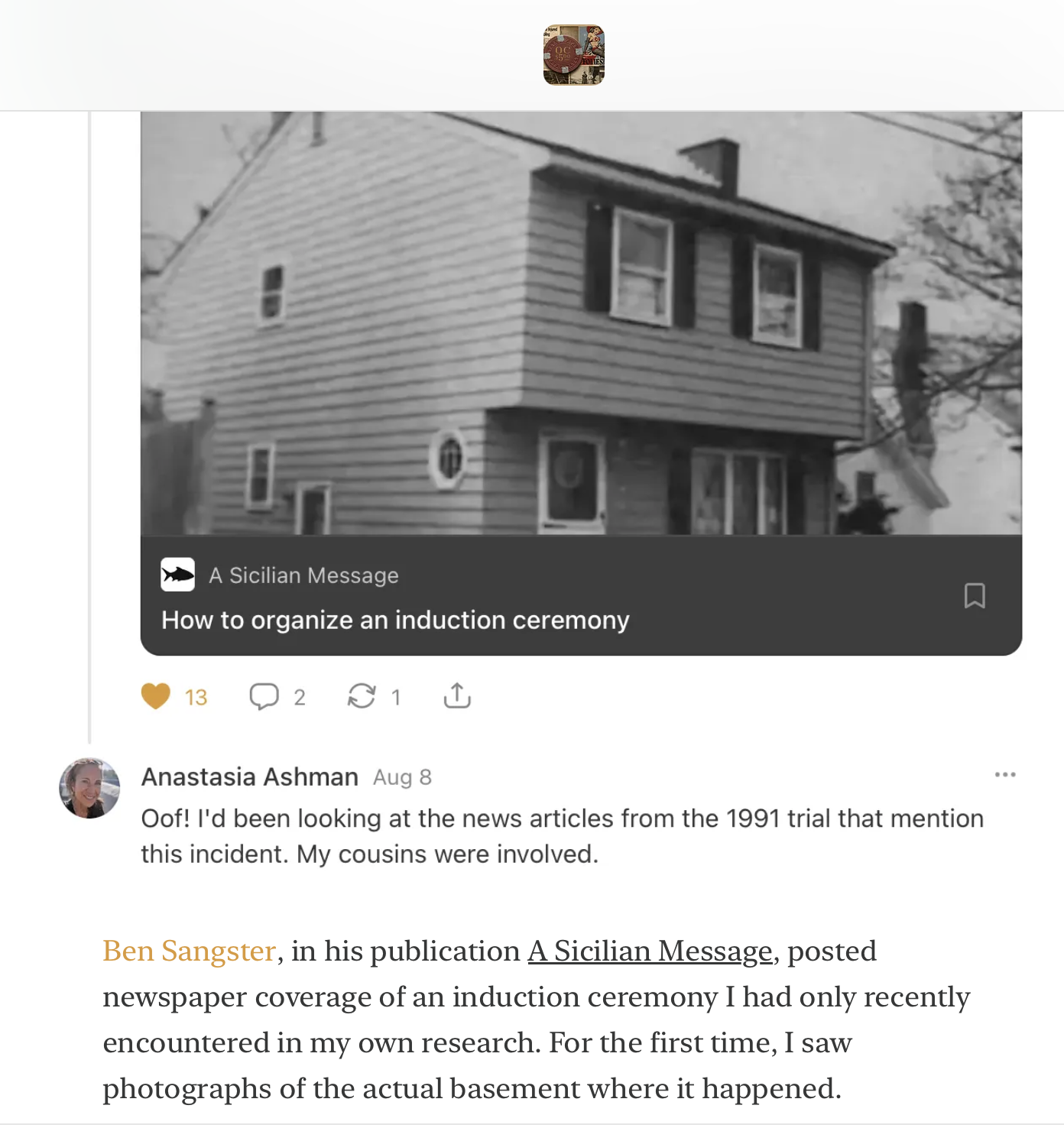
Oof! … My cousins were involved
Then somebody posted photographs of the home where a Mafia induction ceremony had been recorded by the FBI.
I knew the ceremony already.
My cousins entered the record around it.
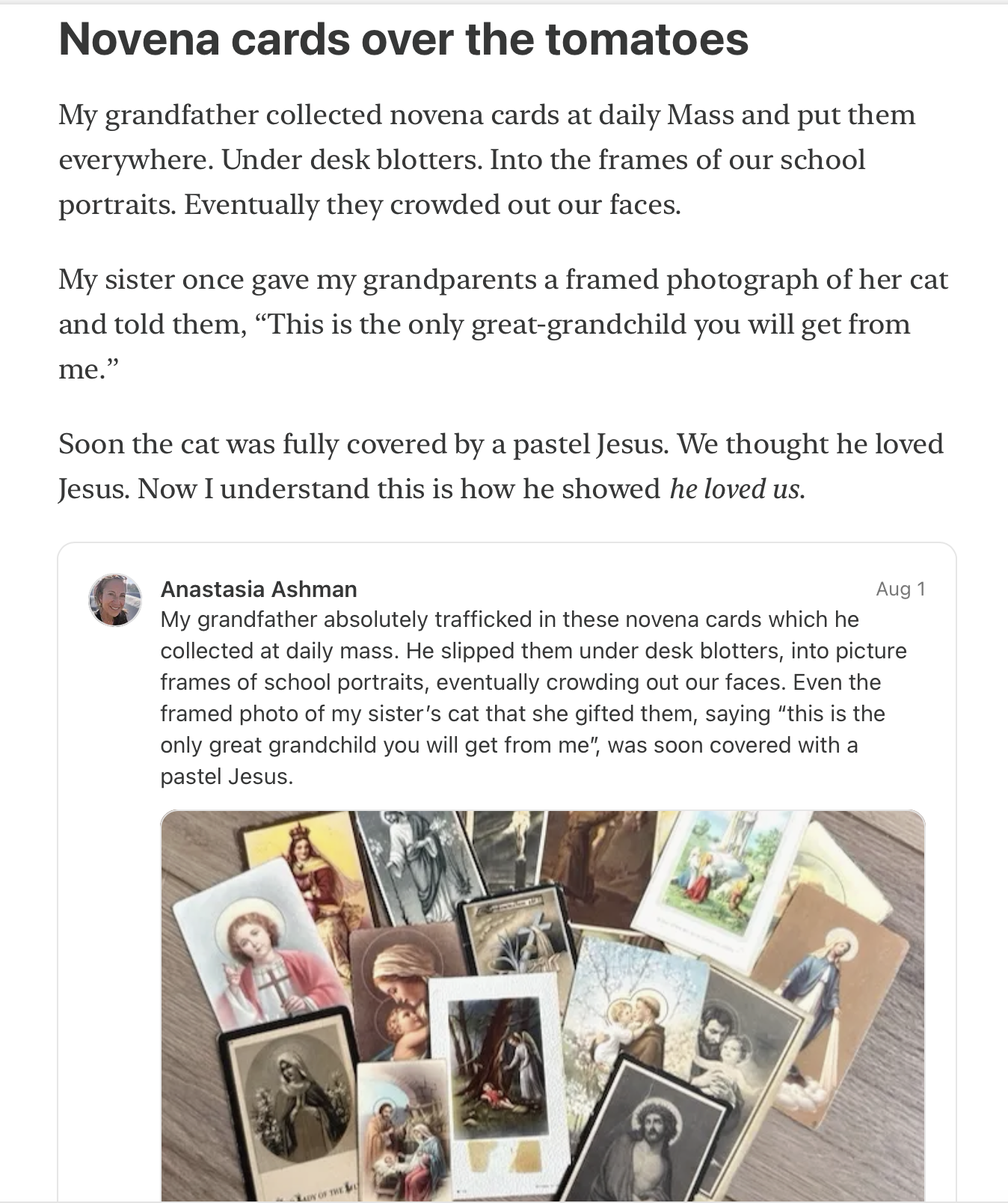
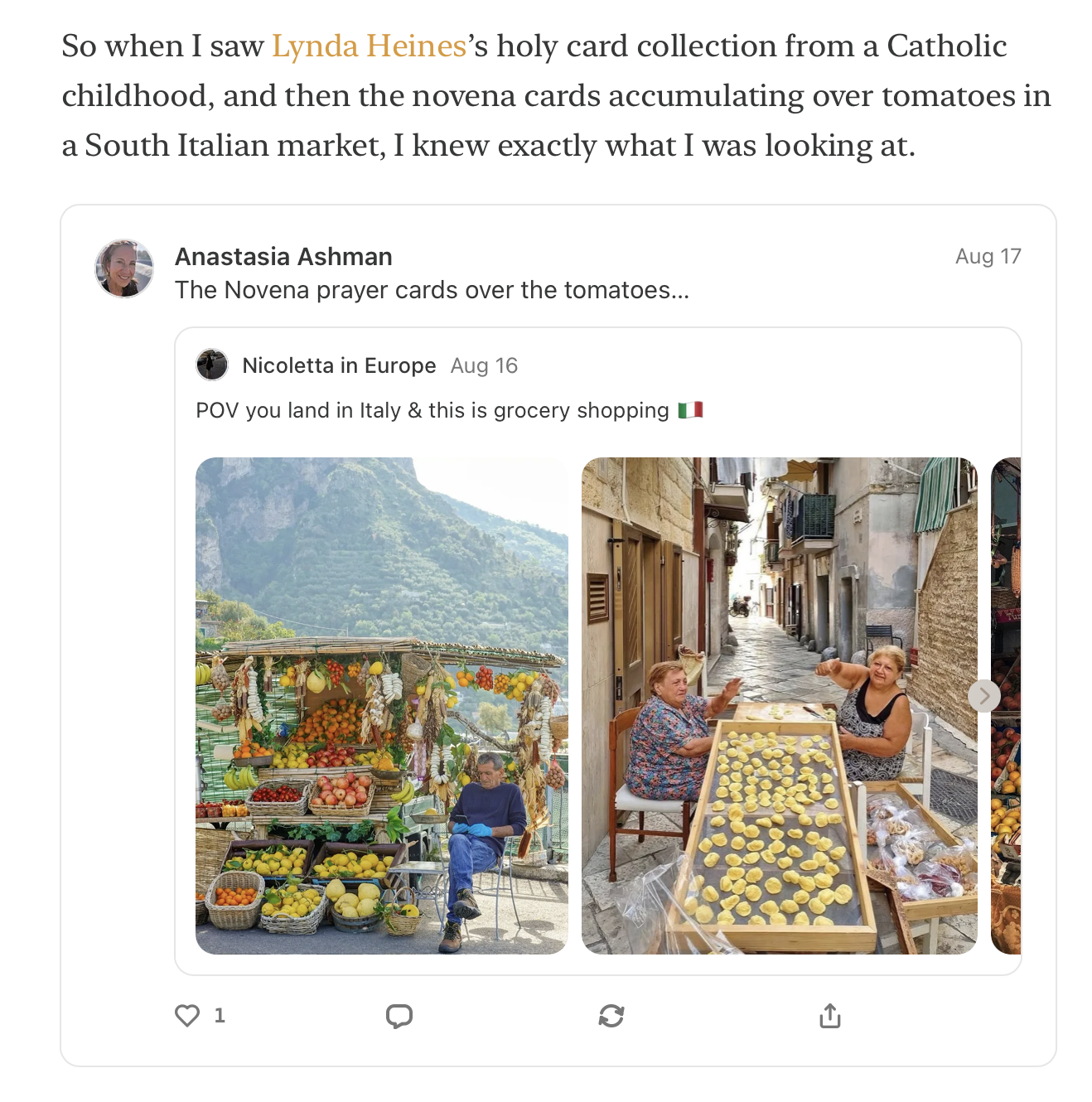
Novena cards over the tomatoes
My grandfather collected novena cards at daily Mass and put them everywhere. Under desk blotters. Into the frames of our school portraits. Eventually they crowded out our faces.
My sister once gave my grandparents a framed photograph of her cat and told them, “This is the only great-grandchild you will get from me.”
Soon the cat was fully covered by a pastel Jesus. We thought he loved Jesus. Now I understand this is how he showed he loved us.
My grandfather absolutely trafficked in these novena cards which he collected at daily mass. He slipped them under desk blotters, into picture frames of school portraits, eventually crowding out our faces. Even the framed photo of my sister’s cat that she gifted them, saying “this is the only great grandchild you will get from me”, was soon covered with a pastel Jesus. - me
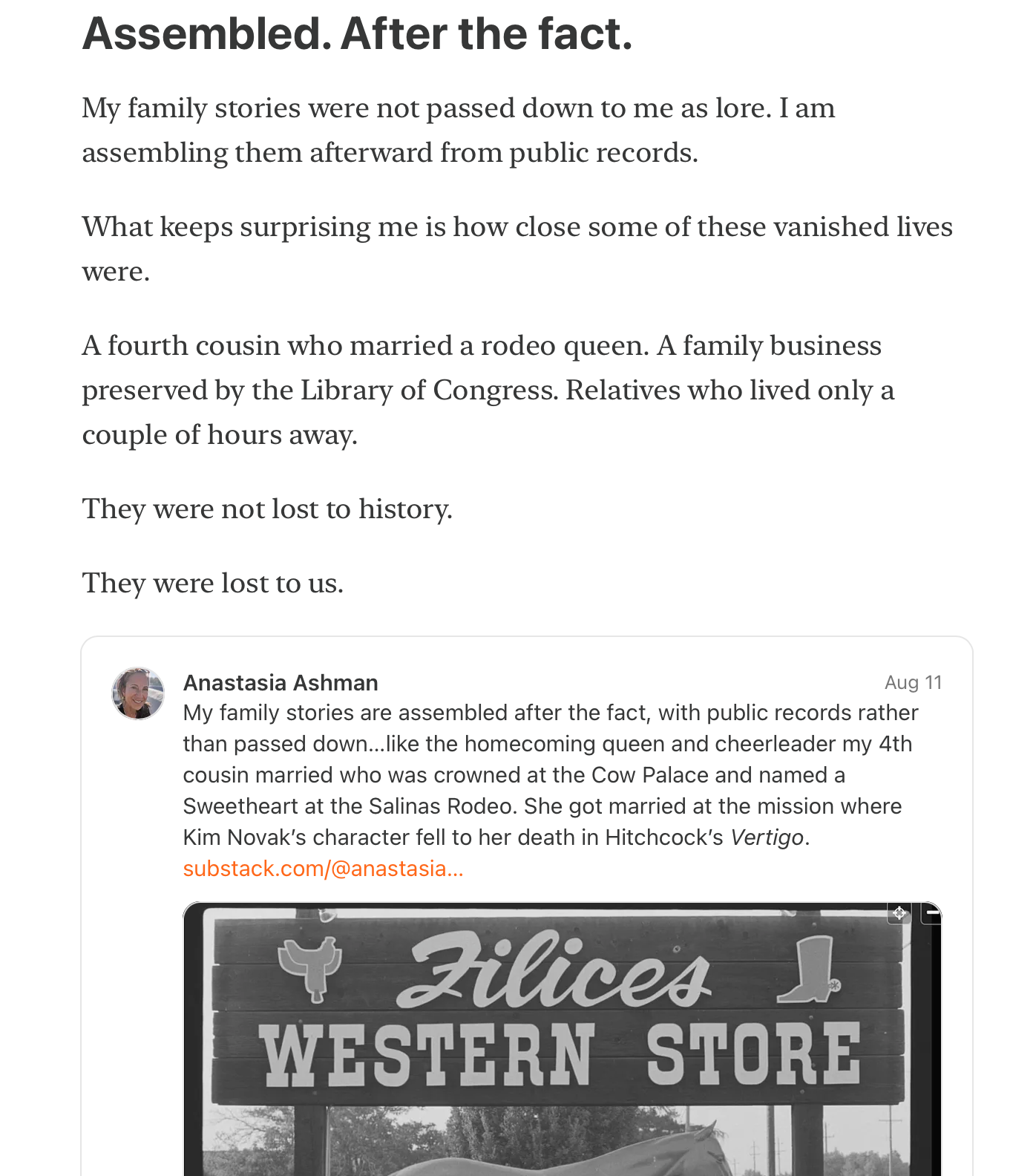
Assembled. After the fact.
My family stories were not passed down to me as lore. I am assembling them afterward from public records.
What keeps surprising me is how close some of these vanished lives were.
A fourth cousin who married a rodeo queen. A family business preserved by the Library of Congress. Relatives who lived only a couple of hours away.
They were not lost to history.
They were lost to us.
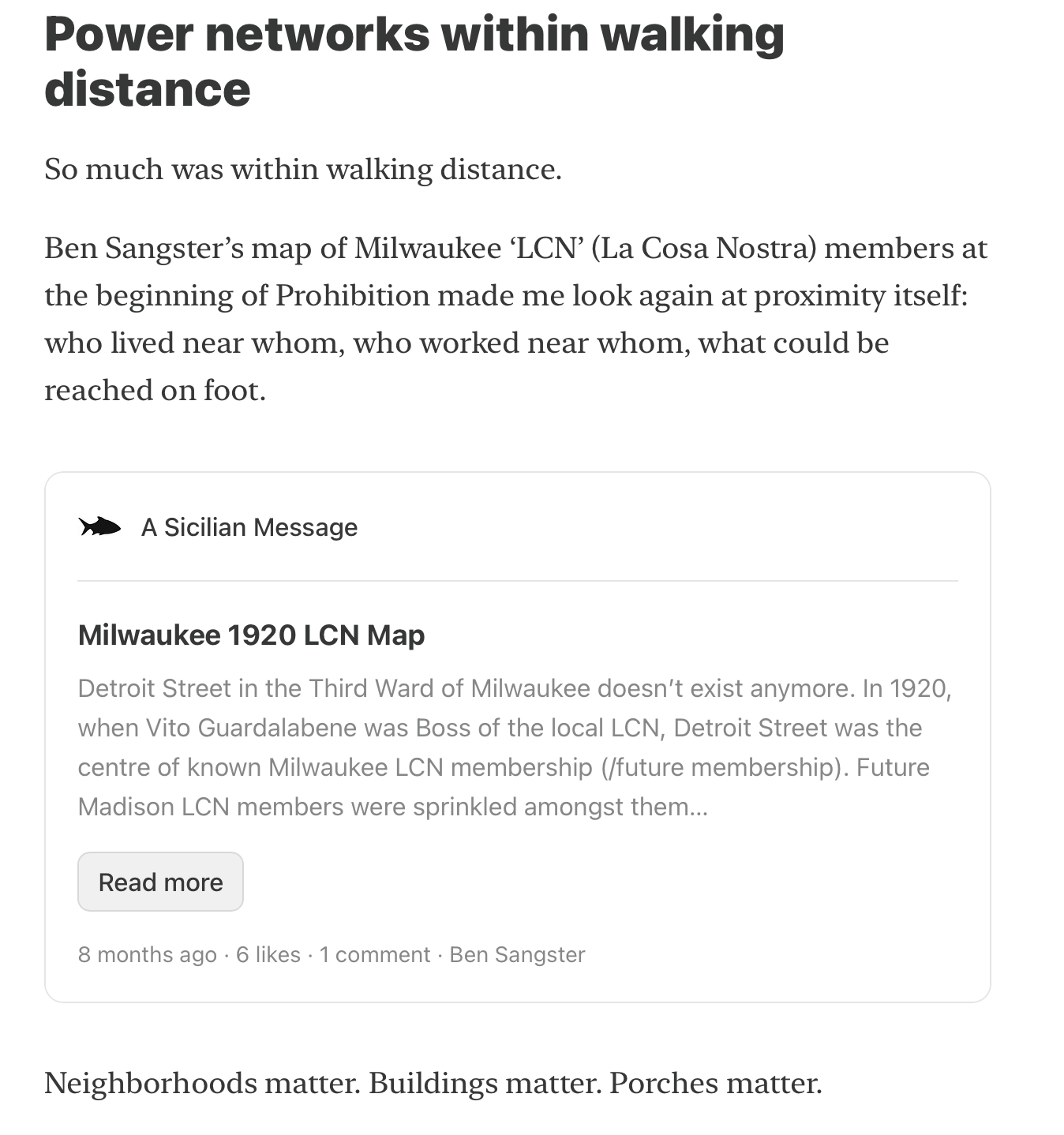
Power networks within walking distance
So much was within walking distance.
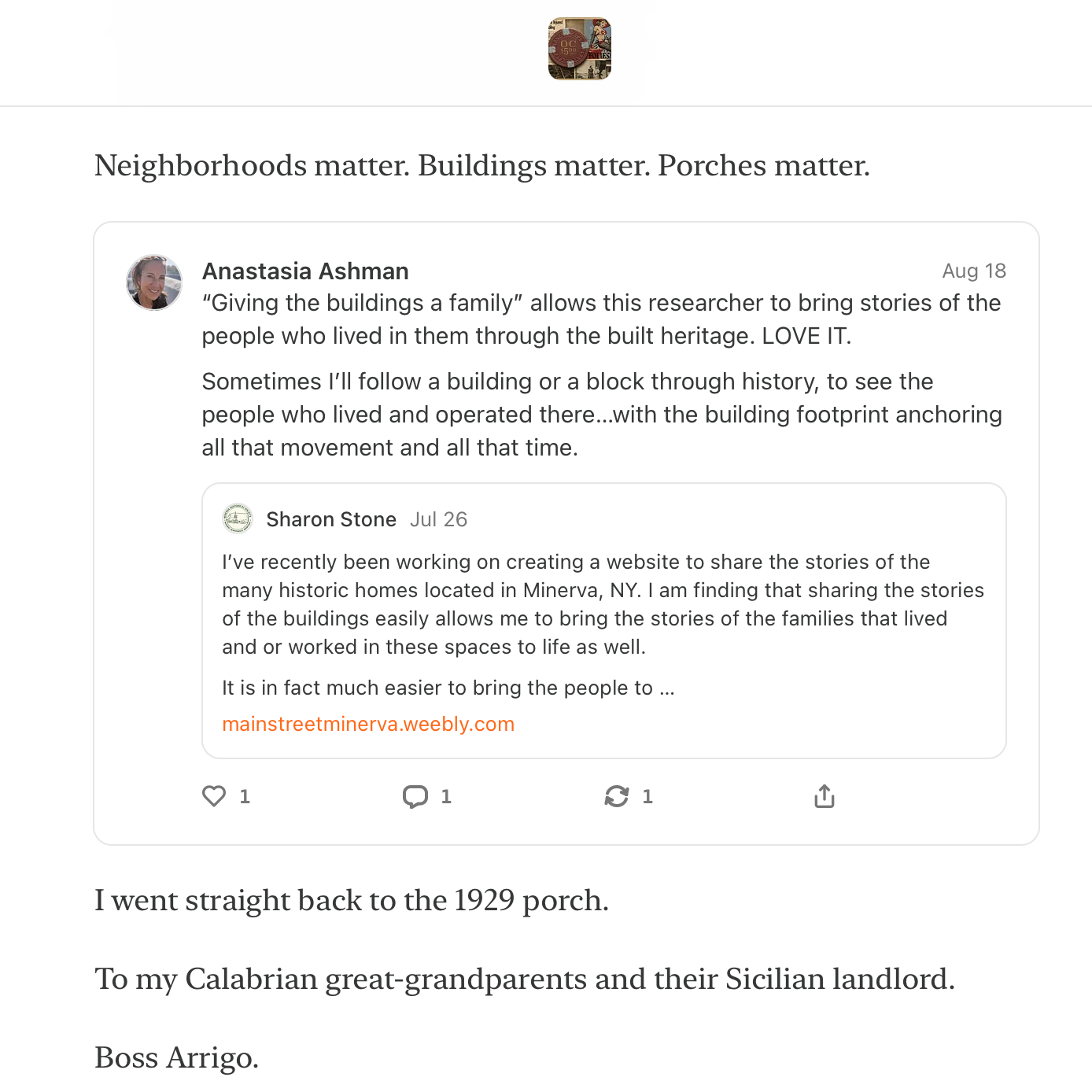
Ben Sangster’s map of Milwaukee LCN members at the beginning of Prohibition made me look again at proximity itself: who lived near whom, who worked near whom, what could be reached on foot.
Neighborhoods matter. Buildings matter. Porches matter.
I went straight back to the 1929 porch.
To my Calabrian great-grandparents and their Sicilian landlord.
Boss Arrigo.
Did I get the answers I was looking for, someone asked me.