308 Nightclubs for 14,000 People
I knew nothing about Calumet City until my family story led me to nearby Chicago Heights.
Calumet City sits right on the Illinois-Indiana state line, in the middle of a region I had mostly understood through industry: steel mills, factories, rail lines, refineries, workers moving back and forth across municipal boundaries that meant less economically than they did on a map.
Then I found a January 1941 spread in Life about Calumet City nightlife.
Population: 14,000.
Bars and taverns: 308.
That works out to almost one drinking establishment for every forty-five residents.
I grew up in a university town with more coffee shops than bars, so perhaps my scale is distorted. But 308 still seemed like a lot.
Way too many for the local population alone.
Which made me stop looking at the clubs themselves and ask a different question.
Who was keeping them in business?
The answer started to come into focus when I looked at what surrounded Calumet City and Chicago Heights.
Steel mills. Factories. Rail yards. Industrial plants. Thousands of men working shifts that started and ended at all hours.
This was not a nine-to-five landscape.
A worker finishing late at night did not necessarily want to go home to bed. Someone getting off before dawn did not need entertainment to wait until evening.
And apparently it didn’t.
One of the musicians working the Calumet City circuit was Sun Ra.
I once got to see him at the Village Vanguard in New York. Sun Ra!
Years later, he remembered playing the Calumet City clubs from evening until nearly dawn. The schedule sounds punishing from the musician’s side. The shows were staggered, so when one club paused for an intermission, a performer could move to another and play there.
The entertainment kept circulating.
One room slowed down. Another picked up.
The night did not end just because one set did.
That detail made the whole place look different to me.
On one stretch of State Street, twenty-six taverns and nightclubs occupied just two blocks.
Some stayed open for most of the day and night.
Many employed B-girls whose job included getting male customers to buy more drinks.
That is the kind of detail that makes the economics visible.
A customer was not simply buying liquor.
He was buying time.
Liquor. Music. Gambling. Food. Cigarettes. Women. Company. Spectacle.
I had been encountering all of these things separately in the records.
A tavern here.
A nightclub there.
A gambling room.
A jukebox.
A restaurant.
A hotel.
A floor show.
Taken one at a time, they looked like nightlife.
Taken together, they began to look like an economy.
And not just any economy.
An entertainment economy built right next to the industrial one.
The factories and mills produced wages. They also produced exhaustion, odd hours, transient populations, single men, married men away from home, salesmen, drivers, travelers and workers whose lives were organized around shifts instead of evenings.
The clubs were positioned to absorb some of that money.
Not necessarily in one dramatic night.
A drink here. A meal there. A few songs. A bet. Cigarettes. Another drink. Another room.
The point is not that every steelworker spent his paycheck on State Street.
I cannot know that, and I do not want to invent him.
The point is that an entertainment district this dense had to be feeding on something larger than Calumet City itself.
The industrial belt supplied the customers.
And geography mattered.
If you worked in Chicago Heights or somewhere nearby, you did not have to drive thirty miles into Chicago to find a night out.
Nightlife came to you.
That may be the part I had been missing.
I had been looking at the men who ran things.
The owners. The operators. The gamblers. The people moving liquor, money, machines and influence.
But none of that explains itself.
Supply requires demand.
And around Chicago Heights and Calumet City, industry seems to have created both the money and the schedule for an after-dark economy to thrive.
My 5th Great-Uncle Died In The Duke’s Licorice Factory
A death record from Calabria connects my relative, a duke, and a black candy that somehow made it to the Smithsonian…
Nobody in my family ever told me a story about Francesco. I had heard the name Salerno from my grandfather. They were legendary, those Salernos. What did he tell me? I cannot recall a thing.
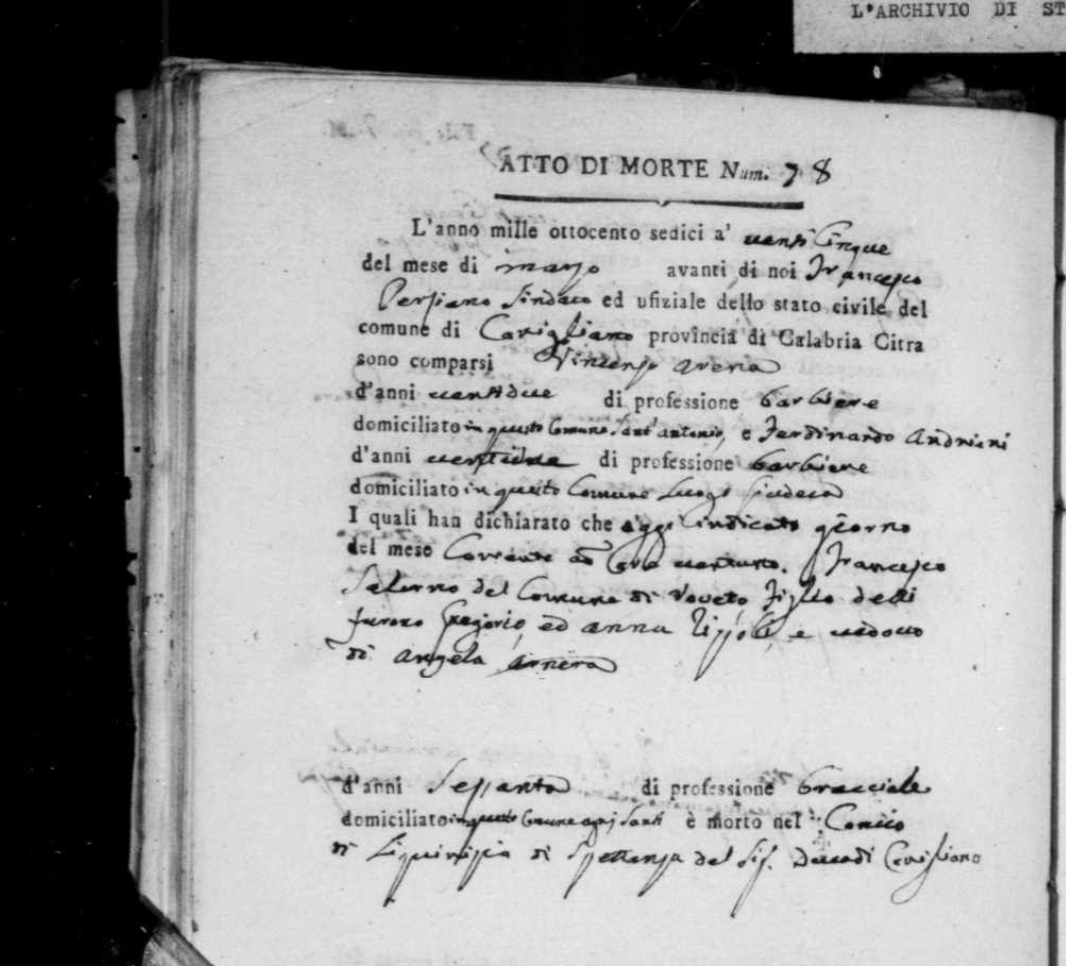
Francesco Salerno’s death record in the National Archives of Cosenza
But I know where Francesco died.
He spent his last day in a licorice workshop belonging to the Duke of Corigliano.
On January 5, 1817, Francesco was sixty years old and working as a laborer when he died in the concio della liquirizia, the Duke’s licorice-processing workshop in Calabria.
Naturally, I stopped researching Francesco and started researching licorice.
My sisters and I were licorice fiends so I’m not a newcomer to licorice. No one ever connected our fixation on this candy to a family story. The duke was news.
It turns out this was not some eccentric duke making candy in his kitchen. A century earlier, the Duke of Corigliano had established one of Calabria’s earliest conci, helping turn the wild licorice root there into a regional industry.
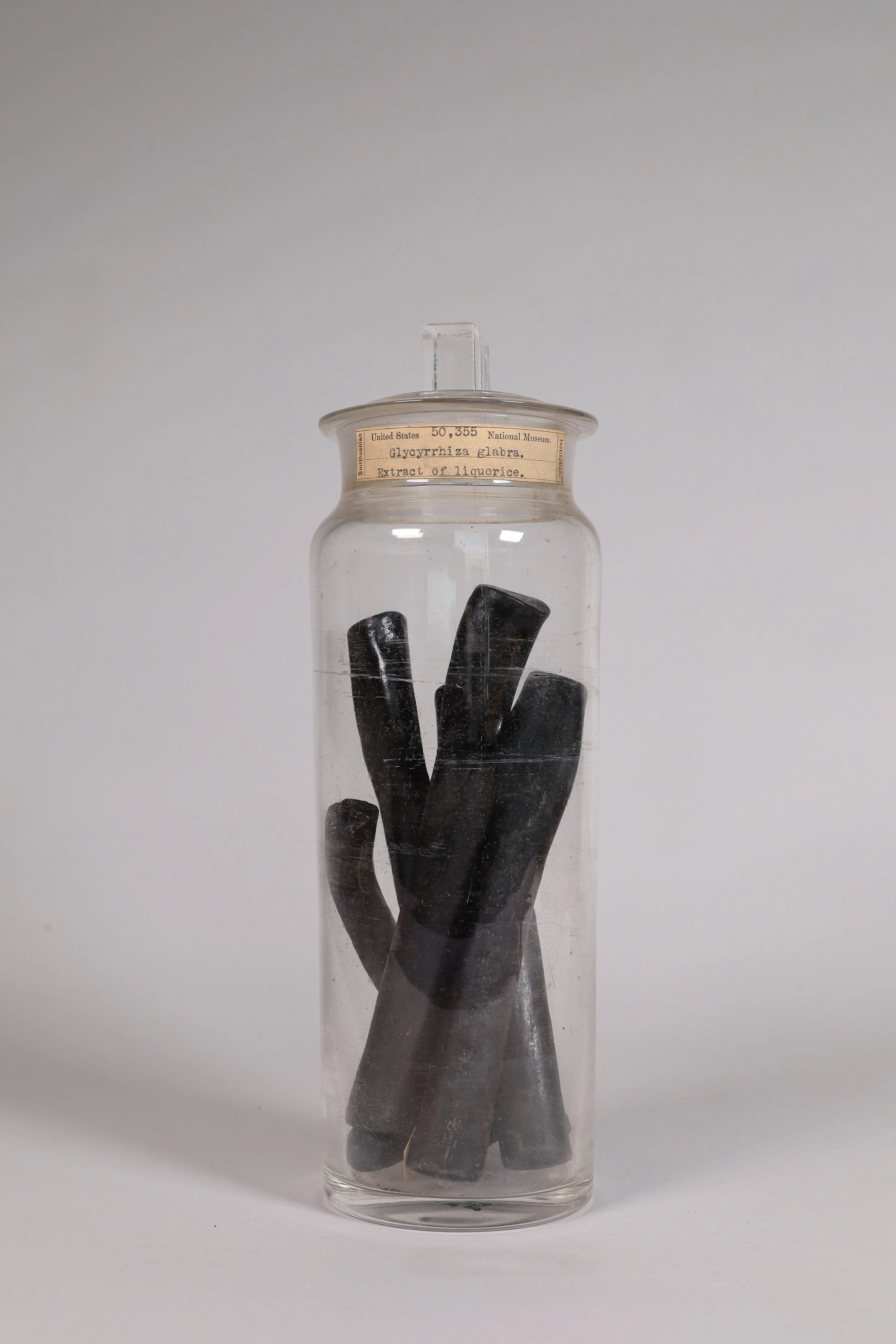
Duca di Corigliano Licorice Sticks, at the National Museum of American History, Smithsonian Institution. These date to about 1885, nearly seventy years after Francesco died in the Duke of Corigliano’s licorice workshop.