The Awning Steals My Attention
A family album may tell you who somebody wanted remembered. The background can tell you where they actually were.
The photograph was supposed to be about three girls.
My mother, at five years old, stands in the middle, flanked by two of her young aunts only a few years older than she was. It’s Little Italy, Chicago, about 1940. They are dressed for school, or whatever girls dressed for, facing the camera and squinting into the light.
For a long time, I saw three little girls. Then the background began to matter more.
Behind the girls were parked cars, a hydrant, houses, storefronts and a striped awning across the street. None of it had been included deliberately. It was simply what happened to be there when someone raised the camera.
I enlarged the photograph.
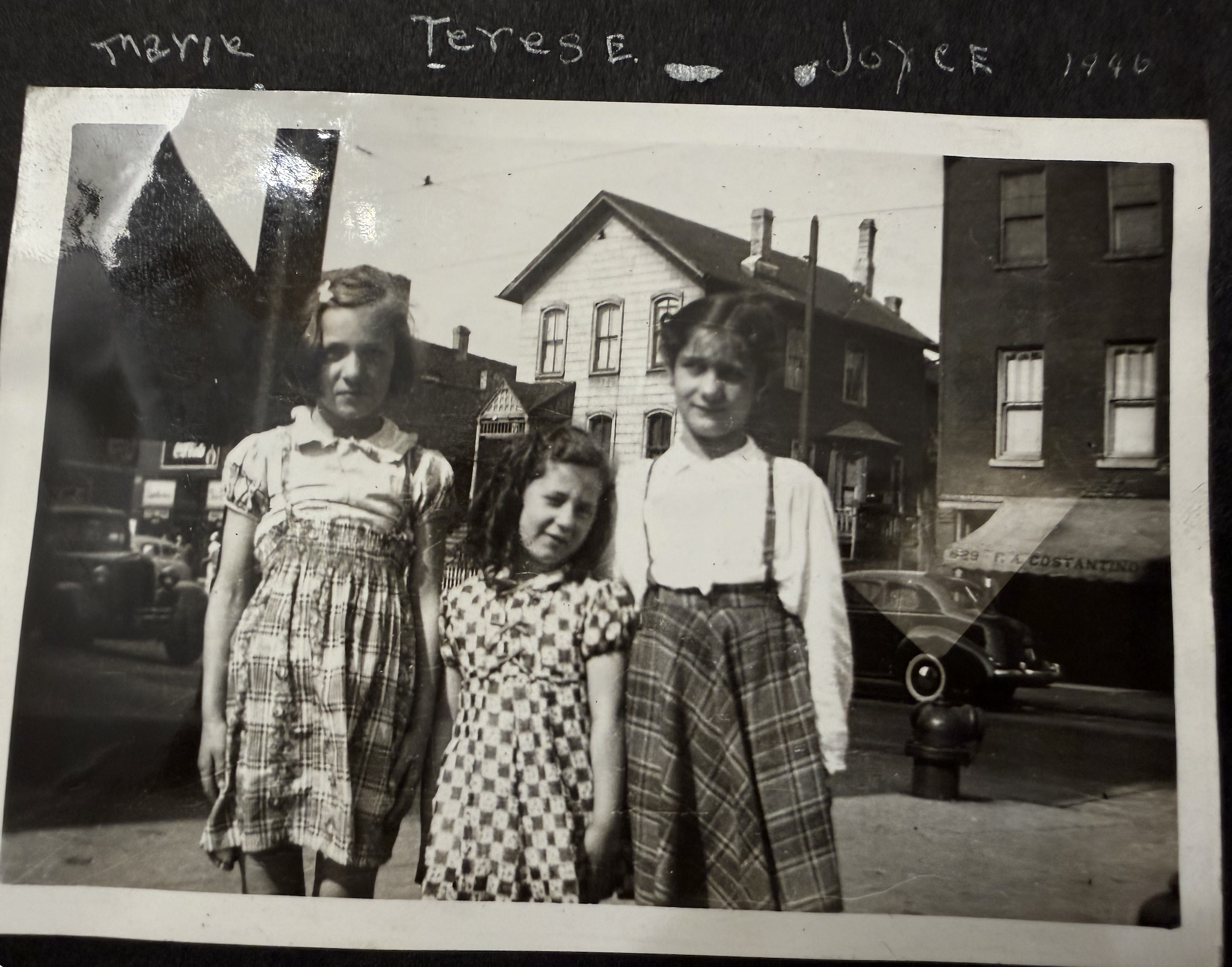
From my grandmother’s album, © 2026 Anastasia Ashman.
On the awning I could make out a number:
629
Then a name:
F. A. Costantino?
It was the number that stopped me.
A census record had recently placed for me that my grandmother lived at 628 South Racine Street on Chicago’s Near West Side.
The storefront in the photograph was 629.
The camera had been pointed almost directly across the street from the homestead.
Suddenly this was no longer just a family photograph taken somewhere in the old Italian neighborhood. It had coordinates.
The background became the evidence
No one taking that picture in 1940 cared whether the address across the street was legible.
They wanted the children.
Yet decades later, the incidental details became more useful to me.
The awning fixed the location. The census supplied the opposite address. Together they put my mother on a particular piece of sidewalk.
Once I knew where she was standing, I went looking for the block.
It no longer exists.
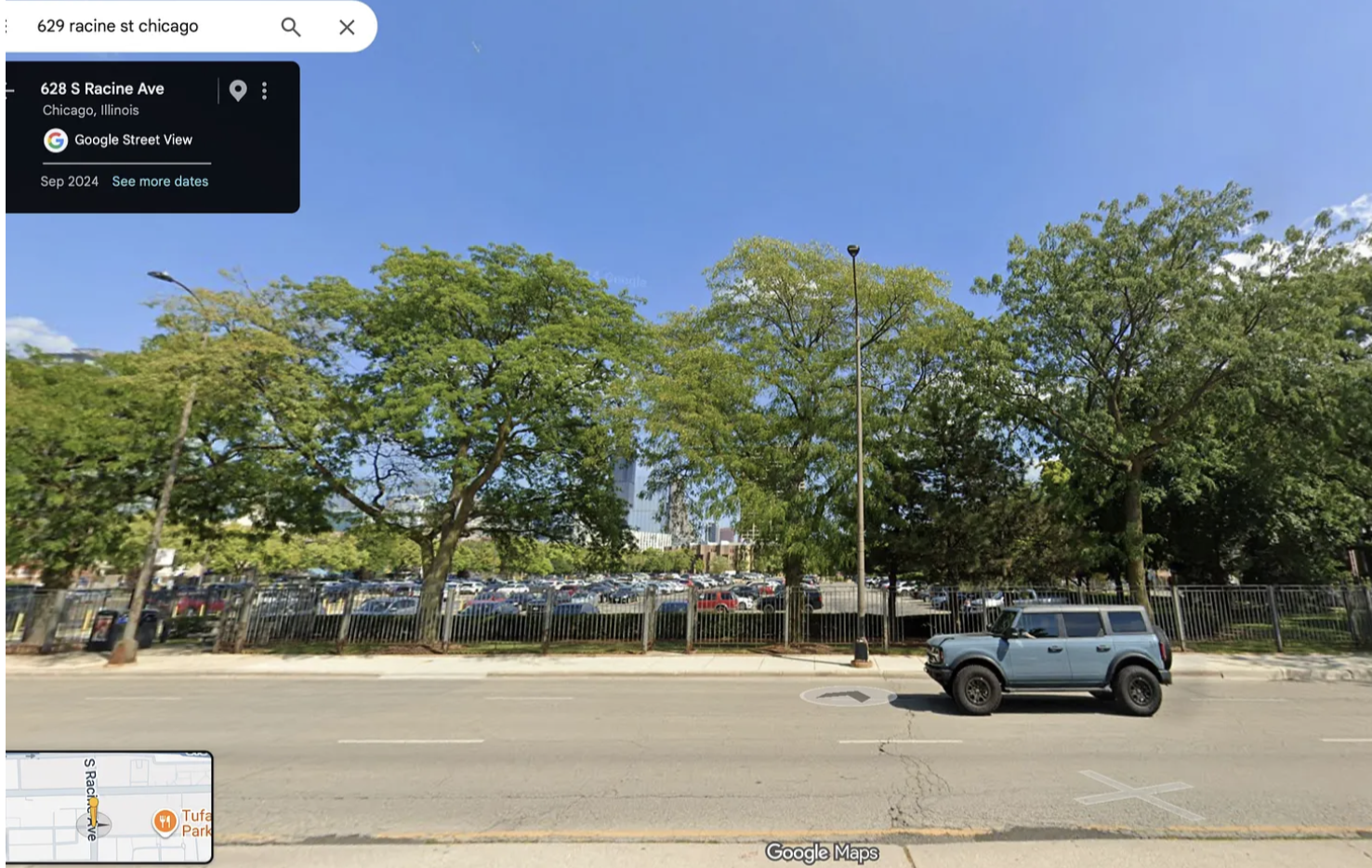
This is where 629 Racine Street was in 1940. It’s now a parking lot for the University of Illinois. Via Google Maps.
The site of 629 South Racine is now part of a radically altered landscape. The building is gone. So are the neighboring structures visible behind the girls.
Much of Chicago’s Near West Side was demolished and remade during the urban-renewal era, including the construction of the University of Illinois Chicago’s Circle Campus. The displacement of residents and destruction of the surrounding neighborhood are well documented by UIC’s Near West Side Renewal Project.
I had known that history in general terms.
That is different from discovering that one of the vanished sidewalks was my mother’s.
Family albums record more than families
Since making this discovery, I have started inspecting old photographs differently.
I still look at the people. But I also look around them.
Street numbers.
Store signs.
License plates.
Porches.
Window lettering.
Cars.
The edge of another building.
Anything that might have seemed too ordinary to identify at the time.
Family photographs are full of this accidental information. They preserve a version of the built world precisely because nobody thought the built world was the subject.
Another photograph in my archive helped start the entire Family of Mine project. My grandmother had written beneath it:
I came to concentrate on the mysterious “Boss Arrigo.”
But that photograph was doing something else at the same time. It recorded a Chicago building where family life and commerce occupied the same address, with apartments above and businesses below.
The caption pointed me toward a man.
The image preserved an environment.
That distinction now seems important.
A family album may tell you who somebody wanted remembered. The background can tell you where they actually were.
And sometimes the city removes the second thing before anyone realizes it mattered.
The buildings disappeared from Racine Street.
The photograph did not.