They Put the Police Chief in a Cell
In January 1929, a sweeping raid on Chicago Heights began not with a still or gambling room, but at the police station. Outside authorities demanded the keys, locked up the police chief when he objected, and took control before moving through the city. Following my family’s businesses block by block, I found myself mapping something else too: local power.
Chicago Heights, Illinois, 1929. A federal raid began with the local police.
A Town I'm Reconstructing
There's a railroad running north to south through Chicago Heights, Illinois, about thirty miles south of Chicago.
I've been building a map of the town from the records connected to my family. Groceries, butcher shops, restaurants, filling stations, hotels, saloons and clubs. The businesses were often connected through people as well as commerce.
Some addresses appear again and again, in different decades and different documents. Put them on a map and you can see how much activity was concentrated within walking distance.
Much of that Chicago Heights is gone.
But the police station is still in the same location, near the railroad tracks.
I hadn't paid much attention to it until I came across a newspaper report from January 1929.
The Police Station Was the First Target
On January 7, 1929, the Capital Journal in Salem, Oregon, reported a major raid on Chicago Heights.
The operation involved 100 federal agents and twelve squads of Chicago police. They had assembled at dawn on Chicago's South Side, carrying warrants prepared after months of investigation.
Their targets included illegal liquor operations and gambling establishments.
The officers didn't begin by searching the saloons, warehouses or other businesses.
They went directly to the local police station.
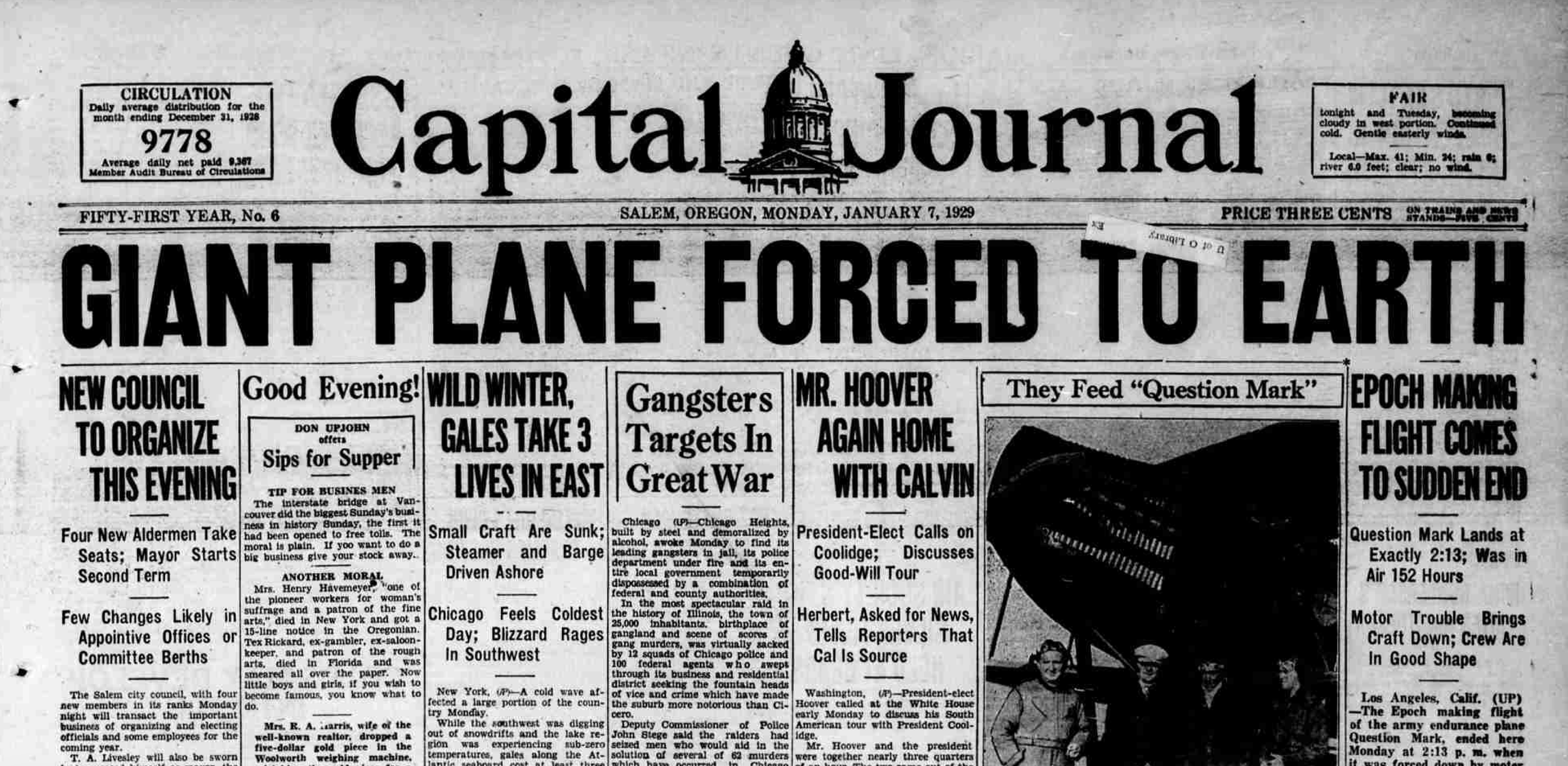
“Gangsters Targets in Great War.” The Capital Journal, Salem, Oregon, January 7, 1929, p. 1. Historic Oregon Newspapers, University of Oregon Libraries.
Chicago Deputy Police Commissioner John Stege demanded the keys to City Hall and the jail.
The Chicago Heights police chief objected.
He and his desk sergeant were put in a cell.
Other Chicago Heights officers were detained as they arrived at the station or returned from their beats.
With the local police temporarily in custody, the outside officers conducted searches across the city. The newspaper reported twenty homes forcibly entered and the seizure of weapons and ammunition.
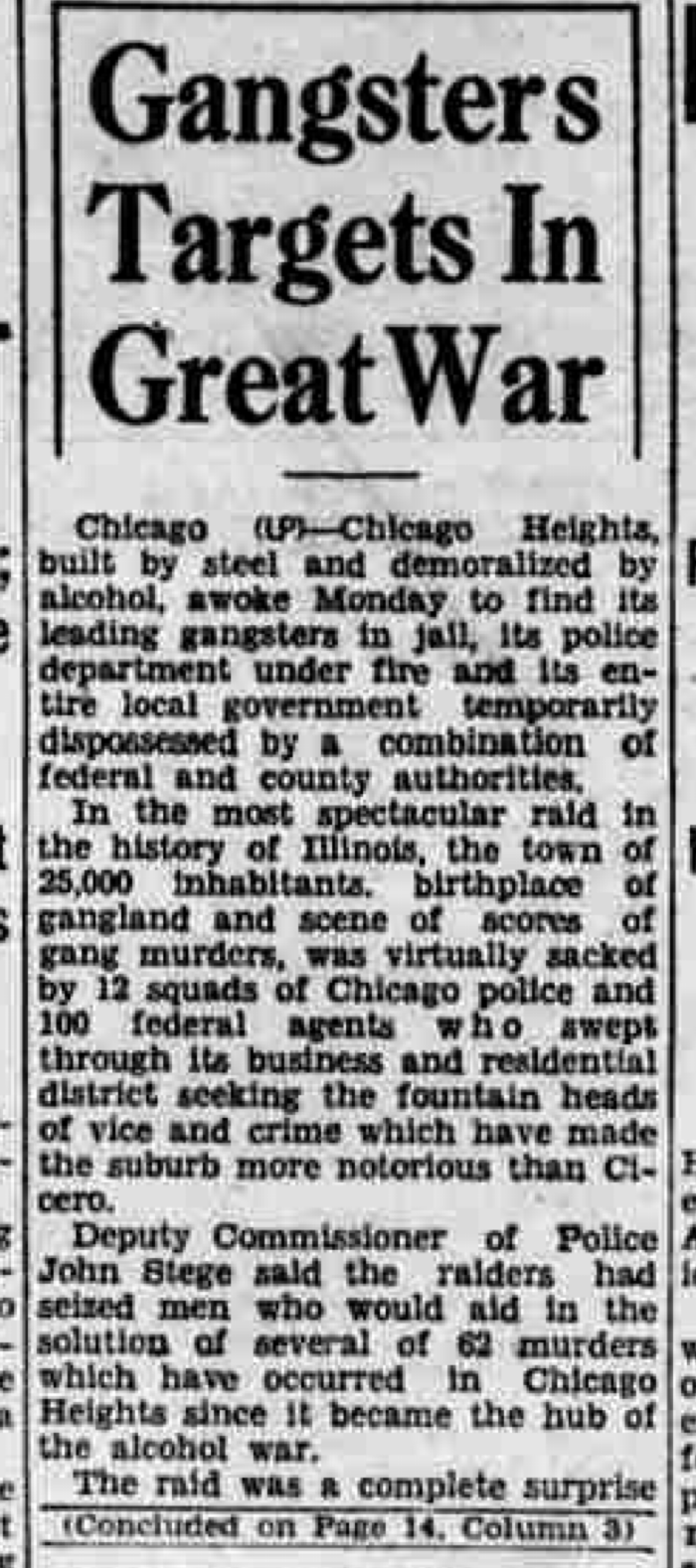
“Gangsters Targets in Great War.” The Capital Journal, Salem, Oregon, January 7, 1929, p. 1. Historic Oregon Newspapers, University of Oregon Libraries.
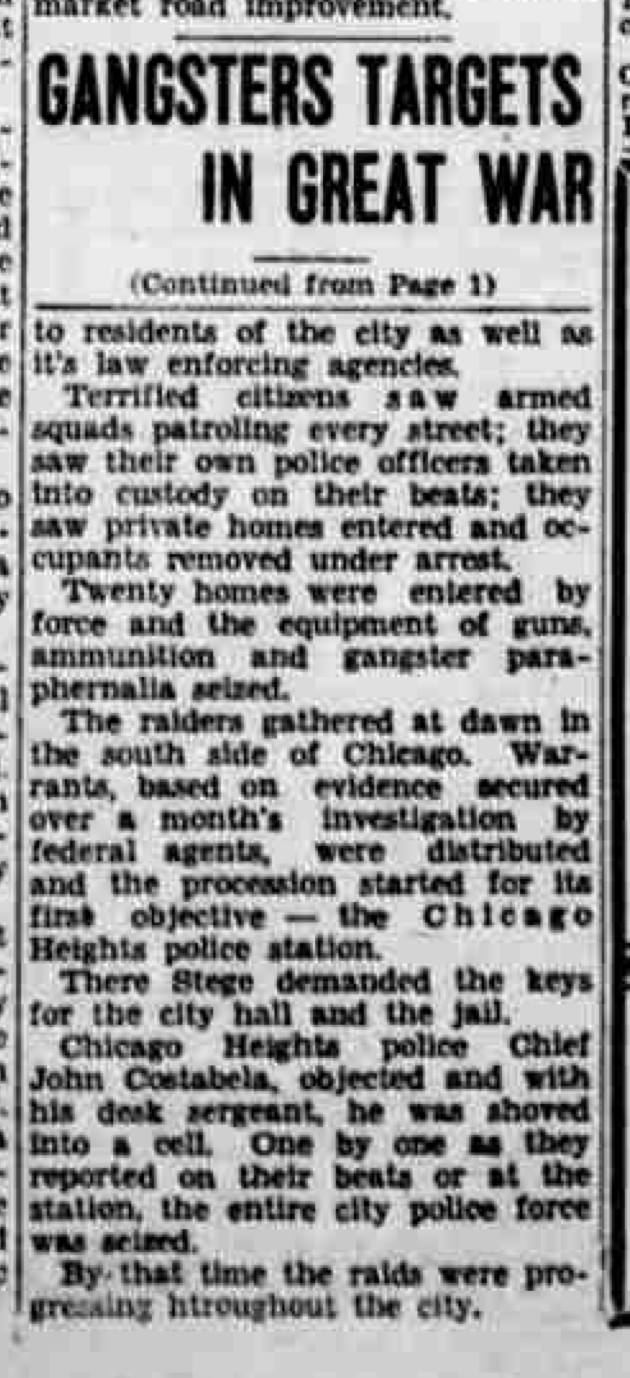
The raiders' arrival at the Chicago Heights police station, the demand for the keys, and the detention of local officers. The Capital Journal, January 7, 1929, p. 14. Historic Oregon Newspapers, University of Oregon Libraries.
Who Was Policing Chicago Heights?
What interests me is the order of operations.
The federal authorities had spent months investigating illegal activity in Chicago Heights. When they were ready to act, one of their first concerns was the local police department.
The newspaper doesn't establish what the Chicago Heights officers knew, why the raiders detained them, or what happened to them afterward.
Those are separate questions.
But the raid makes something visible that is harder to find in ordinary business records: a conflict between the authorities responsible for enforcing the law in the same territory.
That's especially interesting to me because my research has moved well beyond identifying individual relatives. I'm reconstructing the economic and social world in which they lived, including the businesses, relationships and arrangements that made that world function.
The municipal government was part of it.
Police departments, local officials and city institutions exercised authority over the same streets where those businesses operated.
On that January morning, outside officers arrived and took control of the local police station before proceeding with their searches.
The report doesn't name any of my relatives. Nor does it explain the relationship between Chicago Heights government and the commercial world I'm tracing.
But it gives me another set of questions to bring to the records.
I can locate businesses on a map. I can follow proprietors, employees and customers from one address to another.
Now I want to know who held power over those streets, how that power was exercised, and whose interests it served.
My Grandfather Wore A Diamond Horseshoe Pin
For years, this was a photograph of my grandfather as a young man among others in my grandmother’s albums.
Studio portrait. Newsboy cap. Dark overcoat. Striped tie. Seventeen? Eighteen? He looks serious, but not solemn. Carefully dressed in street garb without looking formal.
If I dated this right, he had left school and was working as a grocery store clerk.
Then I enlarged the photograph on my phone.
Fastened to his luscious striped silk tie was a tiny sparkly horseshoe.
I had never noticed it.
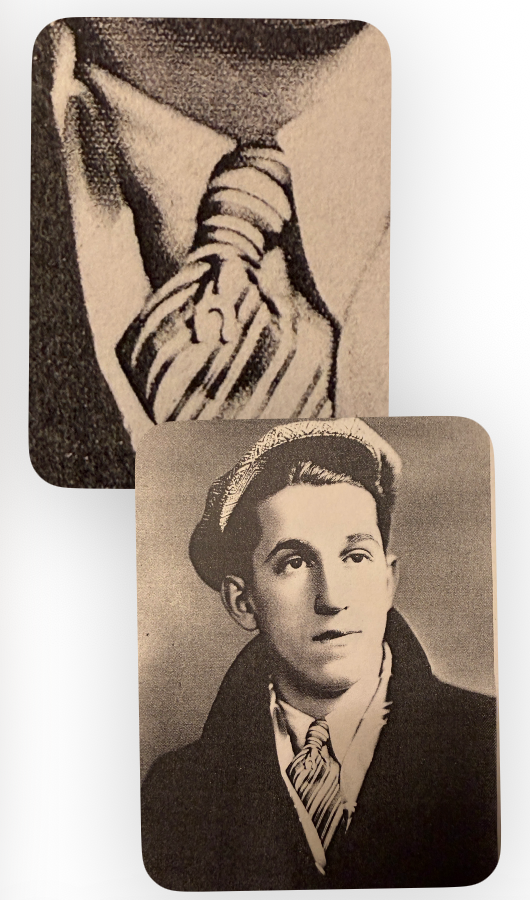
My grandfather around 1930, when he was a young grocery clerk in Chicago. © 2026 Anastasia Ashman
It appears to be silver or platinum and set with small clear stones. Rhinestones, perhaps. I hope. Diamonds, perhaps. The photograph cannot tell me.
It is not subtle.
Once I saw it, the portrait changed.
The coat and cap belong to an ordinary young working man. The pin introduces something else. A little flash. A little luck. A little display.
And, apparently, another horse.
And piece of jewelry doesn’t prove anything.
But this has become a recurring finding in my family photographs. Evidence of something I can’t explain.
A pinkie ring appears in more than one photograph.
Men turn up in good suits.
There are tenements in the background sometimes, yes, but also cars positioned just inside the picture.
There are formal portraits, jewelry, carefully chosen clothes, the small signals people use when they want to present themselves as having arrived, or at least as being on their way.
The written records are much less expressive.
A census might say clerk.
My family did not leave behind explanations saying, Here is how we got from there to here. No running account of the economic changes that carried one generation from immigrant neighborhoods and modest occupations toward property, cars, better clothes and, eventually, descendants growing up thousands of miles away in California.
What survived instead were the surfaces. Photographs. Clothes. Houses. Cars. Jewelry.
A horseshoe can mean luck.
Gambling. Horses.
It can mean nothing: I liked this pin.
I don’t know what it meant to my grandfather.
But I know he chose to wear it for the photograph.
And I know I did not see it until I began looking at these pictures differently.
The archive had not hidden the pin from me.
It had been sitting in plain sight.
I just had not yet learned to look for that unexplained something in the picture.